
How to memorize quickly: 5 techniques that really work
May 28, 2026
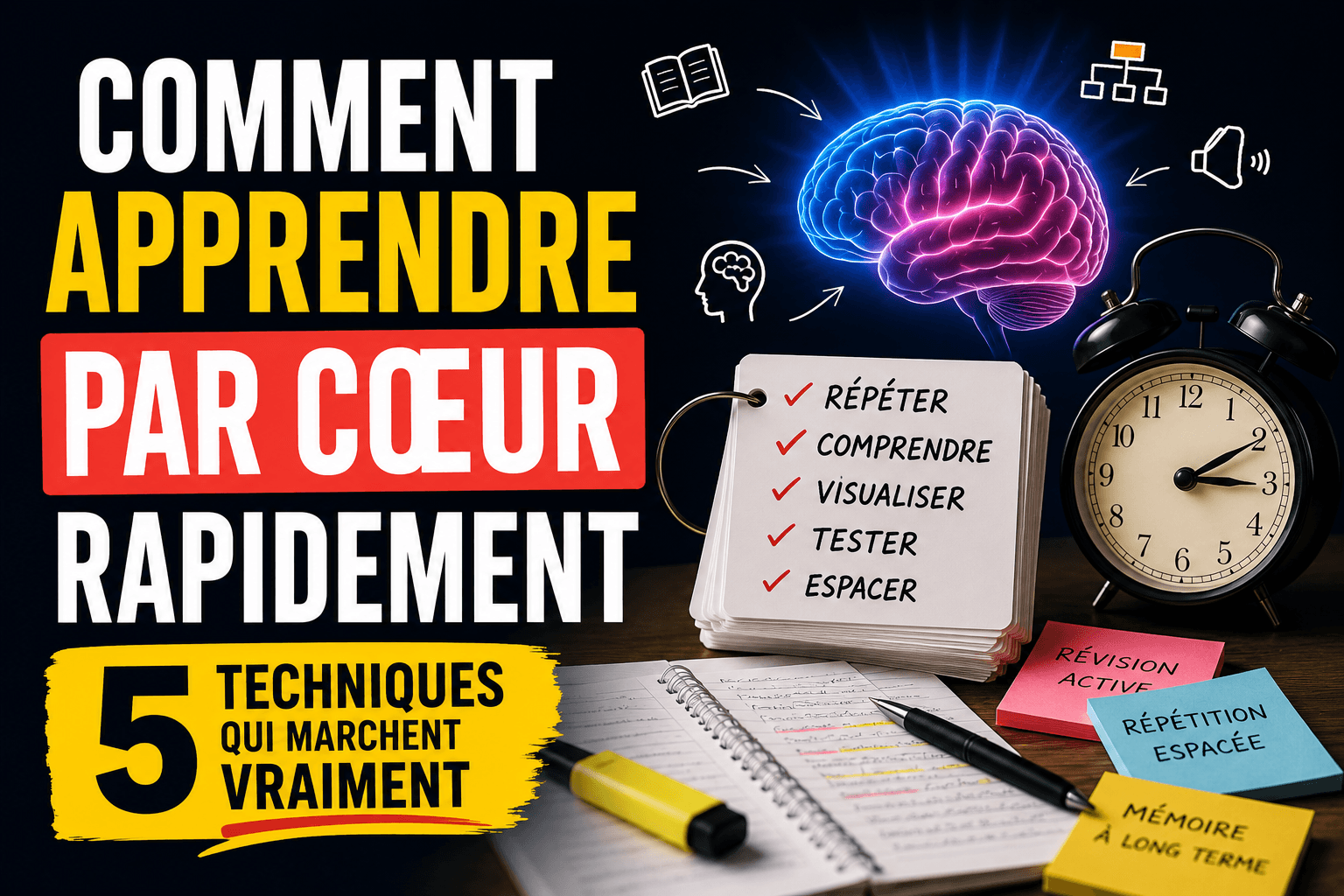
You have 12 pages to know by heart for tomorrow. You reread. You reread. You reread. You close the notebook, you know 20% of it.
The problem: you learned to memorize the way people did in 1995. But there are 5 techniques validated by cognitive science research that work 5 to 10 times better.
And the good news: it's easy and you can start tonight.
The myth: "I have a bad memory"
Nobody has a bad memory. You just have bad methods.
An average human brain can memorize tens of thousands of pieces of information. The problem is that we are taught in school to reread. And rereading is exactly what works the least.
If you change your method, you will be shocked at how much you can retain.
Technique 1: the blank sheet (active recall)
The most brutal, and the most effective.
How to do it
You read your lesson once
You close the notebook
You take a blank sheet of paper and write down everything you remember
You compare it with the lesson and identify what is missing
You test yourself again the next day
Why it works
Every time your brain retrieves information (instead of rereading it), it strengthens the memory trace. This is the "testing effect."
A study by Roediger and Karpicke (2006) showed that students who self-test retain information 50% better than those who reread.
When to use it
For conceptual courses, chapters in social sciences, history, philosophy. Anything that requires reproducing a structure of ideas.
Technique 2: flashcards with spaced repetition
How to do it
You turn each key concept into a flashcard (question on one side, answer on the other)
You test yourself: you see the question, you answer in your head, you check
The cards you miss come back quickly. The cards you master come back less often.
Why it works
You combine two ultra-powerful principles: active recall + spaced repetition. This is the method used by medicine, law, and language students all over the world.
When to use it
Vocabulary, formulas, dates, definitions, theorems. Anything that requires precise factual memory.
The big trap
Making flashcards takes hours. Modern solution: you let an AI generate the flashcards from your course. You save 2 hours per chapter.
Technique 3: the method of loci (mind palace)
How to do it
You choose a place you know by heart (your house, your route from school to home)
You mentally place each piece of info to memorize in a specific spot in this place
To recall it, you mentally "visit" the place
Why it works
The human brain is incredibly good at memorizing places (evolutionary heritage). By attaching abstract information to familiar places, you exploit this strength.
This is the method used by world memory champions to retain hundreds of numbers or playing cards.
When to use it
Ordered lists: steps of a process, chronological order, enumerations.
Example: to memorize the 7 stages of photosynthesis, you place each stage in a room of your house.
Technique 4: the Feynman technique (explain it simply)
How to do it
You take a concept
You explain it as if to a 12-year-old, in your own words
Every time you stumble, you go back to the lesson and re-understand
You redo the explanation, even simpler
Why it works
Rephrasing with your own vocabulary forces your brain to understand deeply. Not just recognize.
A Stanford study showed that students who explain what they are learning retain 90% of the content, compared to 10% for simple reading.
When to use it
Complex concepts in science, economics, philosophy. Anything you need to be able to explain in an oral exam.
Technique 5: mnemonics
How to do it
You turn hard-to-remember information into a sentence, an acronym, or a striking image.
Classic examples: - "FANBOYS" for coordinating conjunctions (for, and, nor, but, or, yet, so) - "ROYGBIV" for the colors of the rainbow (Red, Orange, Yellow, Green, Blue, Indigo, Violet) - "My Very Educated Mother Just Served Us Noodles" for the order of the planets (Mercury, Venus, Earth, Mars, Jupiter, Saturn, Uranus, Neptune)
Why it works
Your brain retains what is ridiculous, funny, or emotional better. Flat information is forgotten. Striking images stay.
When to use it
Short lists to learn by heart, formulas, important dates, language vocabulary.
The combined method to memorize a course in exactly 1 hour
For a 10-page chapter:
15 min — Comprehensive Reading: you read once, calmly
15 min — Feynman Technique: you write a simple explanation of the chapter in your own words
20 min — Flashcards: you test yourself on key concepts using flashcards
10 min — Blank Sheet: you close everything and write down what you remember
Total: 1h. And you actually retain it, unlike with 3h of rereading.
The ultimate mistake: not spacing out reviews
You can apply these 5 techniques to perfection, but if you do everything in one session and never go back to it, you will have forgotten everything in 1 week.
The rule: - Day 0: learn with one of the techniques above - Day 1: do a short session (10 min) - Day 3: 5-10 min - Day 7: 5 min - Day 14: 5 min
This is spaced repetition. Combined with any of the 5 techniques, you retain information long-term.
How Koro AI accelerates all of this
The problem with all these techniques: prep takes time.
Making flashcards manually = 2h. Sorting key concepts = 1h. Programming spaced repetition = headache.
Koro AI does all this in 30 seconds: - You upload your course - The AI generates study guides + flashcards + quizzes - Spaced repetition is managed automatically - You can chat with your course for the Feynman technique
You focus on what matters: testing yourself, retaining, reproducing.
Conclusion
To memorize quickly by heart = 5 techniques: blank sheet (active recall), flashcards (active recall + spaced repetition), mind palace, Feynman technique, mnemonics. Combined and spread out over time, they can make you memorize a chapter in exactly 1 hour. Rereading is dead. Testing is life.