
How artificial intelligence is changing the way medicine is learned
Oct 27, 2025
Introduction
You know it better than anyone: learning medicine is a marathon. Hundreds of pages of lectures, diagrams to understand, pathologies to memorize, exams to prepare... in short, a true intellectual Everest.
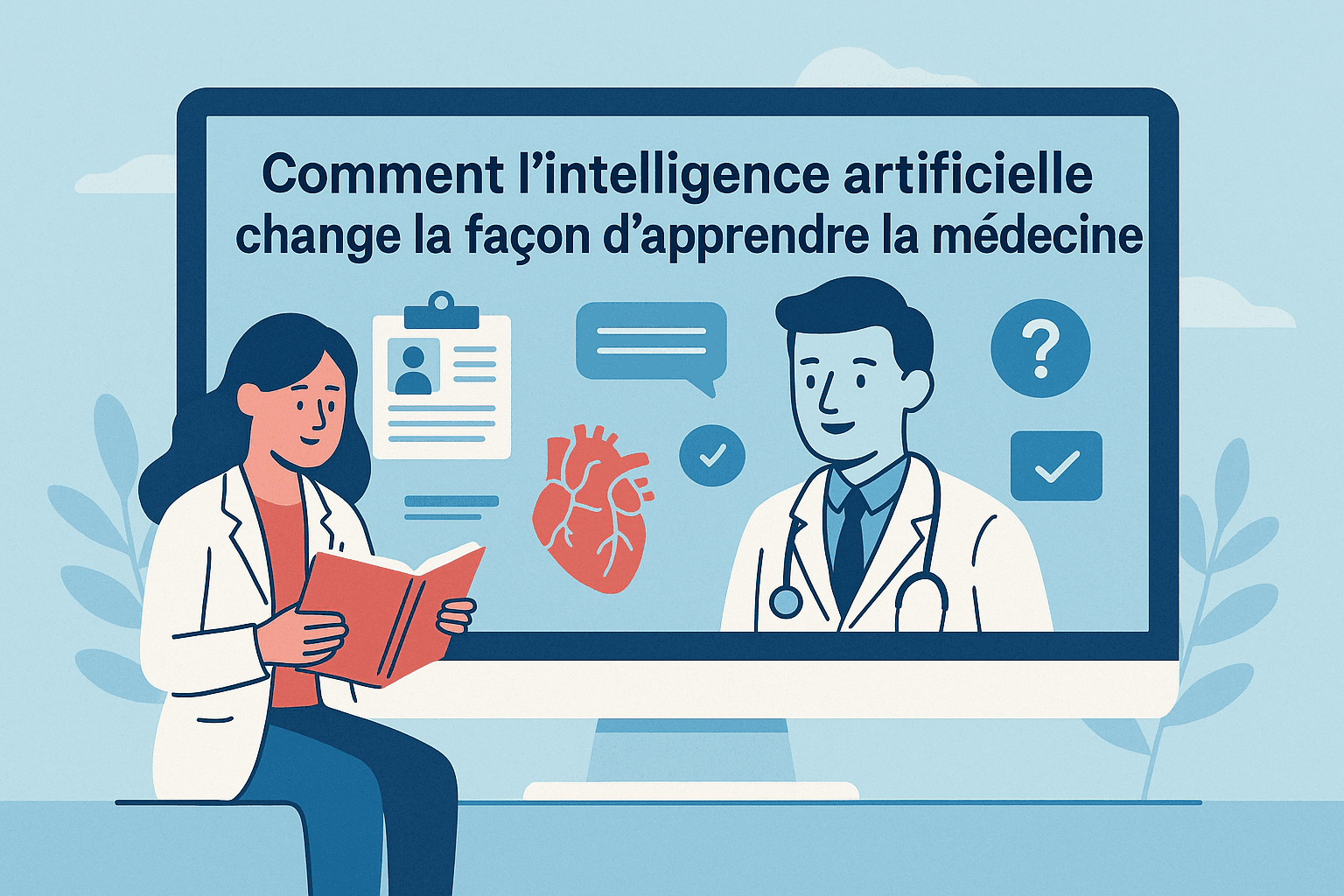
However, for the past few years, a silent revolution has been taking place in lecture halls: artificial intelligence (AI). And it is radically changing the way medical students learn, revise, and succeed.
So, how is AI concretely transforming medical education? And above all, how can you use it to revise medicine better without spending your nights on it?
1. Artificial intelligence at the service of medical learning
Artificial intelligence is no longer reserved for laboratories or hospitals. It is also making its way into medical studies, supporting students from their first year.
More and more universities and faculties are integrating AI tools into medical training : diagnostic simulators, virtual practical cases, learning chatbots, or intelligent revision platforms.
These tools are based on machine learning and adaptive learning, capable of analyzing your strengths and weaknesses to help you progress faster.
As a result: you no longer endure your learning; you interact with your course, you understand better, and you retain information longer.
It’s simple: thanks to AI, revising medicine becomes more active, more targeted, and more effective.
2. Revising medicine differently: when AI becomes your personal coach
One of the greatest assets of AI in medical learning is its ability to adapt to you.
Rather than imposing a one-size-fits-all pace, artificial intelligence helps you to revise according to your own profile : it identifies the concepts you master, those you forget, and those to be reviewed as a priority.
You can for example:
Transform your lectures into intelligent revision notes generated automatically.
Practice with personalized quizzes, based on spaced repetition.
Receive immediate feedback on your answers to correct your mistakes in real time.
This is what we call intelligent tutoring : AI acts like a personal coach that guides you step by step in your medical revisions.
And the cherry on top 🍒: many of these tools incorporate gamification — a playful learning that stimulates motivation with challenges, goals, and rewards.
3. The concrete advantages for medical students
👉 Save time : no more need to spend hours making notes by hand. AI can automatically synthesize your courses, even when they span several hundred pages.
👉 Improve retention : spaced repetition and AI quizzes enhance long-term memorization.
👉 Less stress before exams : you see your progress in real time and know where to focus.
👉 More efficiency : AI in health learning allows you to approach complex topics at your own pace, without drowning in unnecessary details.
Students in PACES or first-year medicine have understood: revising with AI means adopting a smarter and less exhausting approach.
4. Focus: Koro AI, the AI assistant that boosts your medical revision
Among the most appreciated tools by students, Koro AI stands out.
It is a playful and ultra-intuitive revision aid application, designed for medical students (but not only).
You can upload your courses (PDFs, photos, documents) and let the artificial intelligence automatically create clear revision notes, tailored quizzes, and precise summaries.
Each quiz ends with a little funny or motivating comment, goals to achieve, and a smooth interface that makes revisions almost... enjoyable 😄
In short: Koro AI perfectly embodies this AI revolution in medical studies — a tool that helps you learn faster, better, and with enjoyment.
5. The limits and precautions to keep in mind
Of course, artificial intelligence does not replace your critical thinking or clinical practice.
You remain primarily a future physician, and your role is to think, understand, and reason.
AI helps you to learn more effectively, but it is up to you to connect knowledge, observe, interpret, and judge.
In short, AI is a tool, not a substitute. The balance between technology and human reflection is the essence of true medical intelligence.
Conclusion: AI, the new ally of future physicians
Artificial intelligence is already changing the way medicine is learned.
It helps you to revise more effectively, to retain information longer, and to reduce stress related to the mass of information.
In a few years, every student will have their own personal AI assistant — a learning companion always ready to explain, summarize, and question.
And you, if you let AI accompany you, you will see that revising medicine can become smoother, smarter... and a little more fun.