
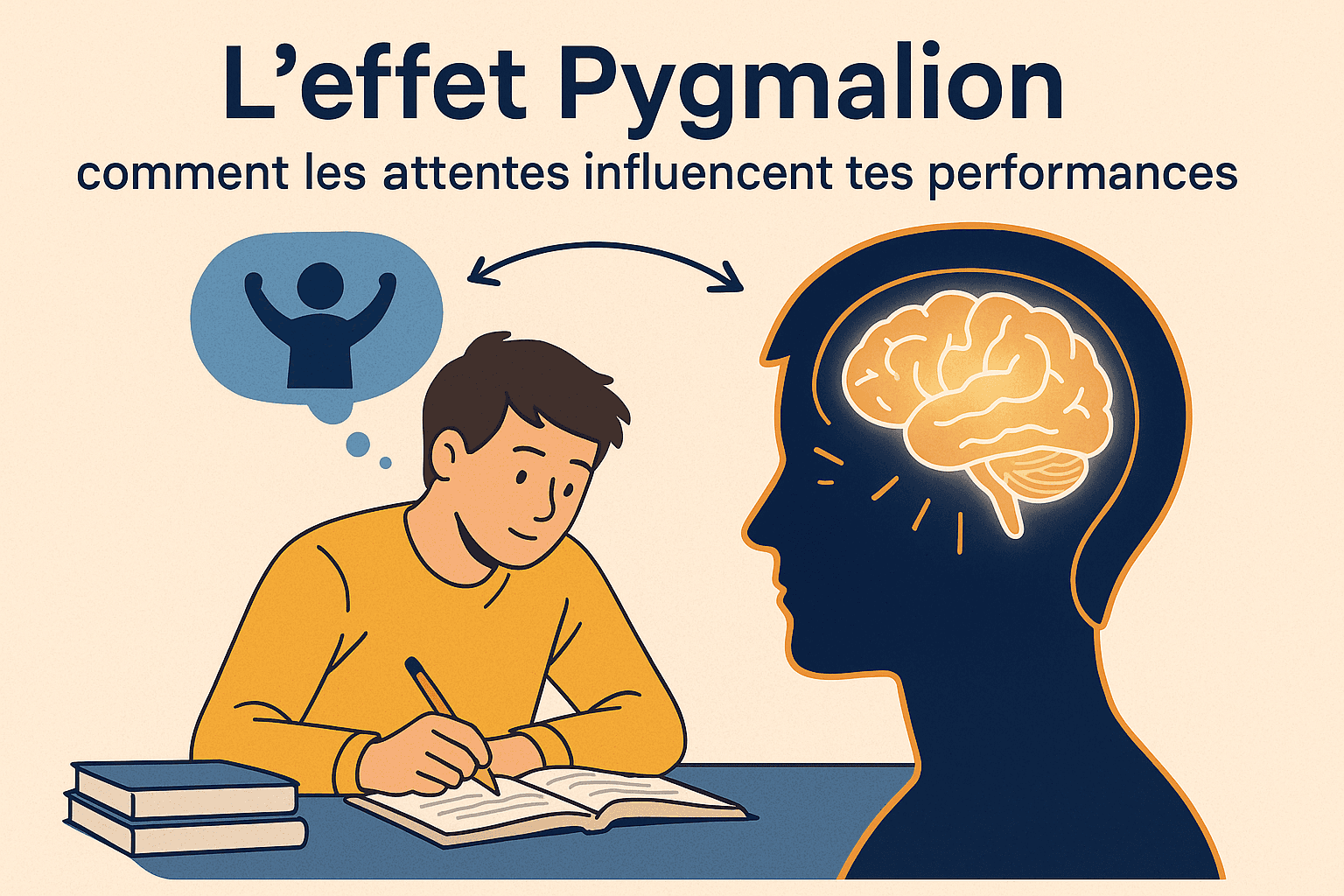
The Pygmalion effect: how expectations influence your performance.
Dec 12, 2025
Introduction
Have you ever surprised yourself by achieving something simply because someone believed in you? Or conversely, have you ever gone into an exam convinced you were going to fail… and ended up failing?
It’s not a coincidence. It’s the Pygmalion effect. And if you are a student, understanding this phenomenon can literally change the way you learn and perform.
In this article, we will see how expectations (yours and others') influence your motivation, your memory, your academic success… and how to use this psychological lever to boost your academic performance without working harder, just by working differently.
1. The Pygmalion Effect: The Simple and Quick Version
The Pygmalion effect is when the positive expectations someone has of you actually improve your results.
And conversely, negative expectations = decreased performance.
This phenomenon was highlighted by Rosenthal and Jacobson: they showed that by telling teachers that certain students were going to "explode the scores," those same students… really did excel. Why? Because the teachers treated them a bit differently, with more patience, more encouragement, and more feedback.
A self-fulfilling prophecy.
2. Why Expectations Have a Real Impact on Your Brain
You are not a robot. Your emotions, your self-perception, your confidence, all of that influences your memory, your concentration, and your motivation.
✔ The brain creates shortcuts (cognitive biases)
If you believe you are bad at math, your brain will filter everything that "confirms" that idea.
If you believe you can improve, it will look for evidence to the contrary.
✔ Motivation depends on the identity you build
"I am someone who works seriously" → you do things seriously.
"I am someone who never gets started" → you procrastinate.
✔ Expectations modify your behaviors
You sort your notes better, you take clearer notes, you put in extra effort… often unconsciously.
The Pygmalion effect is a combination of motivation psychology, self-perception, self-efficacy, and even a bit of neuroscience.
3. How to Create a Positive Pygmalion Effect for Yourself
The idea is to become your own teacher who believes in you.
You will literally program your expectations.
① Choose your student identity
Not "I want to get better grades."
Rather: "I am becoming someone who gives themselves the means to succeed."
② Daily micro-commitments
One note per day.
One quiz each evening.
10 minutes of a chapter.
What matters is doing.
③ Write down the evidence that you are progressing
Your brain loves to forget your victories.
Keep a list of "success evidence."
Your self-esteem rises, your performance does too.
④ Surround yourself with positive signals
A clean work environment, clear organization, simple tools.
Less friction = more motivation.
4. The Golem Effect: The Inner Enemy You Underestimate
The Golem effect is the opposite of the Pygmalion effect.
It’s when you sabotage yourself without realizing it.
❌ You think "I’m not cut out for this"
You work less, you stress more, you retain less.
❌ You compare yourself to others
You tell yourself you are "below average," and you limit your potential for improvement.
❌ You avoid difficult tasks
Because you "know" you are going to fail.
The worst part is that these thoughts seem logical at the moment… while they are just disguised negative expectations.
5. How to Neutralize the Golem Effect and Regain Control
✔ Set yourself realistic goals
Not perfect. Realistic.
✔ Accept that progress is non-linear
Studying is not a straight curve.
It has peaks, troughs, and setbacks.
✔ Replace automatic thoughts
"I’m terrible" → "I am understanding slowly but surely."
"I will fail" → "I will do my best."
It may seem simple, but it really changes the internal dynamics.
6. How to Apply the Pygmalion Effect in Your Daily Student Life
Before Studying
Prepare a clear plan.
Decide how many notes or quizzes you will do.
You give your brain direction → it executes.
During Classes
Talk to yourself as if you were your mentor.
"I am capable of understanding."
"I am here to improve."
Before an Exam
Visualize your success.
Not a 20/20, just you managing properly.
When You Lack Motivation
Return to your identity:
"What would the version of me who succeeds do now?"
7. Discreet Mini-Section: How Koro AI Fits Into a Positive Pygmalion Effect
Koro AI is one of those tools that naturally amplifies your positive expectations.
When you upload your courses, the app instantly creates notes, quizzes, and a clear work structure.
Less friction, more confidence.
And the little comments or goals after a quiz reinforce exactly what the Pygmalion effect describes:
you feel capable, thus you become more capable.
No need to think about it, it’s integrated into your routine.
8. Pitfalls to Avoid If You Want the Effect to Work
Wanting to go too fast
Wanting to change everything at once
Comparing yourself to other students
Repeating negative phrases even jokingly
Letting yourself be influenced by people who doubt you
The Pygmalion effect can be a powerful motivator… but only if you feed it correctly.
Conclusion: You Become What You Believe You Can Become
Your results depend not only on your intelligence or the amount of work you put in.
They depend greatly on your expectations, your identity, the way you talk to yourself, and what you choose to believe about yourself.
Decide today what the new standards you want to adopt will be.
Your brain will follow.
And so will your performances.