
The Cornell method for taking better notes and succeeding in your revisions
Dec 3, 2025

Introduction
If you're struggling to keep up with your classes, with your notes being a mix of fragmented sentences, arrows everywhere, and impulsive highlighting, you are not alone. Most students have never learned to take notes properly. As a result, when you review your classes, everything seems blurry and you waste time instead of saving it.
The Cornell method provides a real solution. It is a structured note-taking technique that helps you understand better, organize better, and memorize your classes better. And most importantly, it works for all levels, from high school to university.
What exactly is the Cornell method
Created at Cornell University, the Cornell method is a very simple note-taking system to implement. You divide your page into three areas:
• a large note-taking area
• a column for keywords and questions
• a summary at the bottom of the page
This organization forces you to understand what you are writing, to synthesize your ideas, and to prepare your revisions from the moment you take notes. You stop accumulating incomprehensible pages, you create real integrated flashcards, and you memorize much more easily.
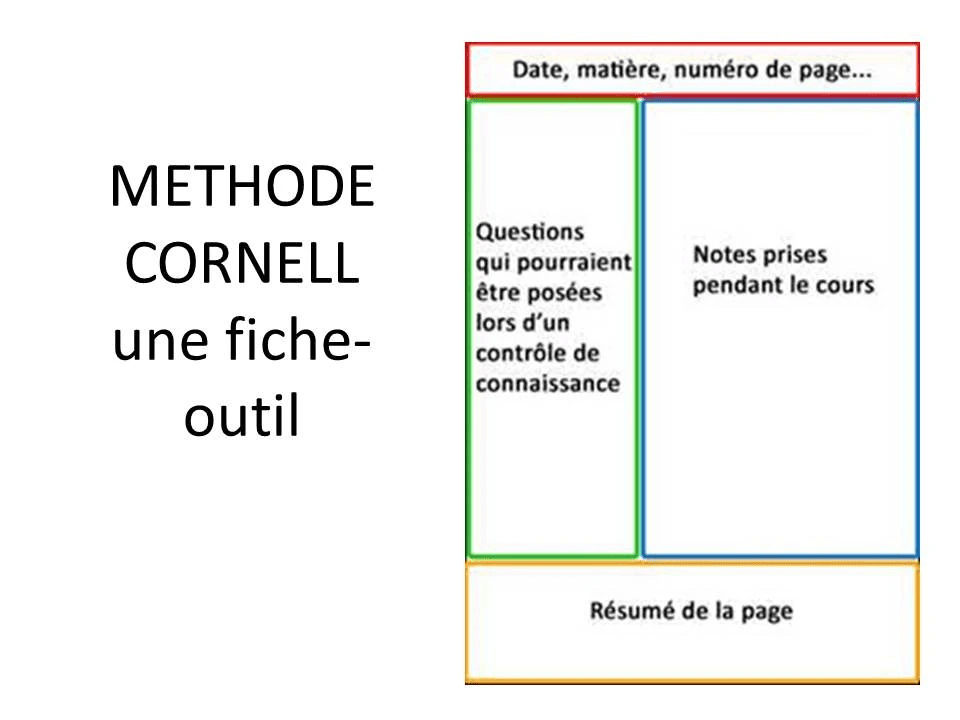
How to use the Cornell method step by step
1. Prepare your page
Draw a column on the left side (about 30 percent of the width) for keywords and leave the bottom of the sheet for the summary.
2. Take notes during class
In the large main area, write down important ideas. There's no need to write every word. Use abbreviations, arrows, quick diagrams. The goal is to capture the essentials.
3. Add keywords after class
In the left column, add key concepts, dates, figures, definitions. This is the step that transforms your class into a revision tool.
4. Summarize
At the bottom, write a mini summary that fits in a few lines. If you can't do it, it means you haven’t understood well. The summary validates your immediate understanding.
5. Actively revise
Ask yourself questions based on the keywords column. Hide the notes part and force yourself to recall the information. This active method improves your memorization and prepares you perfectly for exams.
Example of a Cornell page applied to a real class
Imagine a history class on the French Revolution.
• Main area: economic causes, storming of the Bastille, abolition of privileges.
• Keywords column: absolute monarchy, financial crisis, 1789, Estates General.
• Summary: in four lines, explain the logic of the chapter.
The result: your page becomes a clear, visual, and ultra-effective revision tool.
The advantages that explain the success of the Cornell method
The Cornell method has been used for decades because it really works.
• You understand the class better thanks to the synthesis.
• You memorize faster thanks to active revision.
• You save time during exams.
• You can use it in all subjects: law, medicine, business, science, high school, preparatory classes.
• You no longer need to rewrite all your notes to revise them.
Many students consider it the best note-taking method for university.
Tips to optimize your Cornell pages
• For very fast classes, take raw notes then restructure afterward.
• For subjects with diagrams (science, medicine), use the main area as a graphic space.
• Combine Cornell with spaced repetition or quizzes to boost your memorization.
• If you tend to write everything the professor says, force yourself to limit each page to the essentials.
The limitations of the Cornell method and how to overcome them
The Cornell method is not perfect.
• It requires getting used to, especially if you are not accustomed to structuring your notes.
• For very technical classes, some areas may seem too rigid.
• In very dense lectures, you may run out of time.
But these are easy limitations to overcome: you can make a simplified version during the class then organize it neatly afterward.
Koro AI: a complementary boost to the Cornell method
If you use the Cornell method, you will already be structuring your class intelligently. But sometimes, between classes, exams, and unexpected events, you run out of time to transform all your notes into actual revisions.
That's where a tool like Koro AI can help you. You upload your class notes and automatically get flashcards, quizzes, comprehension questions, and objectives to revise more effectively. It's fun, motivating, and perfectly complements the Cornell approach without replacing it.
Conclusion: try Cornell for a week
The Cornell method is probably the simplest and most effective note-taking technique you can use. It structures, organizes, helps you understand, and makes your revisions much smoother.
Try it for a few days. You will quickly see the difference: more clarity, better memorization, and less stress during exams.