
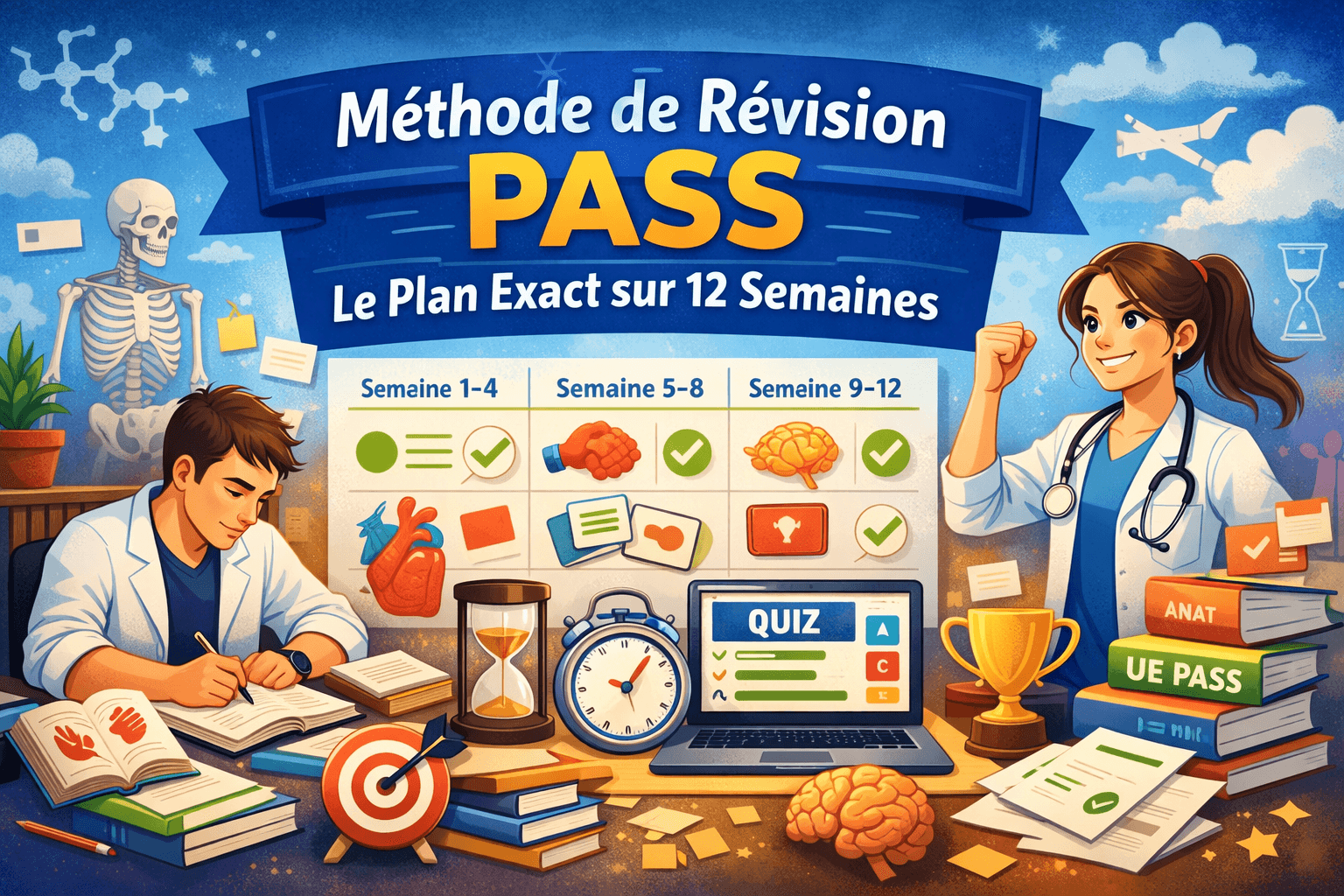
PASS Revision Method: the exact plan over 12 weeks
Jan 20, 2026
Introduction
The PASS is not a matter of intelligence.
It is a matter of revision method, organization, and consistency.
Every year, very capable students fail not because they don’t work hard enough, but because they work poorly. Too much reviewing, too much improvisation, too much pressure, not enough structure.
In this article, you will discover a clear, realistic, and tested PASS revision method, with a 12-week PASS revision schedule, designed to sustain over time without exhausting you.
Understanding the Real Constraints of PASS
Before talking about planning and organization, we need to be honest about the reality of PASS.
Massive volume of courses
Fast-paced university rhythm
Multiple UEs in parallel
Little immediate feedback
High mental pressure
The main problem is not the workload, it’s accumulation without consolidation. Many students progress in the courses thinking they will revise later. In PASS, this "later" never comes.
Improvising your PASS revision schedule is one of the most common mistakes. You end up working a lot, but without knowing if you are really making progress.
Key Principles of an Effective Revision Method in PASS
A good working method in PASS is based on a few simple but non-negotiable rules.
1. Active revision above all
Rereading your courses gives the illusion of understanding. Testing your memory, taking quizzes, reformulating without support – that’s what helps you improve.
2. Consolidate before accumulating
It’s better to master 80% of a course than to skim through 100% of three courses.
3. Consistency beats intensity
Working 6 hours a day consistently is more effective than 12-hour days followed by a crash.
4. Measure what you really know
If you never test yourself, you don’t know where you stand. In PASS, not knowing your position is extremely dangerous.
The Exact 12-Week PASS Revision Plan
This PASS revision plan is structured into three main phases. Each phase has a specific objective.
Weeks 1 to 4: Building the Foundations
Objective: understand and structure.
Understand each course without trying to recite it
Create synthetic PASS revision sheets
Identify the key concepts of each UE
Establish a stable daily rhythm
At this stage, you should already integrate active revision:
simple quizzes
course questions
verbal reformulation
The goal is not perfection, but solid understanding.
Weeks 5 to 8: Consolidate and Automate
Objective: strengthen memorization.
Cross revision between UEs
Regular quizzes to test memorization
Systematic analysis of mistakes
Gradual reduction of time spent per course
This is where the method makes a difference. You need to start recognizing classic traps, frequent confusions, and concepts you consistently forget.
Weeks 9 to 12: Optimize Performance
Objective: maximize points.
Targeted revisions only on weak points
Intensive training through quizzes and MCQs
Simulations in conditions close to the exam
Management of fatigue and stress
At this stage, you are hardly learning new things anymore. You are consolidating, refining, securing.
Example of a Realistic Weekly Schedule in PASS
Here is an example of PASS revision organization over a typical week.
During the Week
Morning: learning or consolidating a course
Afternoon: active revision + quizzes
End of the day: quick review of mistakes
Weekend
Saturday: overall revisions and difficult subjects
Sunday: light reactivation + partial rest
Rest is part of the method. Without recovery, memorization drops.
How to Revise Each Type of Subject Effectively in PASS
Not all subjects are revised the same way.
Memorization Subjects
Short notes
Frequent quizzes
Spaced repetition
Reasoning Subjects
Understanding mechanisms
Targeted exercises
Analysis of mistakes
High Volume Subjects
Strict hierarchy
Identification of profitable chapters
Regular revisions rather than last-minute
Mistakes That Cause Even Motivated Students to Fail
Rereading without ever testing yourself
Trying to do everything perfectly
Accumulating courses without revising
Copying someone else's method without adapting it
Neglecting sleep and recovery
PASS is not a competition of suffering. It is a competition of efficiency.
Using Tools to Keep Up the Pace Without Exhaustion
When the volume becomes too large, automating part of the work can really make a difference.
Centralizing your courses, generating PASS revision sheets, and regularly training with quizzes allows you to maintain an active revision mindset without wasting time on organization.
Some students use tools like Koro AI to turn their courses into sheets and quizzes, track their progress, and maintain constant motivation through clear goals and engaging feedback. The idea is not to delegate your work but to better use your time.
Conclusion
Succeeding in PASS does not rely on hidden talent.
It is based on a clear revision method, a realistic schedule, and consistency over several weeks.
This 12-week PASS revision plan is not magical, but it is feasible.
Starting now with a solid structure is always better than waiting for the "perfect moment".
If you apply this method seriously, you set all the chances on your side to succeed.