
80% of students forget what they learn: how to tame the forgetting curve to finally retain your lessons
Nov 27, 2025
Introduction
Have you ever found yourself rereading your notes three times, thinking you understand everything… then, two days later, nothing at all?
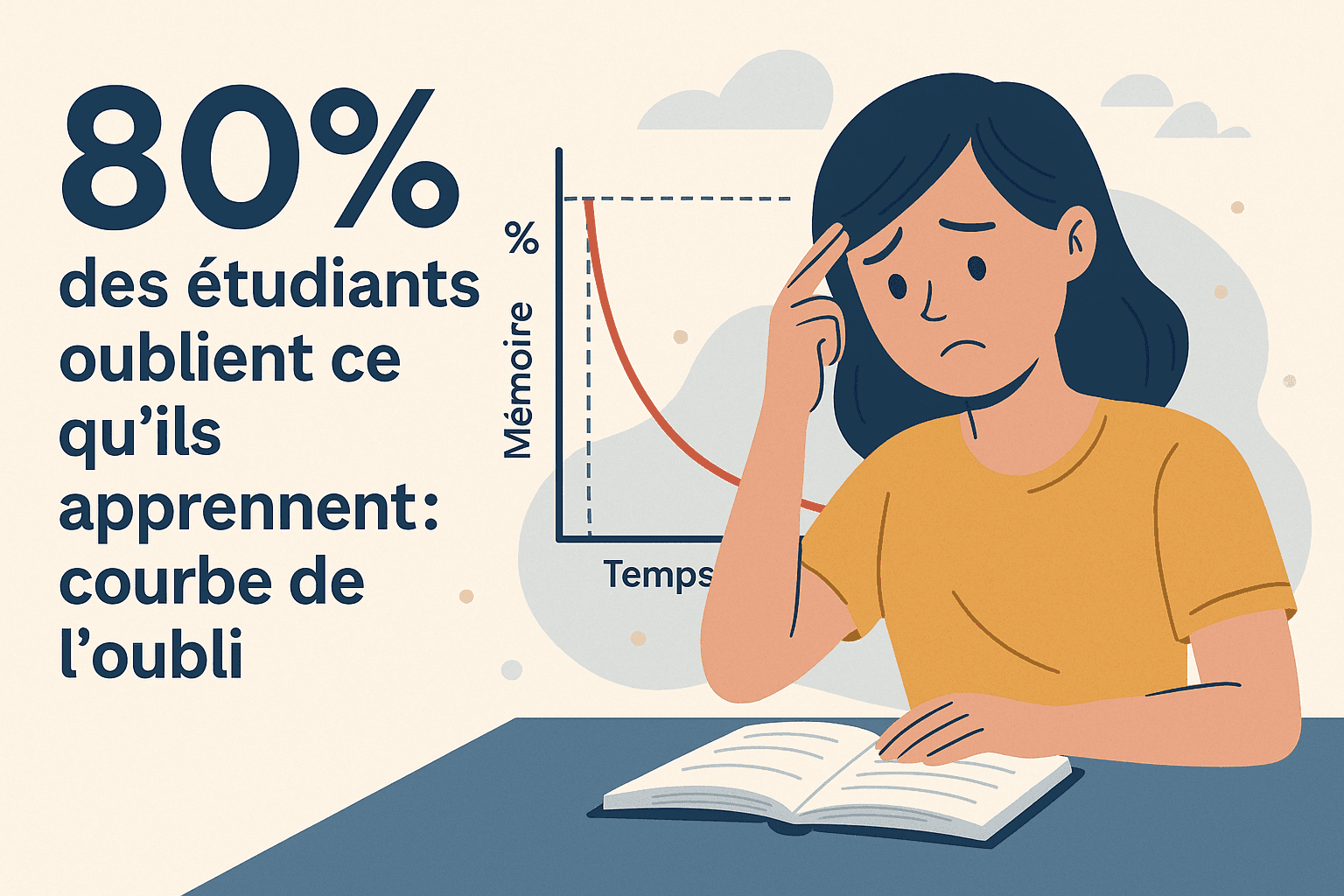
You are not alone: nearly 80% of what a student learns disappears within a few days. This is the famous forgetting curve, identified by Ebbinghaus. And if you use it well, it can become your best ally to learn faster, retain longer, and revise much more effectively.
In this article, you will understand why you forget so quickly, how to optimize your memorization, and how to organize your revisions to stop wasting your time on unnecessary rereading.
1. Why we forget (almost) everything: the real student problem
Every year, students follow the same pattern:
they reread their notes,
they highlight,
they feel like they master the material…
…and yet, long-term memory records nothing.
This mechanism is natural, but amplified by traditional revision methods. You can work hard, but if the method is bad, you will forget quickly, a lot, often.
The goal of this article: to help you understand the mechanics of forgetting and teach you how to circumvent this trap.
2. The forgetting curve: your brain sabotages you… but not on purpose
2.1 What is the forgetting curve?
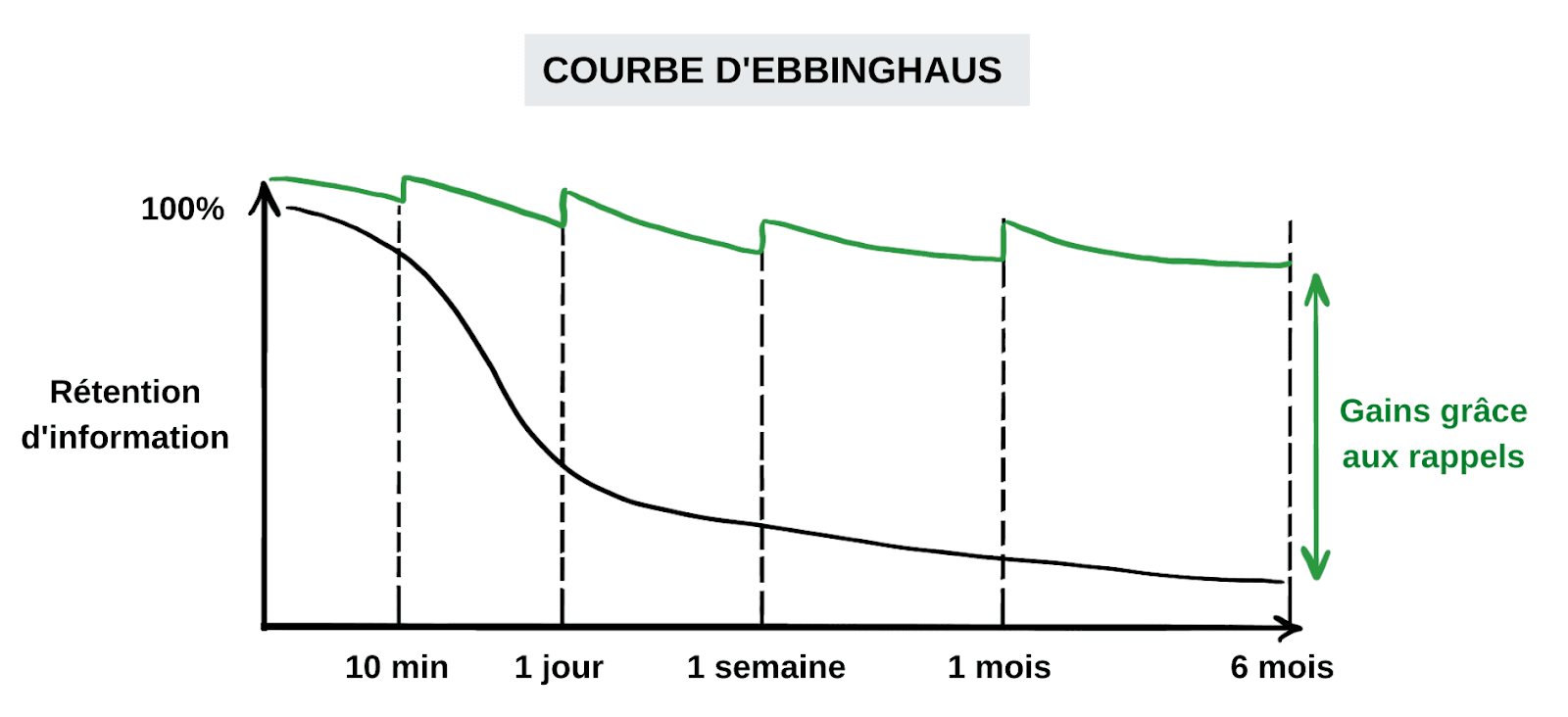
Discovered by Hermann Ebbinghaus, it shows that:
you lose about 60% of information within 24 hours,
80% within a few days,
and nearly everything after a week…
… if you do not actively reactivate the information.
It’s not that you are “bad at remembering”: it’s just your brain eliminating what it deems unnecessary.
2.2 Why do you forget so quickly?
Several reasons:
cognitive overload : too much information at once, your brain sorts it out.
lack of reactivation : what is not repeated, disappears.
passive revision : rereading ≠ learning.
2.3 The worst habit: passive rereading
Rereading, highlighting… gives an illusion of mastery, but you never test your memory.
A very popular method, but… scientifically ineffective.
3. Mastering the curve: how to retain faster and longer
Do you really want to retain? Then you need to work with your brain, not against it.
3.1 Spaced repetition: the number one scientific weapon
The principle: review information exactly when you are starting to forget it.
Simple example:
first reactivation: D+1
second: D+3
third: D+7
fourth: D+14
This is known as spaced repetition, a key technique for long-term memorization.
3.2 Active memorization: the method that changes everything
Instead of rereading, you must test yourself :
quizzes,
flashcards,
MCQs,
real open questions,
memory reformulation.
This is known as active memorization, one of the strongest revision techniques.
3.3 Well-prepared notes: a huge time saver
An effective note does not just summarize a course; it forces you to:
reformulate,
simplify,
ask questions/answers,
isolate concepts that require effort.
This is ideal for countering forgetting and reducing cognitive overload.
3.4 Boosting your memory through the right levers
Sleep : memory consolidates at night.
Emotions : a more “vivid” content is better retained.
Variety of formats : quizzes, flashcards, diagrams, notes.
Regularity : 20 minutes daily > 2 hours of rereading the night before.
4. Organizing your revisions to forget nothing
4.1 Building an anti-forgetting routine
You can apply the following method:
sessions of 20–25 minutes,
a micro-break of 5 minutes,
a quick test at the end of each session,
a lightning reactivation in the following days.
It’s simple, scientifically validated, and extremely effective.
4.2 Prioritizing subjects sensitive to forgetting
Some subjects evaporate very quickly:
law: definitions, case decisions, concepts, hierarchies
biomedical: histology, anatomy, biochemistry
languages: vocabulary
social sciences: theoretical concepts
To be addressed as a priority with spaced repetition.
4.3 Tracking your progress
To avoid the trap of excessive confidence, ask yourself three questions:
Can I answer the question without looking ?
Can I explain it to someone ?
Do I still remember a few days later ?
If the answer is no: you need to reactivate.
5. How Koro AI quietly helps you beat the forgetting curve
(Section intentionally short and non-promotional, as requested.)
Koro AI automatically applies the main principles of active memorization and spaced repetition :
you upload your course (PDF, photos, notes),
Koro generates flashcards, quizzes, and flashcards,
each quiz works your active memory,
objectives, fun comments, and checkpoints keep you motivated.
No hassle: you apply the forgetting curve… without thinking about it.
6. Concrete examples to apply the forgetting curve
Case 1: a 20-page law tutorial
D0: read + create a Q&A note + 10 self-created quizzes
D+1: redo 5 quizzes
D+3: redo 5 quizzes + reformulation
D+7: final test
Case 2: a histology course
D0: flashcards + diagrams
D+1: 10 flashcards
D+3: 20 flashcards
D+7: overall test
Case 3: a math chapter
D0: exercises + key formulas
D+1: redo 3 exercises
D+3: redo 2 difficult exercises
D+7: mini-series of 20 minutes
7. Conclusion: how to stop forgetting once and for all
If you need to remember one thing from this article, it’s this:
👉 forgetting is normal, but predictable.
👉 spaced repetition + active memorization = winning combo.
👉 rereading is not enough.
👉 a simple and regular method allows you to retain 2 to 3 times better.
If you apply these principles, you will retain longer, revise more intelligently, and save a lot of time.