
Why ChatGPT is not good for students (and how to really study effectively)
Nov 26, 2025
Introduction
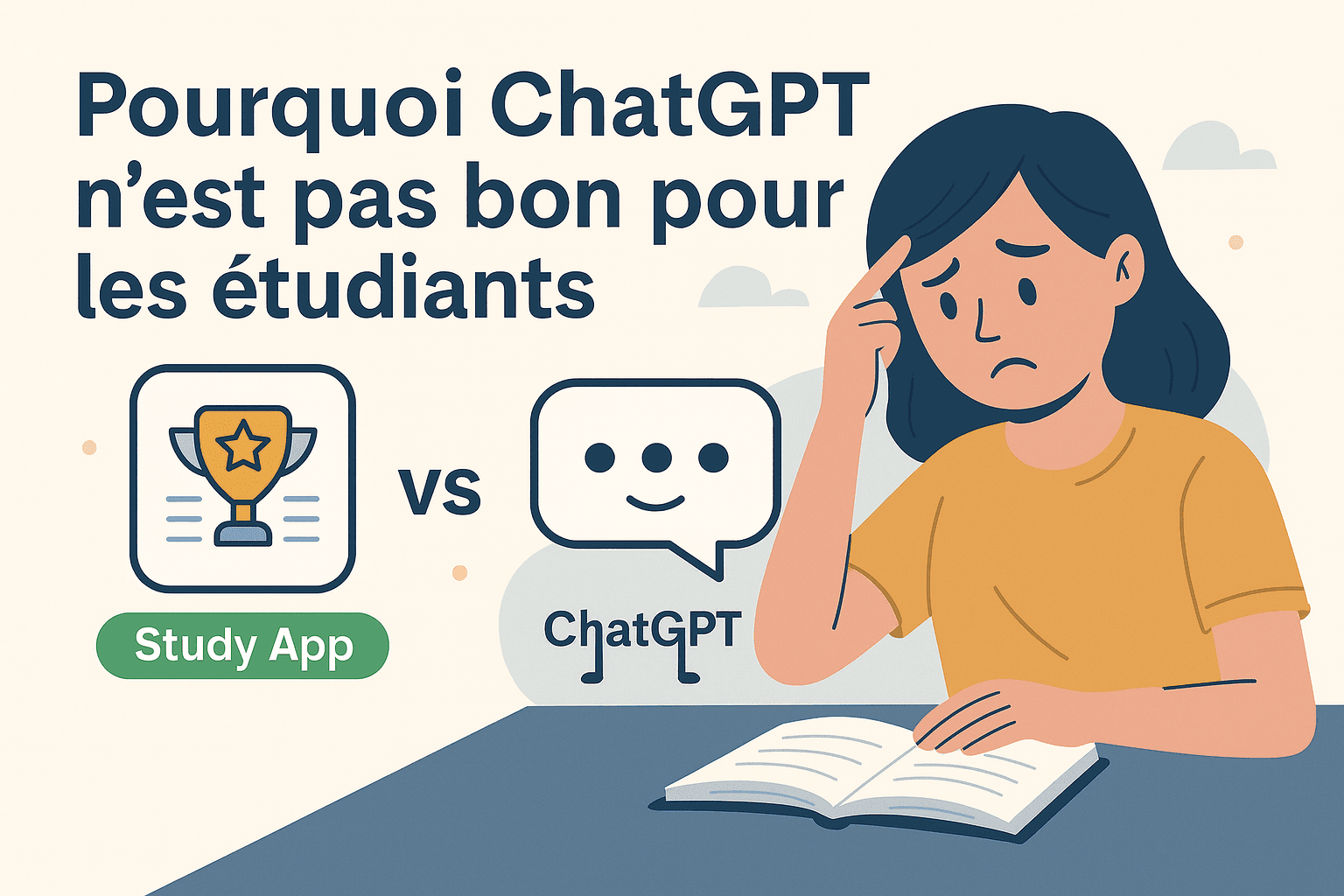
Since the arrival of ChatGPT, a lot of students use it to summarize their courses, create plans, write essays, or sometimes… cheat. It’s fast, convenient, impressive. But let’s be honest: for reviewing, for understanding, for memorizing, ChatGPT is not the ideal tool.
And if you really want to succeed in your exams, you absolutely need to understand why.
In this article, you will discover the limits of ChatGPT for students, the risks to your learning, and especially how to use AI without penalizing yourself. And at the end, an alternative designed for you, a student revision tool created to help you learn faster and retain longer.
1. ChatGPT is not designed for learning
We often imagine that ChatGPT is a sort of super teacher capable of explaining any course. But its goal is totally different: to generate text.
Not to teach you, not to help you memorize, not to improve your study method.
1.1 A generalist AI, not an educational platform
ChatGPT is not a revision application. It’s an “all-terrain” AI: it writes poems, code, jokes, literary analyses… but it does not structure your learning.
When you review, you need flashcards, quizzes, active memorization, tracked progress, not just a well-written text.
1.2 Often superficial explanations
The answers seem clear, but they often lack depth. The result is:
You think you have understood, but faced with your exam → it’s empty.
Superficial understanding is one of the biggest dangers of ChatGPT for students.
1.3 The risk of errors and hallucinations
ChatGPT can invent:
numbers
dates
quotes
definitions
“logical” but completely false conclusions
If you do not yet master your course, you cannot spot the error.
The risk of errors with ChatGPT is real, and it can cost you points.
2. Help that sabotages your learning
2.1 You shift from active learning to passive learning
A good student does not only read.
They:
reformulate
test their knowledge
self-evaluate
practice
repeat
ChatGPT encourages the opposite:
You read, you copy, you move on → your brain records nothing.
2.2 The copy-paste trap
You copy a summary, you learn it quickly, it seems effective…
But since you did not think about the content, the memorization does not set in. And the risk of plagiarism exists if you submit an unmodified assignment.
2.3 Dependency
You lose the habit of searching, understanding, reformulating.
The less you work yourself, the more your brain “forgets how to learn”.
It’s the opposite of an effective revision method.
2.4 A false impression of time saving
We think we save time with ChatGPT.
But if you have to verify each piece of information…
If you have to reformulate to understand…
If you arrive at the exam without mastering…
In the end, you lose time.
3. What a good revision tool should provide
Unlike a generalist AI, a good student revision tool should help you to:
Structure your course
Understand easily
Memorize durably
Test your knowledge
Track your progress
Learn actively
Personalize according to your level
This is precisely what ChatGPT lacks. It generates, but it does not educate.
4. ChatGPT vs a specialized tool: the match
Criteria | ChatGPT | Student revision tool |
|---|---|---|
Reliability | average, possible errors | high, based on your course |
Personalization | low | high |
Active memorization | no | yes (flashcards, quizzes, repetition) |
Work structure | none | clear and progressive |
Risk of plagiarism | high | none |
Goal | writes | helps you learn |
ChatGPT is excellent for brainstorming, reformulating, understanding differently.
But for reviewing, it does not compete with a platform designed for learning.
5. An alternative designed for you: Koro AI
If you want an AI truly suited for revisions, there are intelligent revision applications designed specifically for students.
For example, on Koro AI, you simply upload your course (PDF, photos, Word…), and the tool automatically creates for you:
clear revision flashcards
quizzes to test your understanding
a pathway for active memorization
goals, tracking, and even funny little messages at the end of each quiz
This is exactly what ChatGPT lacks: a structure, an educational approach, and a personalized revision experience.
6. How to use ChatGPT without getting trapped
You can very well use ChatGPT in your studies, provided you follow a few simple principles:
use it to understand, not to learn in your place
always check sources
avoid copy-pasting
combine ChatGPT with active methods: quizzes, flashcards, spaced repetition
maintain your autonomy: your brain must stay the pilot
The AI can make you better… if you use it wisely.
Conclusion
ChatGPT is powerful, impressive, useful… but not for reviewing.
It’s not an educational tool, let alone a working method.
If you really want to succeed in your exams, you need to use tools designed for learning, based on active memorization and personal progression.
You can keep ChatGPT for brainstorming, explaining, unlocking a paragraph.
But for reviewing, understanding, memorizing, progressing → choose suitable tools.