
Active recall: the method that helps you retain information 2x faster (scientific study)
May 28, 2026
You reread your class notes 4 times. You highlight in yellow. You tell yourself "ok, I know this." The day after the exam: nothing. Blank brain. Black hole.
The problem isn't you. It's the method.
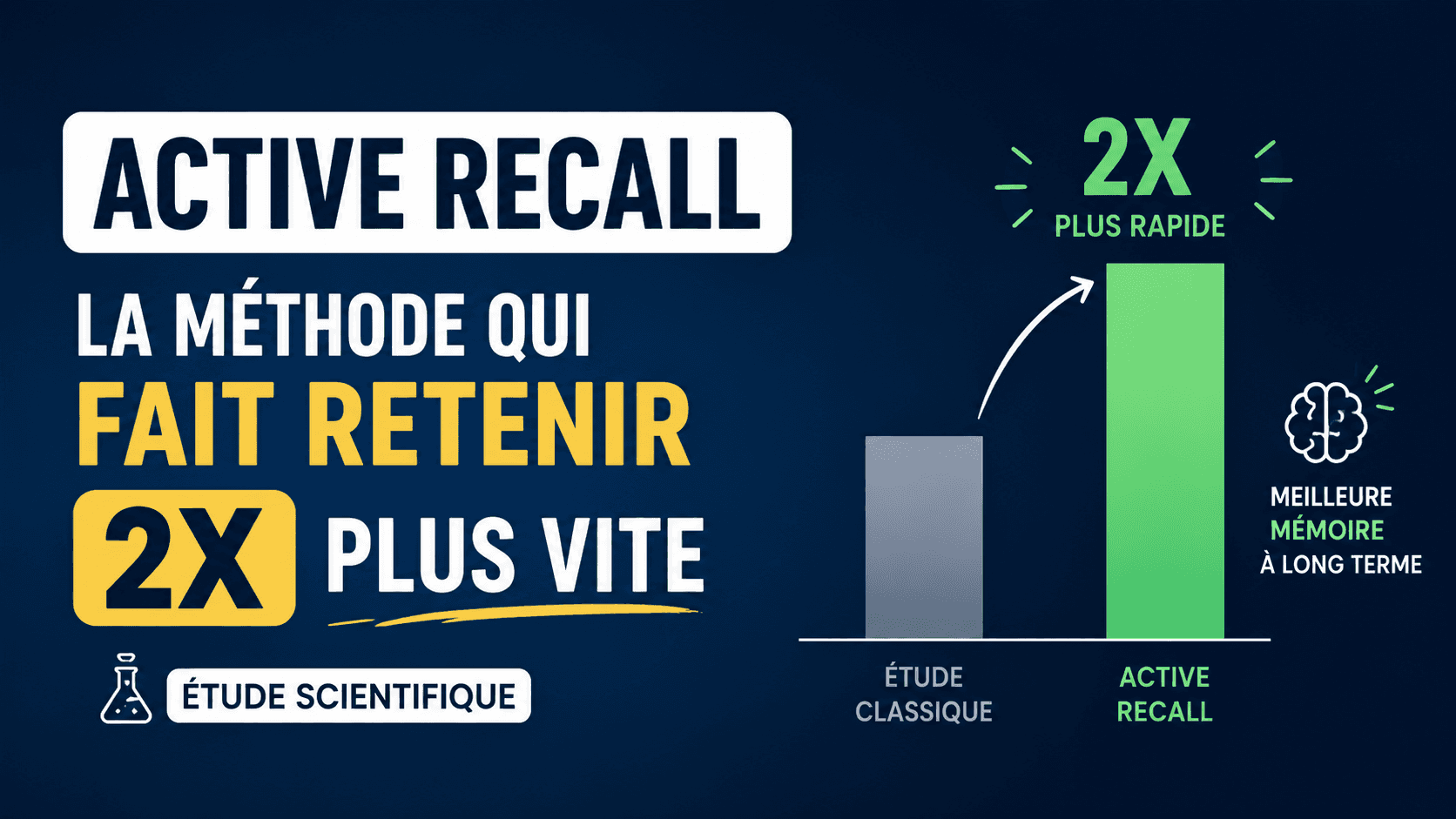
According to a study by Roediger and Karpicke (Washington University), students who use active recall memorize 50% better than those who reread their notes. Rereading is the illusion of learning. Active recall is learning.
What is active recall, concretely?
Active recall is testing your memory before you feel like you have learned.
Instead of rereading:
You close your notes
You ask yourself a question
You try to answer from memory
You check
It's uncomfortable. It's even frustrating the first few times. But that is exactly why it works: your brain works to retrieve the information, and therefore engraves it deeper.
Why it works (science in 2 sentences)
When you reread, your brain recognizes the information. Recognizing ≠ knowing. When you do active recall, your brain retrieves the information. And every retrieval strengthens the memory trace. It is the "testing effect."
Result: you retain information longer, with fewer hours of studying.
The 4 ways to do active recall (without complicated equipment)
1. The blank sheet of paper (the most brutal, the most effective)
After a class, you take a blank sheet of paper. You write down everything you remember. Without looking. Then you compare it with your notes and fill in the gaps.
Time: 15 min. Retention level: huge.
2. Flashcards
A question on one side. The answer on the other. You test yourself. You sort out the cards you miss to review them later.
The 2026 version: you let an AI generate the flashcards from your course so you don't waste 2 hours making them.
3. Quizzes / Multiple Choice Questions
You make questions about your course, or you use those provided by the teacher. You answer without looking. You check your answers.
4. Explaining to someone else
You explain the chapter to a friend, your dog, your mirror. If you get stuck, you've found a gap. (This is also the basis of the Feynman technique.)
The active recall routine in 30 minutes a day
5 min: blank sheet on yesterday's lesson
15 min: flashcards of the last 3 chapters
10 min: 1 multiple-choice quiz or 5 open-ended questions
Done for 2 weeks before an exam, this gets you a B+ or better even without being a genius.
Mistakes to avoid
Testing too early. Read the notes once first. If you have zero foundation, active recall will just frustrate you for nothing.
Testing without checking. If you make a mistake but don't know why, you aren't learning. Always verify the correct answer.
Making 10-line flashcards. One card = one idea. Otherwise your brain gets overwhelmed.
Doing active recall only once. The magic comes from spaced repetition: you review the same cards at D+1, D+3, D+7, D+14. The longer you wait, the deeper the card is engraved.
Combining active recall + spaced repetition = perfect combo
Active recall makes you learn. Spaced repetition makes you keep what you've learned.
The two together is what medical, law, and prep school students do. Not because they are geniuses. Because it is the most effective method in the world, proven by 100 years of research in cognitive science.
How Koro AI speeds up active recall
The problem with the method is the prep time: turning a 40-page course into flashcards takes forever.
Koro AI does this in 30 seconds: you upload your course, and the AI generates study sheets, flashcards, and customized quizzes for you. You test yourself, you study, you retain.
Active recall + spaced repetition + 0 prep. That's the idea.
Conclusion
Active recall is testing your memory before assuming it's full. The blank sheet, flashcards, and quizzes are your three best friends. Combine this with spaced repetition and you retain twice as much, in half the time.
When do you start?