
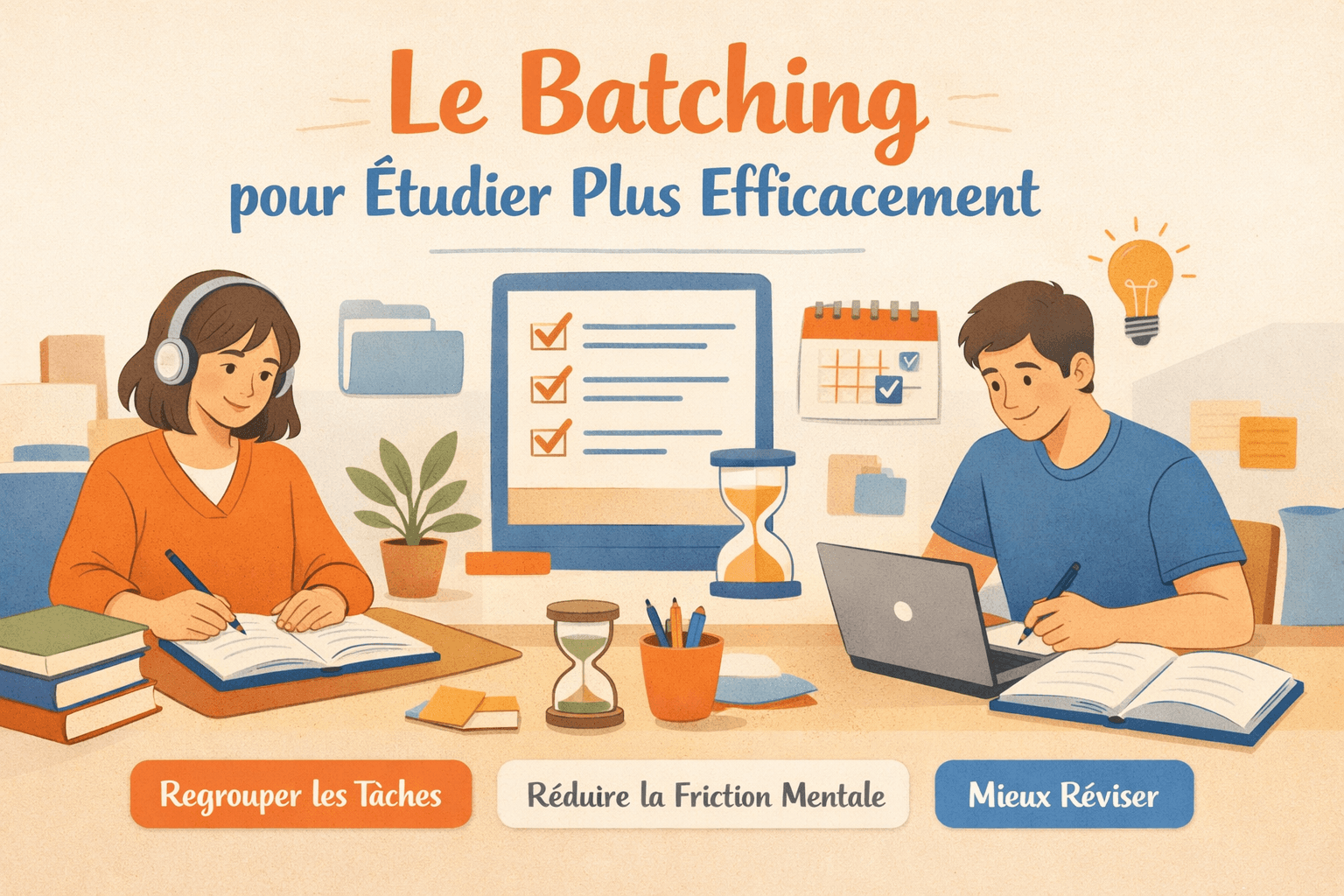
Batching: grouping tasks to reduce friction and study more effectively.
Feb 6, 2026
Introduction
You sit down to revise…
You open your course…
Then your phone…
Then you switch subjects…
Then you wonder why you are already tired.
If this situation resonates with you, rest assured: you are not alone. Many students work in multitasking, thinking they are saving time, when in reality they are draining their concentration.
👉 The truth is that working longer does not mean working better.
This is where a simple but remarkably effective method comes in: batching. A productivity technique that involves grouping similar tasks to reduce mental friction and review more efficiently.
I. What is batching exactly?
A simple definition
Batching is the act of grouping tasks of the same type and doing them in one dedicated session, rather than spreading them throughout the day.
Example:
❌ Reviewing a bit of law, then answering messages, then making a study sheet, then switching subjects
✅ Reviewing only law for 1.5 hours, without anything else
Batching vs multitasking
Multitasking | Batching |
|---|---|
You constantly switch from one task to another | You focus on one type of task |
Quick mental fatigue | Deeper concentration |
Illusion of productivity | Real productivity |
Why your brain loves batching
Every time you change tasks, your brain has to:
refocus
remember where it was
make new decisions
Result: loss of energy, decreased focus, procrastination.
Batching reduces these cognitive costs and helps you enter deeper student work more easily.
II. Why batching reduces mental friction
The hidden cost of task switching
Constantly switching from one subject to another, or from one activity to another, creates invisible mental friction. You are not less motivated: your brain is just overwhelmed.
Decision fatigue among students
Every day, you make dozens of micro-decisions:
Which subject to review?
Make a study sheet or a quiz?
Continue or change?
Batching removes a large portion of these decisions, freeing up energy for the essential: learning.
More focus, less stress
By batching:
you know exactly what you are doing
you progress faster
you lessen the feeling of overload
👉 Less friction = more mental clarity.
III. Batching applied to studies (concrete examples)
1. Batching revisions
Instead of reviewing 4 subjects in the same day:
group similar subjects (e.g., civil law + constitutional law)
create thematic sessions
📌 Example:
Monday: revisions only in economics
Tuesday: revisions only in biology
Result: better memorization and less distraction.
2. Batching study sheets
Classic mistake: making a study sheet right after reading a course.
More effective batching method:
Session 1: understand the courses
Session 2: make all the study sheets for the chapter at once
Your brain is then in a single mode: synthesis.
3. Batching quizzes and practice
Instead of doing a quiz "randomly":
schedule sessions dedicated only to quizzes
do several practice sessions consecutively
Advantage:
you see your progress
you reduce exam stress
you identify your gaps more quickly
IV. How to implement batching step by step
1. Identify your recurring tasks
Read the courses
Make study sheets
Revise
Take quizzes
Review before exams
2. Create realistic time blocks
45 minutes to 1.5 hours per session
Only one category of tasks per block
3. Adapt batching to your rhythm
High school: shorter sessions
University/preparatory courses: longer blocks
Always schedule breaks
V. Common mistakes to avoid
❌ Having sessions that are too long
❌ Batching incompatible tasks (reviewing + responding to messages)
❌ Forgetting breaks (they are part of the method)
Batching is not a race; it’s a sustainable strategy.
VI. Tips to make batching more motivating
Set a clear goal per session
Visualize your progress (checklists, tracking)
Use gamification: challenges, scores, rewards
👉 The more motivating it is, the less you procrastinate.
VII. Tools that make batching revisions easier
Batching is even simpler when everything is centralized.
For example, some students use revision tools to:
upload their courses only once
generate study sheets and quizzes in batches
carry out revisions without getting distracted
With a tool like Koro AI, you can:
transform multiple courses into study sheets at once
create quiz series for a subject
receive fun feedback at the end of the quiz
set motivating goals to keep up the pace
👉 The idea is not to do more, but to study more intelligently.
Conclusion
Batching is a simple but extremely powerful method for students.
By grouping your tasks:
you reduce mental friction
you limit procrastination
you improve your concentration
you learn more effectively
💡 Less distraction = more energy for understanding and memorizing.
👉 Test batching during your next revision session. You will quickly notice the difference.