
The testing effect: why testing yourself is much more effective than rereading for lasting memory retention
Feb 5, 2026
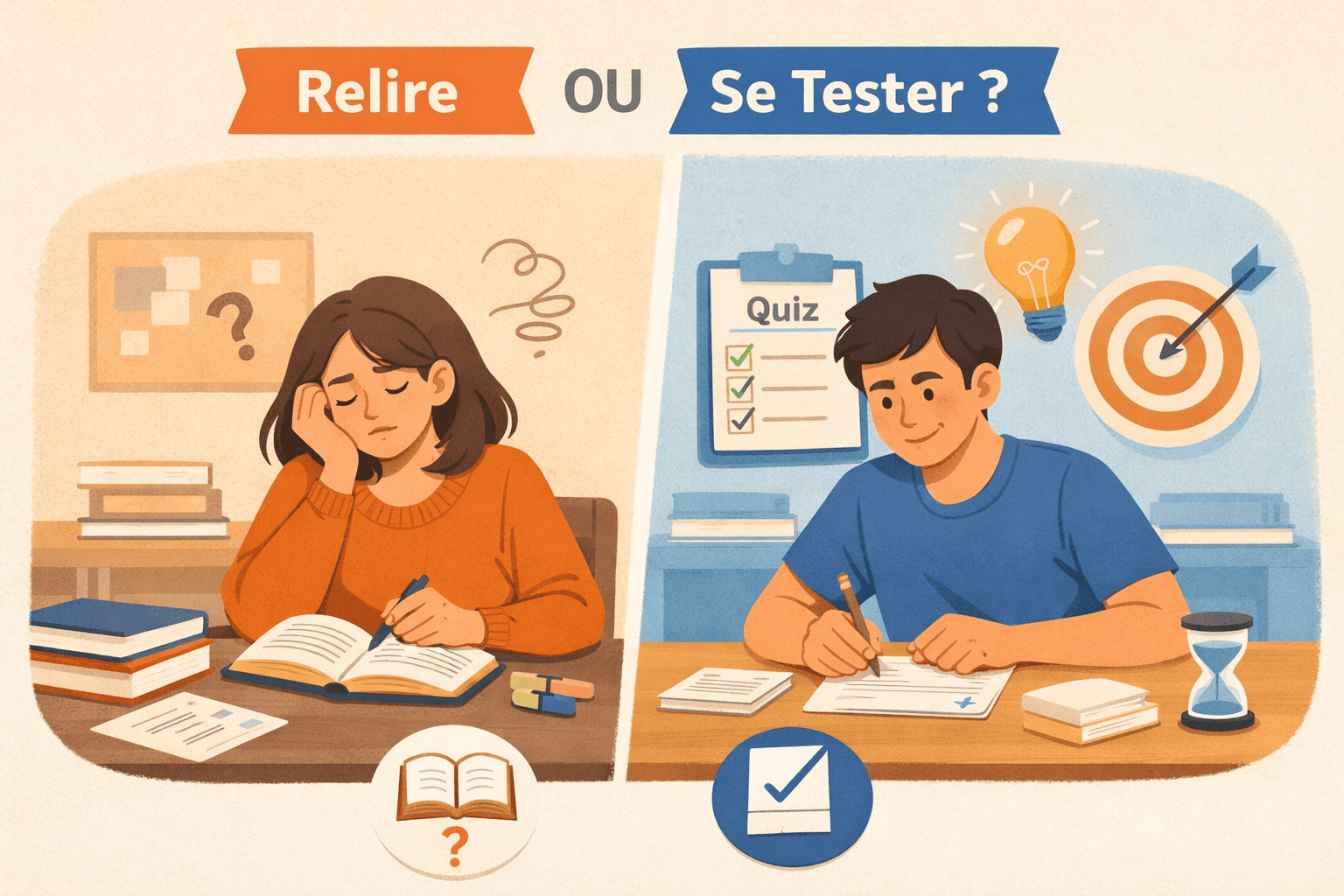
1. Why revise so much… and forget so quickly?
You surely know this situation 👇
You spend hours rereading your notes, your notes are highlighted in all colors, everything seems clear to you…
Then comes the exam.
And there: black hole 😶🌫️
This scenario is extremely common among students. And yet, rereading is still considered a "serious" study method. In reality, learning sciences show that rereading your notes is one of the least effective methods for long-term memorization.
The good news?
There is a simple, free, and scientifically proven learning technique: the testing effect.
👉 What if, instead of rereading, you started testing yourself to learn better?
2. What is the testing effect?
The testing effect (or testing effect in English) is a well-known phenomenon in cognitive psychology of learning.
👉 It shows that regularly testing oneself greatly improves memorization compared to simple rereading.
In short:
Rereading is a passive exposure to information
Testing yourself is an active retrieval of information from your memory
And it is precisely this retrieval effort that strengthens learning.
Even if you make mistakes, the mere act of trying to find the answer helps your brain consolidate long-term memory.
3. Why rereading your notes gives an illusion of learning
Rereading gives a pleasant feeling:
"I recognize the content, so I know it."
The problem?
This feeling is an illusion of competence.
Why it doesn't work:
Rereading creates a feeling of familiarity, not true mastery
You recognize the information… but you are not able to retrieve it on your own
In the exam, the notes are no longer in front of you
That’s why many students ask themselves:
👉 "Why doesn’t rereading my notes work?"
Science is clear: rereading improves long-term memorization little, especially compared to active revision techniques.
4. Why testing yourself really improves memorization
Testing yourself is difficult. And that’s exactly why it works.
🧠 Key mechanisms:
Cognitive effort: your brain is working actively
Strengthening neural connections
Better retrieval of information on exam day
Errors become valuable information
Contrary to popular belief, making mistakes is not a failure.
It’s a signal for your brain: "This info is important, I must remember it."
The more you practice repeated testing, the more powerful the effect. It’s one of the pillars of active learning.
5. What scientific studies say (without jargon)
Many studies in neuroscience and cognitive psychology confirm the testing effect.
Famous study (Roediger & Karpicke):
Group 1: repeated rereading of a text
Group 2: reading + review quiz without support
📊 Results:
In the short term: similar performances
In the long term (1 week):
Rereading group: huge forgetfulness
Quiz group: much more retention
And the most surprising?
👉 Quizzes work even without notes in front of you.
That’s why the testing effect is now considered one of the best study methods for students.
6. How to apply the testing effect effectively in your studies
Good news: no need for complicated tools.
✅ Simple techniques:
Ask yourself questions after each chapter
Transform your notes into questions/answers
Take regular revision quizzes
Use spaced repetition (revising at spaced intervals)
Accept not knowing everything immediately
👉 If you’re wondering how to study effectively before an exam, start by replacing 50% of your rereading with testing.
7. Examples of effective test formats
Here are several effective memorization techniques:
✅ Multiple choice quizzes
✅ Open-ended questions (the most powerful)
✅ Flashcards
✅ Timed mini-exams
✅ Progressive score goals
These formats promote active revision, effective memorization, and more durable learning.
8. Mistakes to avoid when testing yourself
Even a good method can be misused.
❌ To avoid:
Testing yourself only the night before the exam
Looking at the answer too quickly
Only testing what you already know
Seeing the test as a punishment or evaluation
👉 The goal is not to judge you, but to learn faster and longer.
9. 👉 A small parenthesis: making the testing effect simpler (and more fun)
A common problem among students:
👉 the lack of time to create effective revision quizzes.
Some tools today allow you to:
import your notes
automatically generate effective revision sheets
create revision quizzes
receive motivating feedback (and sometimes fun 😄)
For example, Koro AI offers:
direct loading of notes
automatic creation of sheets + quizzes
motivating goals
a fun experience that makes studying less tedious
The idea is not to do more, but to study better.
10. Conclusion: less rereading, more testing
If you were to remember one thing:
👉 Rereading gives the impression of learning. Testing yourself actually makes you learn.
The testing effect is one of the most powerful learning techniques, validated by learning science and neuroscience.
✅ Less passive rereading
✅ More active retrieval
✅ Better long-term memorization
✅ More effective revisions for exams
So at your next revision session, ask yourself this question:
"Am I rereading... or really learning?" 🎓💡