
Spaced repetition: the key to effective studying
Feb 4, 2026
Introduction – Why studying more doesn’t mean studying better
If you are a student, you probably know this situation: you spend hours revising your courses, you feel like you understand... then, on the day of the exam, everything slips away.
This feeling of false mastery is one of the biggest traps of traditional revision.
Good news: there is an effective revision method, validated by neuroscience, that enables you to better memorize your courses, to study intelligently and to learn faster without cramming.
This method is called spaced repetition.
In this article, you will understand how to use spaced repetition for revision, why it works, and how to easily integrate it into your student revision schedule.
What is spaced repetition?
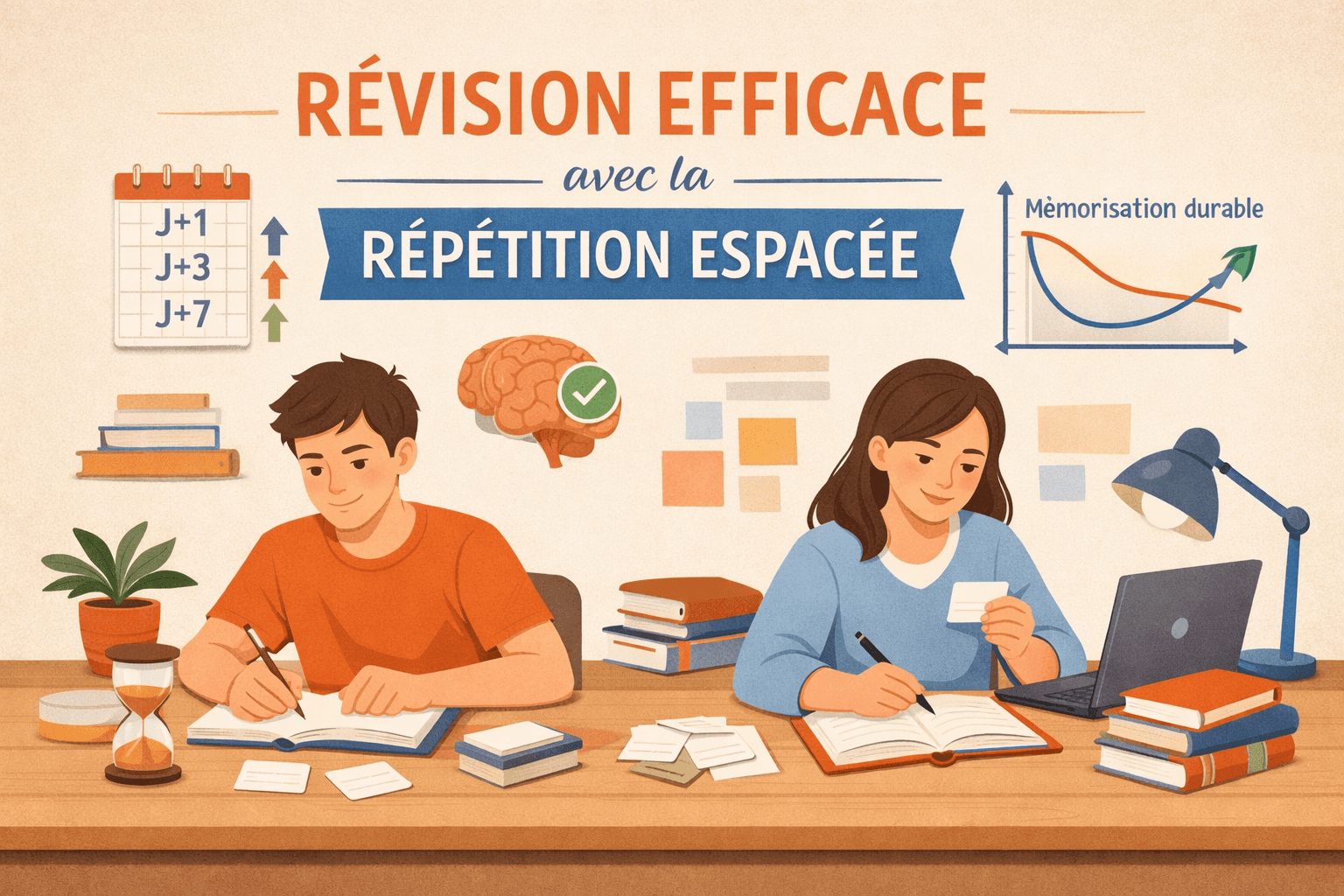
Spaced repetition is a memorization technique that consists of reviewing information several times, but by spacing the revisions over time, rather than reviewing everything at once.
👉 Instead of reviewing your course 5 times in the same day, you revise it:
once,
then at Day +1,
Day +3,
Day +7, etc.
🧠 Scientific origin
This spaced repetition method comes from the works of Hermann Ebbinghaus, a pioneer in cognitive psychology. It is now at the heart of memory science and many modern learning techniques.
❌ Traditional repetition vs ✅ spaced repetitions
Traditional repetition: passive re-reading, illusion of knowledge
Spaced repetitions: active, durable, and effective memorization
Result: you spend less time revising, but you retain much more.
The forgetting curve: why we forget (and how to avoid it)
The forgetting curve shows that our brain naturally forgets information if it does not reactivate it.
After 24 hours, a large part of an unrevised course is already forgotten.
Why?
Because the brain sorts information and deletes what it deems unnecessary.
✅ The solution
Spaced recalls send a clear signal to your brain:
“This information is important, keep it.”
Each recall strengthens the memory trace and improves long-term memorization.
This is exactly what allows you to study effectively before exams without mental overload.
Why spaced repetition is one of the most effective methods
Spaced repetition is considered the best revision method for students for several reasons:
✅ Concrete advantages
⏱️ Time-saving: you avoid unnecessary revisions
🧠 Durable memorization: ideal for midterms, competitions, exams
😌 Less stress: no more last-minute cramming
📚 Active learning rather than passive
❌ Cramming vs ✅ intelligent revisions
Cramming overloads your short-term memory.
Spaced repetition, on the other hand, builds a solid and durable memory.
Numerous studies in neuroscience confirm that this method used by neuroscience for learning is far more effective than simple re-reading.
How to apply spaced repetition in your revisions
🔹 A. Suitable materials
To optimize your revisions, favor active materials:
Flashcards
Revision quizzes
Questions and answers
Interactive quizzes
These formats require you to actively remember, which enhances learning.
🔹 B. The right timing for revisions
Here is a simple example of revision schedule:
Day 0: learning the course
Day 1: first revision
Day 3: second recall
Day 7: consolidation
Day 21: long-term memorization
👉 The more difficult a course is, the closer the recalls should be at the beginning.
🔹 C. The importance of active learning
Reading ≠ learning.
Testing yourself, making mistakes, answering questions... that’s the real active learning.
It’s also the best way to:
revise without cramming
avoid forgetting your courses
succeed in your university, preparatory school, or high school exams
Common mistakes to avoid
Even with spaced repetition, some mistakes can hinder your progress:
❌ Reviewing everything the night before
❌ Passively re-reading your notes
❌ Spacing too much or not enough
❌ Lacking consistency
The key is consistency and adapting to your student pace.
How digital tools facilitate spaced repetition
Managing spaced repetition manually can quickly become complicated.
That’s where intelligent revision apps make a difference.
✅ Advantages of digital tools
Automation of recalls
Tracking progress
Revise with interactive quizzes
Less mental load for students
Some apps go even further than simple flashcard apps and become real memory aid tools.
Focus tool – A modern aid to revise without stress
Today, there are revision apps for students that combine spaced repetition and artificial intelligence.
For example, some apps like Koro AI allow you to:
Import your courses (PDF, notes, slides)
Create revision notes automatically
Take quizzes to revise in a fun way
Receive motivating feedback after each session
The goal is not to replace your work, but to revise intelligently with a tool that adapts to you.
Concrete example: a week of revision with spaced repetition
🎓 Case: law undergraduate
Before
Intensive re-reading the night before
High stress
Frequent forgetfulness
After (with spaced repetitions)
Short quizzes every day
Planned revisions
Better understanding
More stable results
In one week, he goes from suffering through revisions to a real student work method.
Conclusion – Revise less, memorize more
Spaced repetition is not yet another miraculous technique, but an effective revision method, scientifically proven, that allows you to:
learn faster
better memorize your courses
pass your exams without exhausting yourself
If you really want to optimize your revisions, stop cramming and try a new way of learning.
Your brain (and your schedule) will thank you 😉