
Alternatives to glue boxes: how to revise effectively without cramming
Jan 4, 2026
Introduction
Glue boxes have become a reflex for many students. You highlight, you reread, you reread again… and yet, on exam day, blank.
If you have ever felt like you worked a lot without really retaining, you are not alone.
Good news: today there are alternatives to glue boxes that are much more effective, based on what we really know about learning. In this article, you will understand why glue boxes are reassuring but quickly show their limits, and especially how to study differently, more intelligently, and sustainably.
Glue boxes: why they are reassuring, but why they quickly show their limits
Glue boxes involve rereading your courses over and over again, often while highlighting or passively copying.
They give a sense of control: you see your course, you recognize the sentences, you tell yourself that “it’s getting through.”
The problem is that this method mainly relies on an illusion of mastery.
Why glue boxes are problematic
You are in a passive learning mode
Your brain recognizes the information without reconstructing it
You quickly forget what you have reread
You confuse “I recognize” with “I can recall”
Classic result: you know your course when you read it, but you struggle when you have to answer a question or write.
That’s why more and more students are looking to study without glue boxes, or at least not to make them their primary method.
What science says about learning (simply)
Without getting into jargon, research is clear on one point:
👉 Rereading is not an effective long-term study method.
Passive learning vs active learning
Passive learning: rereading, highlighting, copying without thinking
Active learning: asking questions, rephrasing, explaining, testing oneself
Studies show that students who use active recall retain better, longer, and with less stress.
In other words, to memorize your courses sustainably, you need to force your brain to work, not just recognize the information.
Effective alternatives to glue boxes
This is where everything changes. Here are effective study methods, concrete, applicable from today.
1. Smart flashcards
Making flashcards can be very useful, as long as you do it correctly.
A good study card:
synthesizes the key ideas
rephrases in your own words
structures the information
does not exceed the essentials
A bad card:
copies the course word for word
is too long
becomes a mini glue box
Effective flashcards serve to understand and structure, not to store the entire course.
2. Studying through questions and quizzes
This is one of the best alternatives to glue boxes.
Instead of rereading your course, turn it into questions:
What is…
Why…
How to explain…
What is the difference between…
Then try to answer without looking. Even if you make mistakes, your brain learns a lot.
👉 Testing oneself is much more effective than rereading.
This is exactly the principle that explains why studying with quizzes works so well, especially before exams.
3. Orally explaining
A simple method, often underestimated: explaining your course out loud.
You can:
explain it to yourself
pretend you are teaching
simulate an oral presentation
explain to someone else
If you struggle while explaining, it's because the concept is not yet clear.
It’s an excellent way to study intelligently and identify your weaknesses.
4. Spaced repetition
Reviewing everything at once is ineffective. The brain learns better with spaced reminders.
Simple principle:
review a concept the same day
then a few days later
then a week later
This method allows you to memorize your courses sustainably without spending more time on them.
It is a true alternative to last-minute cramming.
Modern tools to replace glue boxes
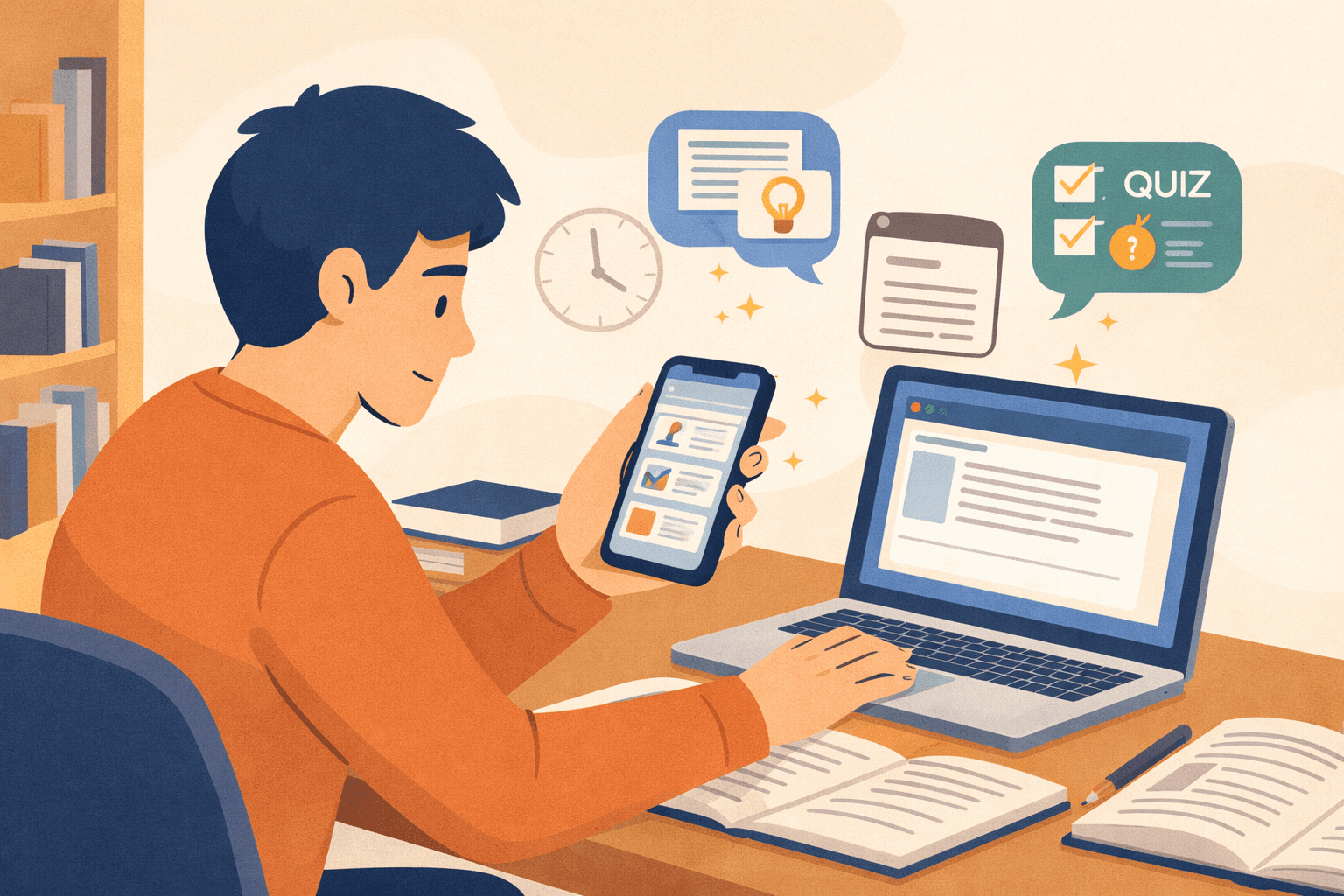
Today, digital tools can really help to study differently than with glue boxes, provided you use them correctly.
The idea is not to delegate your brain, but to:
save time
structure your studies
automate repetitive tasks
focus on understanding and active recall
An example of a useful tool
Some applications allow you to:
automatically transform your courses into study cards
generate quizzes from your content
study in a more fun and active way
This is notably the case with Koro AI, an application designed for students, which allows you to upload your courses and transform them into cards and quizzes.
The quizzes incorporate objectives to achieve and even a little funny comment at the end, which helps to maintain motivation without making studying childish.
This is obviously not a magic wand, but when used well, this type of tool can clearly replace traditional glue boxes.
How to choose the right method according to your student profile
There is not one perfect method for everyone.
If you are visual: clear cards + diagrams
If you lack time: quizzes and targeted questions
If you are stressed before exams: spaced repetition + regular tests
If you have trouble concentrating: short, active, fun formats
The mistake is to force a method that doesn't suit you.
The goal is to study effectively, not to follow a trend.
Conclusion
Glue boxes are not useless in themselves, but they are largely insufficient if you really want to learn.
They give the illusion of working, but do not guarantee understanding or memorization.
Today, the best alternatives rely on:
understanding
active recall
study through questions
explanation
regularity
If you want to stop using glue boxes and study intelligently, start by testing these methods. Keep the ones that work for you, and feel free to rely on modern tools when they help you save time without making you passive.