
Chunking: how to group information to remember 10 times more
Jan 5, 2026
Introduction
If you've ever felt like your brain overload after 20 minutes of studying, it’s not a lack of motivation. It’s a cognitive overload. Your brain simply doesn't know what to do with a dense block of information.
The good news is that there is a simple technique, derived from cognitive psychology, that has been used for decades to better memorize your lessons: chunking. When done correctly, it radically changes the way you learn, without studying longer.
What is chunking exactly?
Chunking is a memorization technique that involves grouping information into coherent blocks, called chunks, instead of learning them one by one.
Your brain does not process long lists well. However, it loves structure.
A simple example:
It is easier to remember 06 12 34 56 78 than 0612345678. The information is the same, but it is segmented.
In learning, it's exactly the same principle. You move from:
a confusing mass of information
toorganized and understandable blocks
This is what we call block memorization.
Why chunking really works
Chunking is not a guru trick. It is based on the biological limits of working memory.
Research by psychologist George Miller has shown that our working memory can handle about 7 items, plus or minus 2. No more.
When you study without structuring:
you exceed this capacity
your brain disengages
you have the illusion of understanding, but you forget quickly
Chunking works because it:
reduces the cognitive load
transforms several pieces of information into one logical unit
frees up mental space to understand and reason
As a result: you learn faster, and above all retain longer.
Chunking vs cramming: two opposing logics
Cramming involves piling up information.
Chunking involves organizing it.
Rereading a lesson in a loop gives a false impression of mastery. Your brain recognizes the sentences, but does not master them.
With chunking:
you identify the key ideas
you understand the connections between them
you build a solid mental structure
This is the difference between reciting and lasting understanding.
How to apply chunking concretely to your studies
1. Identify the key units of the course
Before wanting to memorize, ask yourself a simple question:
What is really important?
Look for:
the fundamental concepts
the mechanisms
the reasoning
the central definitions
Each unit becomes a future chunk.
2. Transform information into digestible blocks
A good chunk contains:
between 3 and 7 elements maximum
a clear title
an internal logic
For example, instead of an entire chapter, you get:
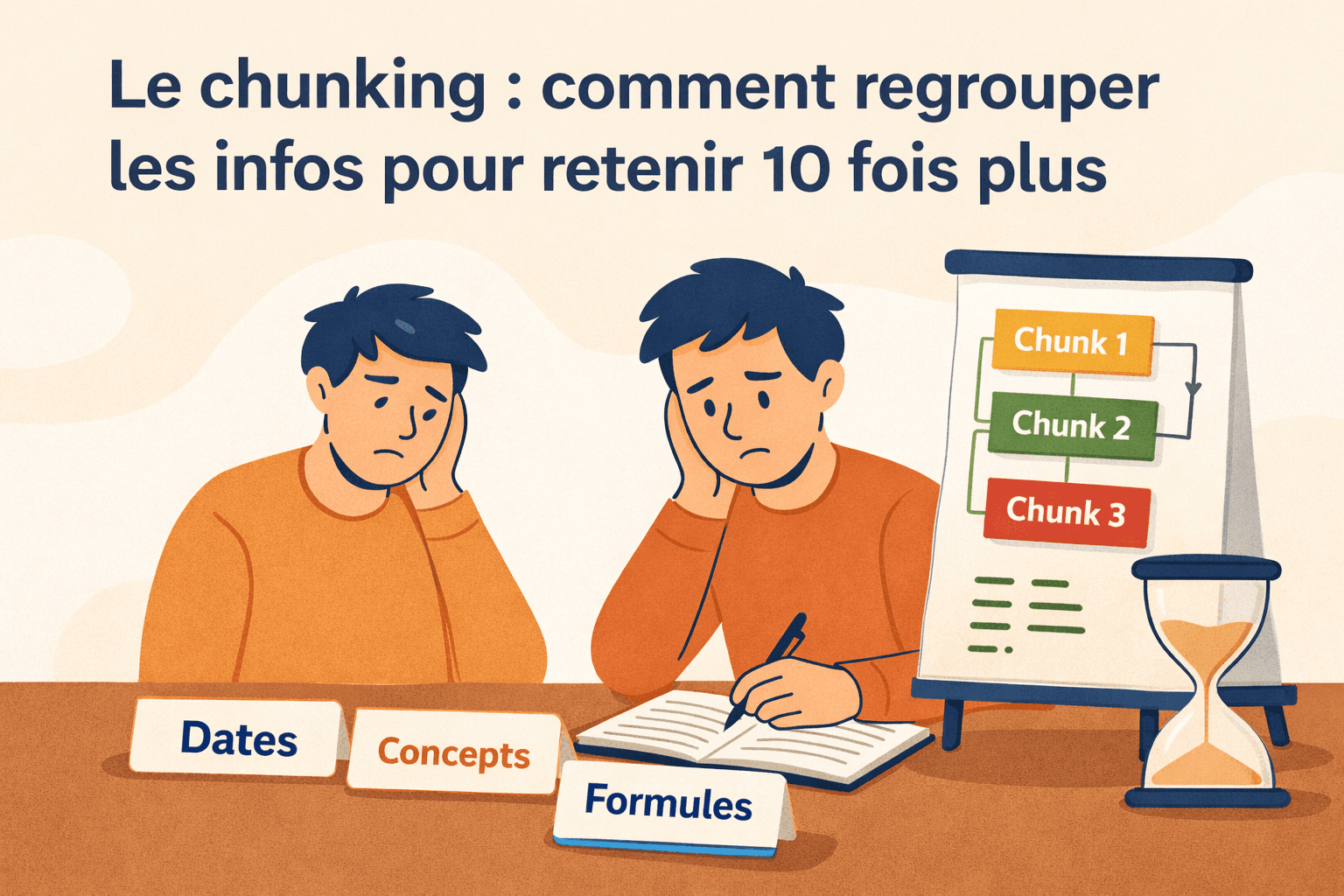
Chunk 1: definition
Chunk 2: mechanism
Chunk 3: consequences
Chunk 4: examples
You transform your lesson from confusing to readable for the brain.
3. Link the chunks together
Chunking is not about isolating, but about structuring.
Link your blocks with:
arrows
diagrams
logical links
questions
This is where learning becomes active.
Examples of chunking by field
In law
A ruling becomes:
facts
procedure
legal issue
solution
scope
In medicine
A chapter becomes:
cause
pathophysiological mechanism
symptoms
diagnosis
treatment
In commerce
A model becomes:
context
hypotheses
steps
indicators
limits
In literature
A movement becomes:
historical context
key authors
main ideas
major works
Same principle, different fields.
Classic mistakes to avoid with chunking
Making chunks too big
Chunking without understanding the substance
Multiplying blocks without logic
Confusing summary and structuring
A poorly done chunk overloads as much as a poorly organized course.
Chunking + quizzes + active recall: the winning combo
Chunking alone is powerful, but it becomes formidable when you add active recall.
The principle:
you study a chunk
you test yourself immediately on it
you identify what you truly master
Short block quizzes are ideal for this. They force your brain to retrieve the information, which strengthens long-term memory.
Integrate chunking into your daily student life
You can use it:
in lectures, to structure your notes
in revision, to transform a dense course
before exams, to review the essentials
in the long term, to avoid forgetting everything
Chunking is a learning skill, not a one-time technique.
A tool that naturally facilitates chunking
In practice, the hardest part about chunking is not the principle.
It’s the time required to structure a course correctly.
This is where tools like Koro AI can help, without replacing your brain.
Specifically:
you upload your course
the information is structured into clear blocks
you get revision notes and quizzes
each quiz forces you to use active recall
The playful aspect and feedback at the end of quizzes make revision more engaging, without turning it into a chore.
Conclusion
Chunking is not a miracle trick.
It’s an intelligent way to adapt your working method to how your brain actually functions.
You won't retain more because you study harder.
You will retain more because you organize better.
Start from your next class:
less information in bulk, more clear blocks, and a brain that can finally breathe.