
ECNi: how to make notes that are truly useful
Jan 23, 2026
Introduction
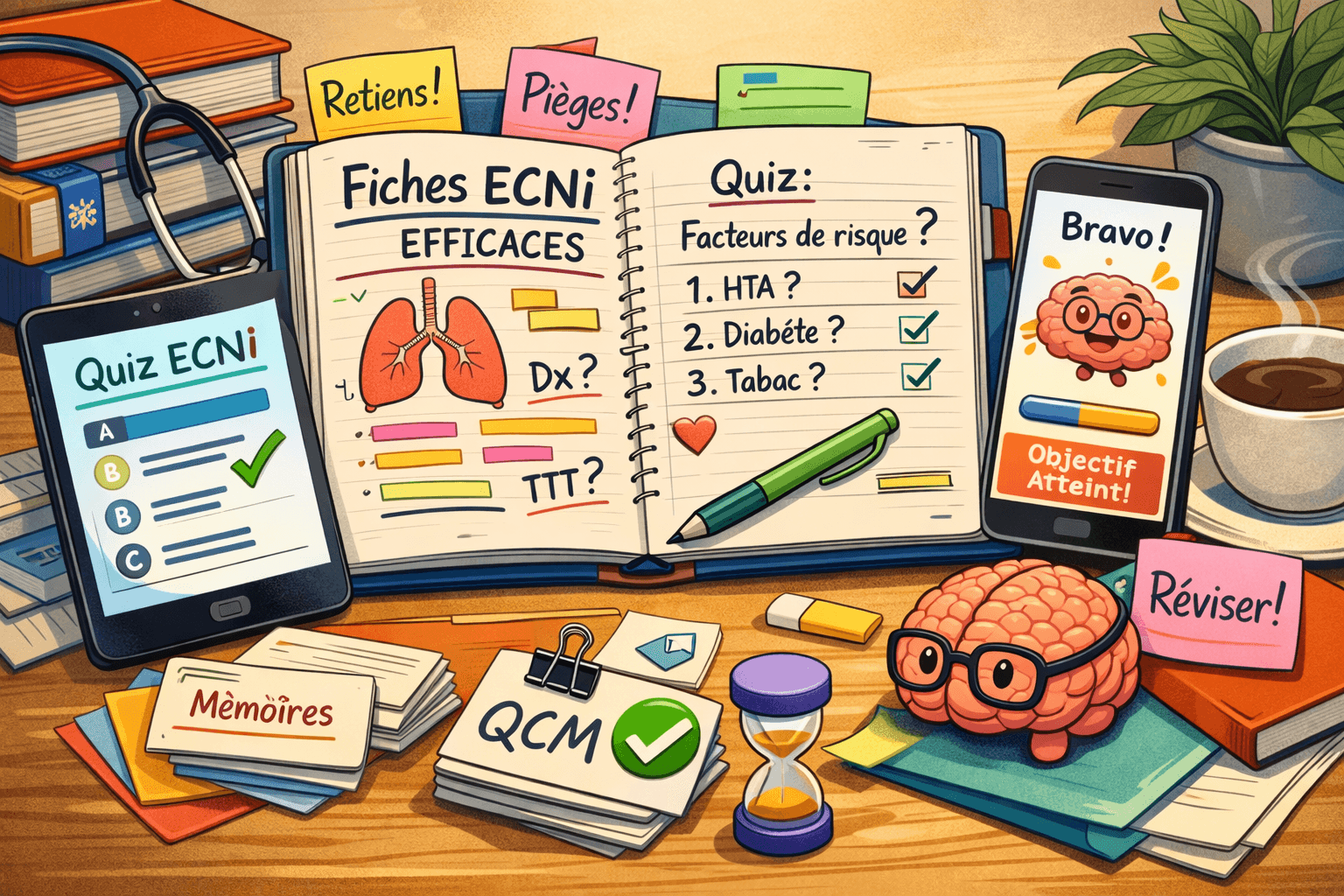
Making flashcards for medical exams is almost a reflex. Everyone does it. Yet, a large portion of medical students spends hours making flashcards… only to achieve a very disappointing result when it comes time to revise.
The problem is not your motivation. The issue is how flashcards are often used.
In this article, you will understand what a flashcard for medical exams actually serves, why many medical revision flashcards are ineffective, and most importantly how to make flashcards that really help you remember, revise, and perform well in medical exams.
The true role of a flashcard for medical exams (and what it shouldn’t be)
A flashcard for medical exams is not a course summary
First classic mistake.
Copying your course, rephrasing it nicely, or condensing it onto two pages is not enough. A flashcard is not meant to store information but to help you retrieve it.
If your flashcard is passively read, it does not help you learn. It simply gives you a false sense of mastery.
A flashcard for medical exams must serve one purpose
A good revision flashcard must fulfill at least one of these roles:
force you to reactivate information from memory
highlight the key points and traps for medical exams
help you test yourself, not reread
If your flashcard does not provoke any cognitive effort, it is ineffective.
Classic mistakes that make flashcards for medical exams useless
Overly long flashcards
Flashcards of 3 or 4 pages give a false impression of seriousness. In reality, they increase cognitive load and make medical revisions heavier and less effective.
The longer a flashcard is, the less often you will revise it. And in medical exams, what matters is repetition.
Overly neat and passive flashcards
Many students spend more time on formatting than on learning.
Colors, highlighting, pretty sentences… all of this is reassuring, but does not improve memorization for medical exams.
Such flashcards promote passive rereading, one of the worst learning methods.
Flashcards made at the wrong time
Making flashcards before understanding a course is a common mistake.
Making flashcards too late, when the program piles up, is just as much of a mistake.
The flashcard for medical exams must be created after understanding, but early enough to be reused several times during revisions.
The 5-step method to create effective flashcards for medical exams
Step 1: understand before making flashcards
Before creating a flashcard for medical exams, make sure you understand:
the pathophysiological mechanisms
the diagnostic logic
the connections between concepts
Without understanding, the flashcard becomes a simple disguised copy-and-paste.
Step 2: extract the essential compatible with medical exams
Not everything needs to be made into flashcards.
Focus on:
the concepts with a high probability of assessment
the classic pitfalls
the essential keywords
The goal is to create a summary flashcard for medical exams, not a duplicate handout.
Step 3: transform the flashcard into an active tool
A useful flashcard must force you to think. For example:
integrated questions in the flashcard
lists to complete from memory
mini quizzes for medical exams
This is the principle of active recall, one of the most effective methods for learning medicine.
Step 4: drastically reduce the size
A good rule:
one key idea per flashcard or per block.
The shorter your flashcard, the more often you will revise it. And the more you revise, the more you consolidate your medical knowledge.
Step 5: test the flashcard regularly
A flashcard for medical exams that is never tested is useless.
Use spaced repetition, revisit it at regular intervals, and measure what you really know.
Paper flashcards or digital flashcards for medical exams?
The limits of paper flashcards
Paper can help with initial understanding, but it quickly shows its limits:
difficult to update
not well suited for medical quizzes
no measure of progress
The advantages of well-used digital flashcards
Digital allows:
active revision
the integration of medical quizzes
clear organization
a considerable time savings in the long run
As long as you do not turn digital into simple passive reading.
How to save time without sacrificing the quality of flashcards for medical exams
Stop trying to do everything
In medical exams, 20% of the content accounts for a large part of the points.
Learn to prioritize:
what appears often
what makes a difference
what you regularly forget
Make reusable flashcards
A good flashcard for medical exams must serve you:
in the short term to understand
in the medium term to revise
in the long term to consolidate
If you only reuse it once, it is not cost-effective.
A tool to go further without reinventing the wheel
Certain tools today allow you to save time without sacrificing the method.
For example, Koro AI allows you to:
directly upload your medical courses
obtain structured and usable flashcards
transform these flashcards into medical quizzes
revise actively with clear and motivating goals
The idea is not to replace your thinking, but to transform your revision flashcards into true tools for active learning.
Conclusion: a good flashcard for medical exams does not reassure, it promotes progress
If your flashcards for medical exams reassure you but you forget quickly, the problem is clear.
An effective flashcard should put you slightly at risk, provoke effort, and force you to test yourself.
Fewer flashcards, better thought out.
Less rereading, more activation.
This approach truly makes the difference in medical exams.
If you want, I can now:
offer you a checklist of "good flashcard for medical exams" to integrate into the article
adjust the article specifically for medical exams 2026
or further optimize the text for pure SEO (tags, semantic variants, subheadings)