
PASS: how to succeed in multiple-choice questions (and stop getting caught out)
Jan 22, 2026
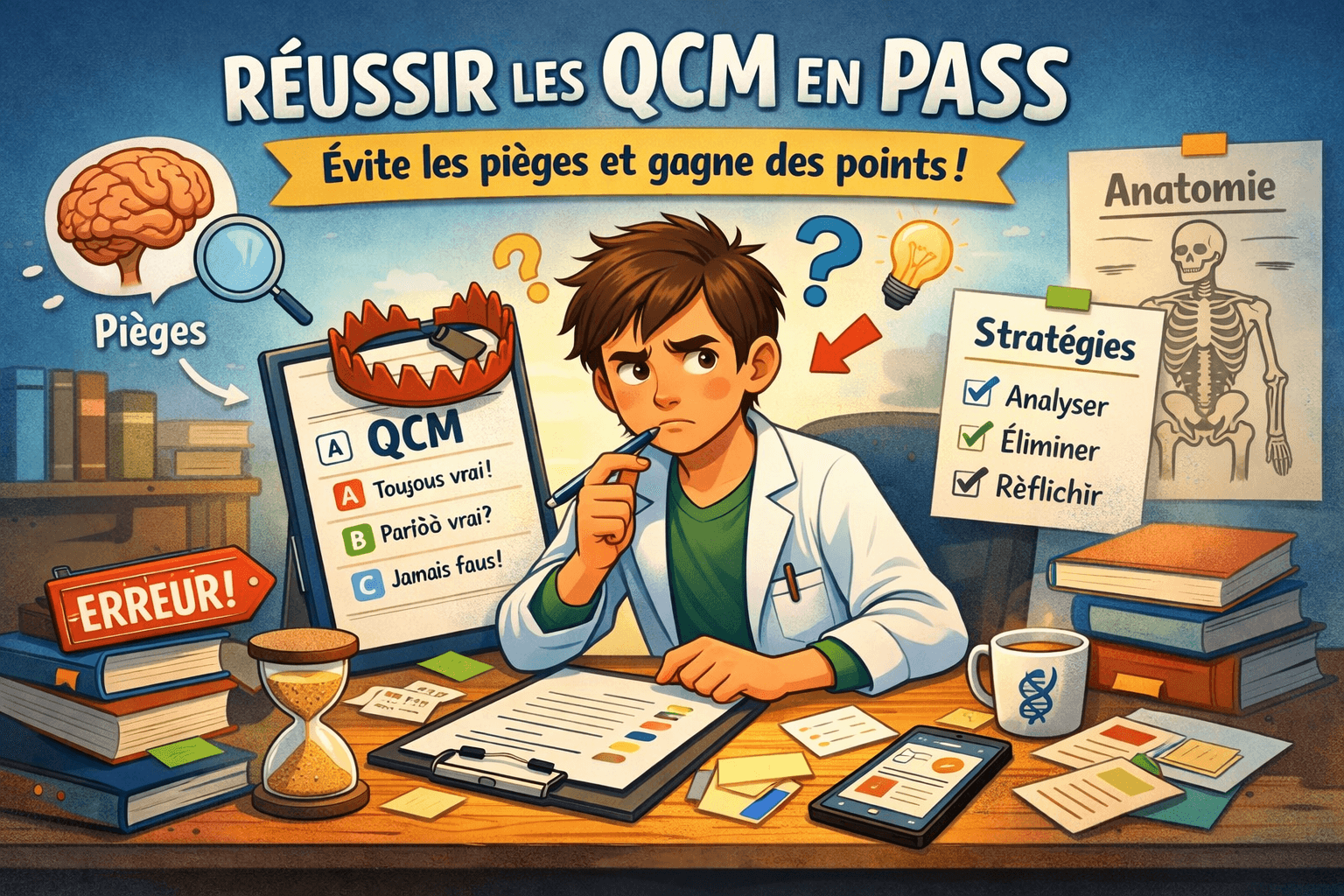
Introduction
If you are in PASS, you have already experienced it. You know your course, you have worked for hours, and yet the MCQs destroy you. Points lost foolishly, traps everywhere, the impression of being worthless even though you are working harder than ever.
Good news: the MCQs of PASS are a skill in their own right, and it can be learned. Bad news: reciting your course is not enough.
In this article, we will see how to succeed in the PASS MCQs, understand the logic of the examiner, avoid the most common PASS MCQ traps, and above all stop losing points unnecessarily.
I. Why the PASS MCQs are so tricky
1. What the MCQs really test (spoiler: not recall)
The PASS medical MCQs do not test if you can recite your notes. They test:
your deep understanding of the course
your ability to prioritize information
your logical reasoning
your ability to eliminate misleading options
That’s why many students say:
I know my course but I fail the MCQs
It’s not a lack of effort. It’s a poor training for PASS MCQs.
2. The common mistakes of PASS students
The frequent MCQ mistakes in PASS always come back:
too quick reading of the statement
overinterpretation of a detail
emotional response under PASS MCQ stress
confusion between a true detail and a correct answer
Result: stupid loss of points in MCQs, while the level is there.
II. Understanding the logic of the examiner
1. How the PASS MCQ traps are constructed
The medical MCQ traps are rarely blatant. They often feature:
false friends (similar but incorrect terms)
true statements but out of context
disguised absolutes (always, never, only)
The goal is not to trap you for nothing, but to check if you master precisely the framework of the course.
2. Why an almost true answer is often false
In PASS, an almost true answer is false.
The PASS anatomy MCQs, PASS physiology MCQs, or PASS biology MCQs require extreme rigor.
A mechanism may be true in one specific case but false in another. The examiner expects you to identify the necessary and sufficient conditions.
III. Step-by-step method for approaching a PASS MCQ
1. Read the statement like a lawyer
Before even looking at the options:
identify the keywords
identify what is actually being asked
pay attention to the time, context, and population studied
This step avoids a lot of PASS MCQ traps.
2. Process the options in the correct order
Effective method for progressing in PASS MCQs:
certainly true
certainly false
reasoned doubt
Never mix intuition and certainty. The PASS MCQ reasoning must remain cold.
3. When not to answer
Depending on the penalty, not answering can be strategic.
Answering randomly in PASS MCQs is rarely a good idea when doubt is total.
IV. The recurring traps to absolutely know
1. The dangerous words
Some words should immediately alert you:
always
never
only
systematically
In medicine, they are rarely correct.
2. The vocabulary traps
A scientifically incorrect term renders the entire statement false.
Deceptive synonyms are a classic weapon in the PASS medical MCQs.
3. The logic traps
Very common:
inversion of cause / consequence
abusive generalization
confusion of correlation / causation
This is where the medical MCQ technique makes the difference.
V. Effectively training for PASS MCQs (and truly improving)
1. Why doing 100 MCQs without analysis is useless
Doing series of PASS MCQs in a loop gives an illusion of productivity.
Without analysis, you repeat the same mistakes.
2. How to intelligently analyze your mistakes
After each PASS MCQ training, ask yourself:
is it a course error
a reasoning error
a reading error
a stress error
It’s this analysis that helps you progress, not the raw volume.
3. Transforming MCQs into a memorization tool
MCQs are a tool for active revision for PASS MCQs.
Explain each correction to yourself, rephrase, make the connection with the course. That’s how you truly consolidate.
VI. Focus method: using MCQs as a progress engine
Students who progress the most in PASS use MCQs as a learning tool, not just as a test.
Quizzes generated directly from your course, with immediate feedback, allow you to:
quickly identify your weaknesses
turn your mistakes into useful notes
keep clear and motivating goals
Some solutions like Koro AI go in this direction: you upload your course, you work via revision notes and quizzes, and each quiz gives you clear feedback, sometimes even with a light touch to maintain motivation. It’s not magic, but it’s consistent with a real working method for PASS.
Conclusion
Succeeding in PASS MCQs is neither a question of luck nor talent.
It is a method, targeted training, and a fine understanding of the logic of the exam.
Two students can know the same course. The one who understands the MCQs, time management for PASS MCQs, and the traps will make the difference.
You don’t lose points because you are worthless.
You lose them because you were never taught how to think in MCQs.