
Interleaving: alternating subjects instead of doing blocks.
Dec 23, 2025
Introduction
If you always study the same way, spending hours on a single subject, there’s a good chance you’re working a lot… to retain less than you think.
And no, the problem isn’t your motivation or your level.
The problem is the method.
Among the effective revision techniques validated by cognitive science, interleaving is one of the most powerful, yet one of the least used by students.
What is interleaving (simply)
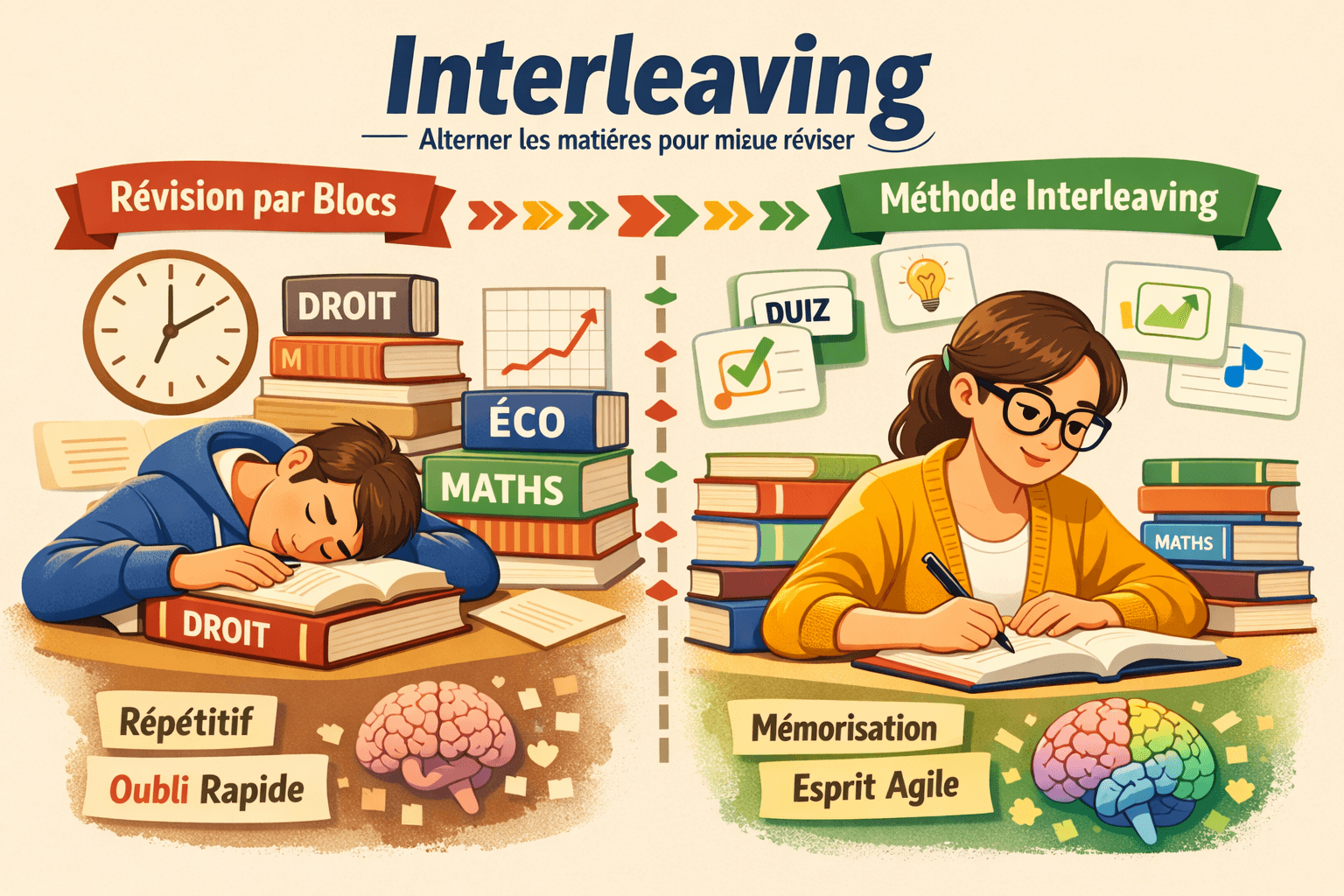
Interleaving, which can be translated as interleaved learning, involves alternating subjects or types of exercises, instead of working in large blocks.
Classic block revision example
3 hours of law
then 3 hours of economics
then 3 hours of math
Interleaving revision example
45 min of law
45 min of math
45 min of economics
then start the cycle again
You revise multiple subjects, but in an organized manner.
This is neither multitasking nor zapping.
Why our brain loves blocks (but is mistaken)
Block revision gives a feeling of fluidity.
Everything seems logical, simple, clear.
The problem is that this feeling creates an illusion of competence.
Your brain confuses:
ease
immediate understanding
real learning
Result: you feel like you have mastered your course… until the moment you have to recall it without support, several days later.
That’s why many students feel they are revising without retaining.
What science says about interleaving
Research in cognitive psychology and learning neuroscience is clear:
interleaving improves long-term memory and knowledge transfer.
Why?
Because your brain must:
identify the right method
make connections between concepts
adapt to a changing context
This extra effort promotes memory consolidation memory.
In other words:
less comfortable in the moment, much more effective over the long term.
Interleaving vs block revision
Block revision
Feeling of rapid progress
Fragile learning
High risk of forgetting
Poor exam adaptation
Interleaving
Feeling of controlled difficulty
Better memorization
Better retrieval of information
More stable performance on the exam day
However, be careful: so-called blocking can be useful at the very beginning to grasp a concept.
But for effective revision, interleaving is clearly superior.
How to apply interleaving practically
Here’s how to use interleaving to revise without complicating your life.
1. Alternate subjects
For example:
law
economics
statistics
Even in a short revision session.
2. Alternate formats
course reading
revision notes
quizzes
exercises
Interleaved learning works even better when you vary the approaches.
3. Plan cycles
A good student revision plan might look like this:
30 to 45 minutes per subject
short break
new cycle
It’s simple but extremely effective.
Common mistakes with interleaving
Many students think they are doing interleaving when they are doing something else.
Frequent mistakes:
switching subjects every 10 minutes
mixing without a clear goal
confusing interleaving and multitasking
never revisiting concepts
Interleaving is not chaos.
It’s a structured alternation.
Why interleaving helps in exams
In exams, no one tells you:
"Now, apply exactly what you saw for 3 hours yesterday".
You need to:
recognize the type of question
select the right method
mobilize the right information
This is exactly what interleaving trains.
That’s why it reduces:
gaps
panic
the feeling of knowing everything… except at the critical moment
Tools to facilitate interleaving
Let’s be honest: applying interleaving on your own takes organization.
Alternating:
can quickly become burdensome.
This is where tools like Koro AI can help, simply because they allow you to transform your own courses into notes and quizzes, and to naturally vary subjects without unnecessary mental effort.
The goal is not to work harder, but to work better.
What to remember
If you had to remember one thing:
👉 Effective does not mean comfortable.
Interleaving sometimes gives you the impression of working less well.
In reality, you are learning more deeply.
Test it over a week:
alternate the subjects
accept discomfort
observe your medium-term memory
Very often, the results speak for themselves.