
How to stop distractions
Dec 22, 2025
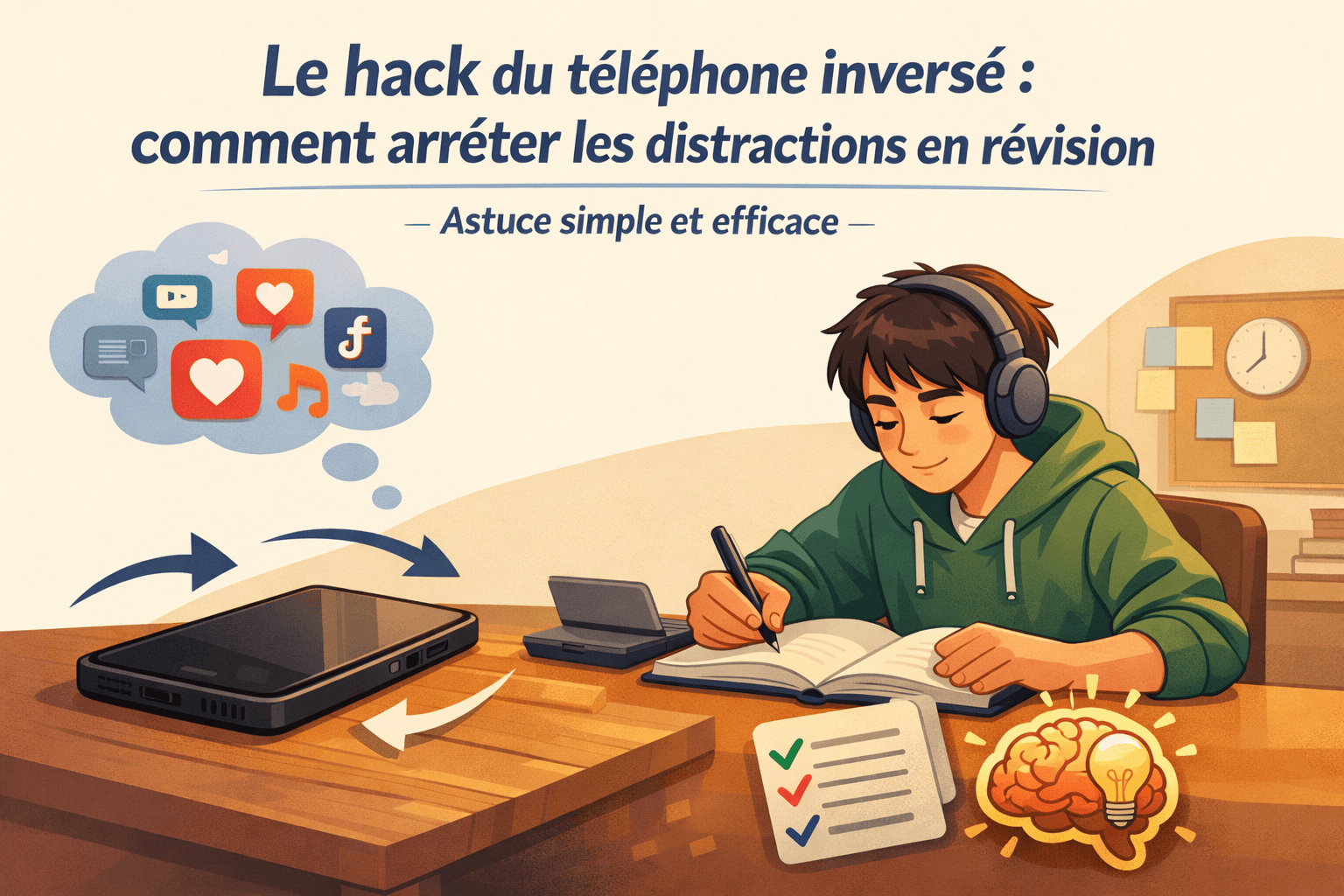
The Reverse Phone Hack (Simple, Effective, Proven)
If you’ve ever opened your phone “just to check the time” only to find yourself 15 minutes later on TikTok, don’t worry: the problem isn't with you.
The distraction caused by smartphones is a cognitive attention problem, not a motivation issue.
Good news: there is an ultra-simple hack, without apps, without extreme discipline, that you can apply during your next study session. We call it the reverse phone hack.
Why Your Phone Distracts You Even When You Aren't Using It
The Myth of “I’m Just Quickly Checking”
Your brain doesn't work in on/off mode.
As soon as your phone is visible, even silent, your attention is already partially engaged. You unconsciously anticipate a notification, a message, a reward.
Result:
your working memory is overloaded
your concentration decreases
you tire more quickly
The Invisible Cognitive Cost of Smartphones
The smartphone creates a permanent attention overload.
Even when placed on the table, screen visible, it captures a portion of your mental resources.
That’s exactly why:
you reread the same sentence multiple times
you lose track of what you’re learning
you feel like you’re working for a long time but poorly
Why Willpower Alone Isn’t Enough
Stopping distractions is not a question of mental strength.
Apps are designed to activate dopamine loops and capture your attention.
In other words: fighting solely with willpower is like playing a rigged game.
The Reverse Phone Hack Explained Simply
What the Hack Actually Entails
The principle is very simple:
put your phone face down on the table
the screen is no longer in your line of sight
ideally, the phone is not just under your hand
It may sound silly. However, the effect is real.
Why It Really Works
When the phone is flipped over:
the visual stimuli disappear
the anticipation of a notification decreases
you reduce the number of unnecessary micro-decisions
Your brain can finally focus on one thing.
What Studies Show About Phone Presence
Research in cognitive psychology indicates that:
a visible phone reduces performance
an invisible phone improves concentration
the simple presence is enough to create cognitive distraction
Even when off, a visible smartphone consumes attention.
How to Apply the Hack Correctly (Without Messing It Up)
Common Mistakes
Many students say they have tried, without results. Generally, they make one of these mistakes:
phone flipped but just next to the hand
screen flipped but notifications still active
phone flipped but screen that lights up
In these cases, the brain remains alert.
Optimal Version for Studying
For the reverse phone hack to really work:
phone face down on the table
real silent mode
sufficient distance to not be able to grab it mechanically
This is not a punishment. It’s a setting of your environment.
When It’s Not Enough
If your scrolling reflex is very strong, this hack may not be sufficient alone.
In this case, you especially need to change the way you study, not just remove the phone.
Amplifying the Effect of the Hack Without Extreme Discipline
Associating the Hack with a Ritual
Always perform the same gesture:
you get settled
you flip your phone
you start your session
Quickly, your brain associates this ritual with concentration mode.
Working in Short Blocks
Concentration is not meant to last for 3 hours straight.
blocks of 25 to 40 minutes
followed by an acknowledged break, phone included
Paradoxically, allowing the break reduces procrastination.
Rewarding the End of a Session
Your brain works on rewards.
Knowing a break is coming decreases the urge to constantly check your phone.
Studying Without Distractions in the Long Term
The Real Problem: Passive Revision
Reading a course or rereading notes fosters boredom.
And boredom calls for the smartphone.
That’s why:
you quickly lose focus
you waste time on your phone
you associate studying with frustration
Why Interactivity Reduces the Urge to Scroll
When you are active:
quizzes
active recall
questions
your brain is already stimulated.
It has less need to seek rewards elsewhere.
A Useful Parenthesis: When a Tool Can Help
If you struggle to study without distraction, it’s not necessarily the phone that’s the problem, but the way you work.
Transforming your courses into:
clear notes
interactive quizzes
concrete goals
significantly reduces the urge to scroll.
Tools like Koro AI actually allow you to automatically transform your courses into active resources, with quizzes, goals to achieve, and light and sometimes funny feedback at the end of a session.
The idea is not to add another app, but to make studying engaging enough so the phone loses its power.
Conclusion
Stopping distractions is not a matter of heroic discipline.
It’s a matter of environment.
The reverse phone hack works because it:
reduces cognitive overload
removes unnecessary stimuli
frees your attention
Try it in your next study session.
You’ll see that sometimes, just placing your phone differently is enough to change your effectiveness.