
Doomscrolling: why do you scroll without stopping and how to regain control when you are a student
Dec 21, 2025
Introduction
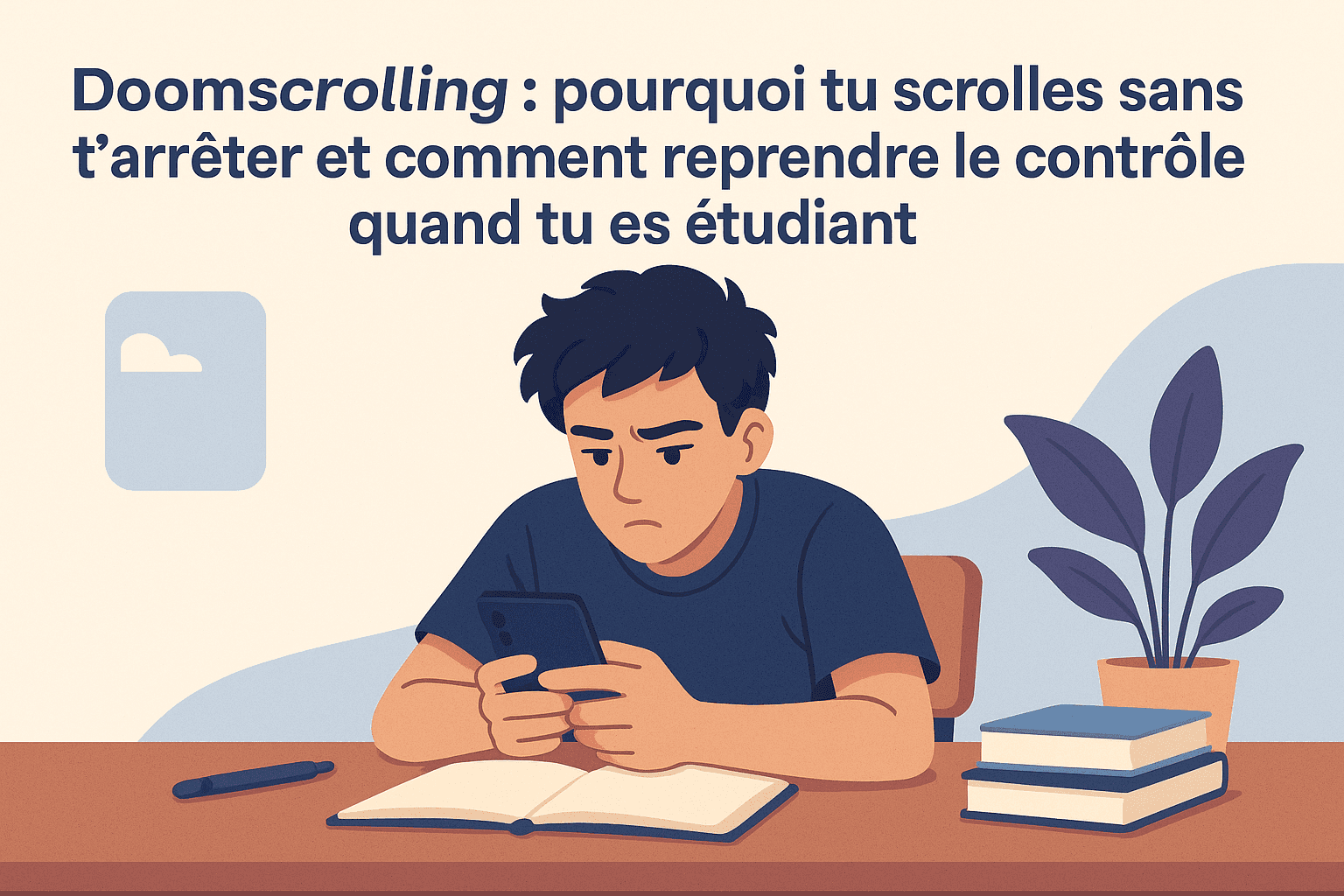
You open TikTok or Twitter "just 5 minutes" before studying.
A video becomes ten. Then twenty.
When you look up, an hour has passed, your brain is saturated and you still haven't started.
This phenomenon has a name: doomscrolling.
And no, it’s not a lack of will, nor a motivational problem. It’s a well-known mechanism of the brain, amplified by social media.
In this article, we will see what doomscrolling really is, why your brain loves it, why it wrecks your studies, and above all how to concretely reduce doomscrolling when you are a student, without forcing yourself or feeling guilty.
What exactly is doomscrolling
Doomscrolling is the act of endlessly scrolling through content on your phone, often automatically, even when that content brings nothing positive.
Originally, the term comes from the idea of consuming anxiety-inducing information continuously. Today, it mainly applies to endless scrolling on TikTok, Instagram, Twitter or YouTube Shorts.
The difference between scrolling and doomscrolling is simple:
scrolling = occasional and conscious use
doomscrolling = scrolling without intention, without limit, without even really watching
Among students, study doomscrolling has become a reflex, especially before or during a study session.
Why your brain loves to doomscroll
If doomscrolling is so powerful, it’s not by chance.
Dopamine and immediate gratification
Every new piece of content triggers a micro-release of dopamine.
Not enough to make you happy, but just enough to make you want to keep going.
Your brain loves it because:
the effort is nearly zero
the reward is immediate
the uncertainty of the next content reinforces the addiction
It’s exactly the same logic as slot machines.
The algorithms of social media
Platforms are built to maximize your student screen time.
The algorithm learns what catches your attention and keeps serving it to you on loop.
Result:
you never have a natural stopping point
your brain gets stuck in a reward loop
stopping becomes harder than continuing
The effects of doomscrolling on students
On concentration
Doomscrolling fragments your attention.
After scrolling, it becomes very difficult to stay focused for more than a few minutes.
This is one of the major causes of student loss of concentration.
On memory and learning
The brain has a limited capacity.
Doomscrolling creates an information overload that prevents:
the consolidation of information
long-term memorization
deep learning
In practical terms, you study more, but you retain less.
On stress and mental fatigue
Doomscrolling is strongly related to:
stress
anxiety
student mental fatigue
sleep disorders
Your brain never has time to settle. It moves from one stimulus to another continuously.
Doomscrolling and studies: why you waste more time than you think
The trap is believing that scrolling is a break.
In reality:
each interruption breaks your flow
it takes several minutes to regain good concentration
your brain remains partially occupied by what you’ve seen
Student doomscrolling turns 1-hour study sessions into 20 minutes of actual effectiveness.
How to concretely reduce doomscrolling when you are a student
Make scrolling less accessible
You don’t need to delete all your apps.
Often it’s enough to:
turn off non-essential notifications
put your phone out of visual range
work in an environment without temptation
The goal is not to fight against yourself but to modify the environment.
Give your brain an alternative
Your brain seeks quick rewards.
If studying is perceived as lengthy and blurry, it will always prefer to scroll.
What really helps:
clear micro-goals
short sessions
quick feedback
Make studying an engaging activity
Reading and re-reading your notes requires a huge effort for little reward.
In contrast:
quizzes
active questions
gamification
activate dopamine even more while reinforcing memory.
Tools and methods that truly help reduce scrolling
The science of learning is clear:
active methods are more effective than simple re-reading.
Quizzes, for example:
reinforce memory
provide immediate feedback
make studying less monotonous
It’s often this interactive dimension that helps reduce doomscrolling, as studying becomes more attractive than the phone.
When studying becomes more engaging than scrolling
Some tools rely precisely on these principles.
For example, platforms like Koro AI allow students to:
upload their notes
automatically generate study cards
practice with interactive quizzes
The idea is not to work more, but to work in a more engaging way.
Feedback, goals, and little end-of-quiz messages create a dynamic that captures attention without exhausting the brain.
This kind of approach works especially because it respects the brain's natural functioning, instead of fighting against it.
Conclusion
Doomscrolling is not a lack of discipline.
It’s the result of a brain exposed to extremely powerful reward loops.
If you really want to get out of it:
there's no need to force yourself or feel guilty
change your environment
change your way of studying
make learning more active than scrolling
Regaining control of your attention is not about removing your phone.
It’s about ensuring that your brain finds more interest in learning than in scrolling.