
Why do we forget when we are stressed?
Dec 20, 2025
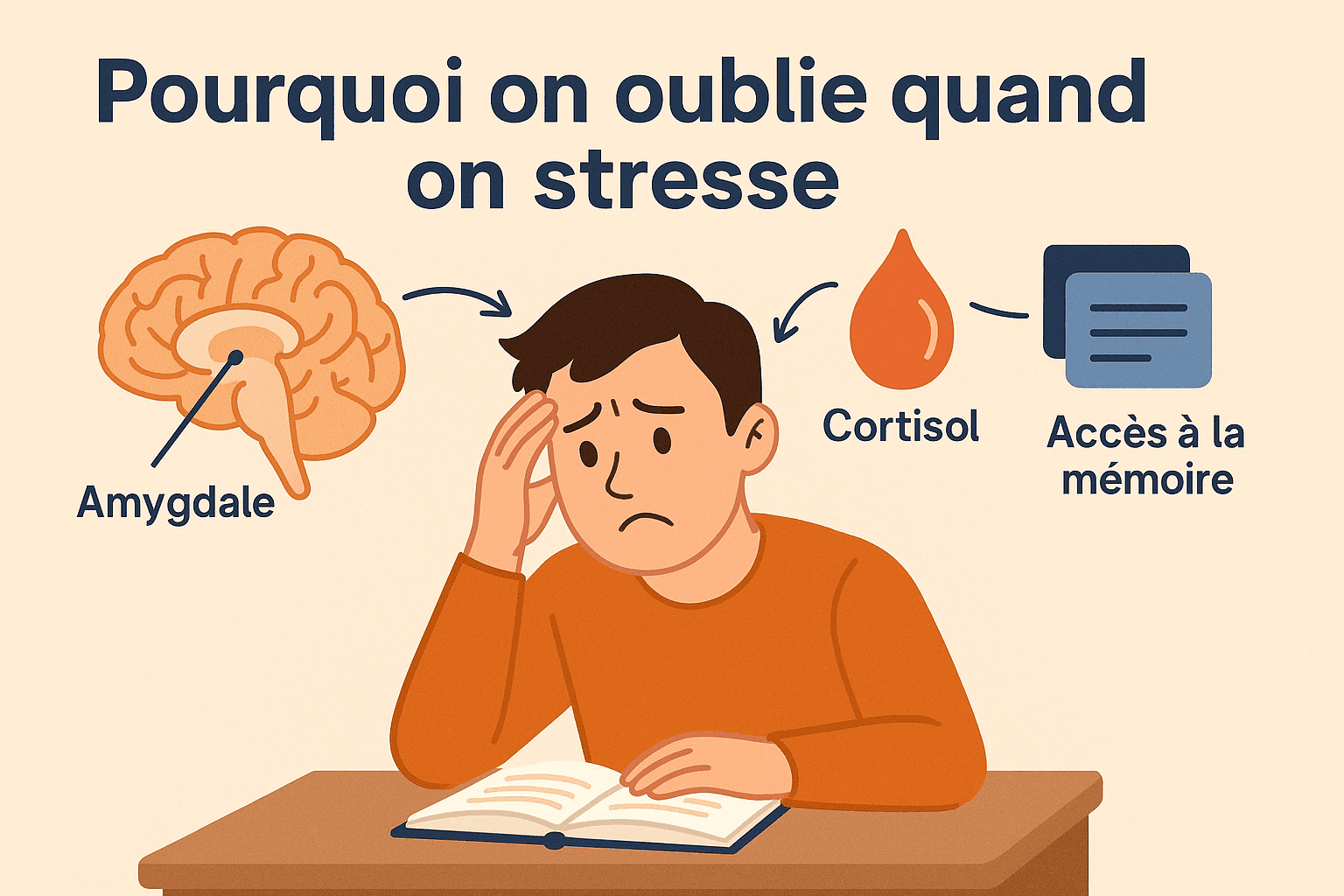
Amygdala, cortisol, and access to memory explained simply
You know your course. You revised it. You reread it.
And yet, on the day of the exam, it's a total blackout.
Impossible to recall a definition that seemed obvious.
Impossible to chain together a reasoning that you had no problem with the day before.
It's not that you didn’t work.
It's not a lack of intelligence or method either.
It’s your brain under stress.
Understanding why stress blocks memory is one of the most important keys to better succeed in your exams. And good news: this mechanism is well known in neuroscience.
1. What stress really does to your brain
Useful stress vs paralyzing stress
An important point from the start: stress is not always bad.
Moderate stress can enhance vigilance, concentration, and even performance. It allows you to be alert before a partial exam or an oral test.
The problem starts when stress becomes too intense.
We then talk about cognitive stress, which invades your brain, saturates your attention, and prevents access to memory. This is the type of stress that many students experience during exams.
The amygdala: the brain's alarm button
The brain's amygdala is a small structure located deep within your brain. Its role is simple: to detect danger.
When the amygdala perceives a threat, it triggers an immediate reaction. The problem is that it doesn’t distinguish between:
a real danger
an important exam
the fear of failure
social pressure
For your brain, a partial exam can be interpreted as a threat.
Result: the amygdala takes control.
And when the amygdala is in charge, the priority is no longer to access your memories, but to survive.
2. Cortisol and memory: why access is blocked
Cortisol, the key stress hormone
When the amygdala activates, it triggers the stress axis (called the HPA axis). This causes the release of cortisol, the stress hormone.
In small doses, cortisol is useful.
In high doses, it becomes a problem for learning and memory.
For students, acute stress before an exam often leads to a spike in cortisol.
The impact of cortisol on the hippocampus
The hippocampus is an essential structure for:
long-term memory
the consolidation of memories
the recall of information
However, the hippocampus is extremely sensitive to cortisol.
When cortisol levels are too high:
memory access is disrupted
the recall of information becomes difficult
memory seems "empty"
Important to understand:
the memory is not erased. It is simply inaccessible.
That's why many students say after the exam:
"But I knew it, though."
3. Why you experience memory lapses during exams
Overloaded working memory
Under stress, your working memory is overloaded.
Working memory is what allows you to:
think
make connections
solve problems
organize your ideas
When you are stressed, a large part of this memory is monopolized by:
anxiety
intrusive thoughts
the fear of failure
Result: there aren’t enough mental resources left to properly access your knowledge.
Blocked access, not erased knowledge
This is an essential distinction.
Stress doesn’t erase your lessons.
It blocks access to memory.
That’s why:
the memory may come back later
you might answer a question correctly… once you leave the room
you perform better in mock exams than in the actual exam
It’s not a capability issue, but a physiological context issue.
4. Chronic stress: a real poison for learning
When stress becomes permanent
Stress before an exam is one thing.
Chronic stress is another.
Many students experience:
continuous pressure during revisions
constant fear of not being up to par
comparison with others
guilt for never doing enough
This prolonged stress keeps cortisol levels elevated over time.
Long-term effects on memory
Chronic stress has well-documented effects on the brain:
less effective memory consolidation
slower learning
persistent mental fatigue
loss of confidence in one's abilities
In other words, the longer you are stressed, the more difficult it becomes to learn effectively.
It’s a vicious cycle experienced by many students.
5. How to limit the impact of stress on your memory
Revise to reduce uncertainty
The brain gets stressed mainly when it doesn’t feel prepared.
Passive revision methods like simple rereading give an illusion of mastery but do not truly reassure the brain.
In contrast, active recall (testing yourself, doing quizzes, recalling without notes) greatly reduces uncertainty. And therefore stress.
Simple techniques validated by science
Here’s what really works:
slow breathing to activate the parasympathetic system
active repetition rather than rereading
exam simulations to acclimatize the amygdala
spaced revisions to consolidate memory
These techniques do not eliminate stress, but they prevent it from blocking access to memory.
6. A word about organizing revisions
A large part of student stress comes from mental load.
When your courses are poorly structured, scattered, or difficult to utilize, your brain perceives an additional threat.
Tools that quickly transform a course into clear notes and quizzes can help to:
structure information
test yourself regularly
visualize your progress
reduce anxiety related to uncertainty
It is in this logic that applications like Koro AI are used by some students to alleviate mental load during revisions, without replacing personal work.
Conclusion
If you have ever experienced memory lapses under stress, it's not a personal flaw.
It’s a normal reaction of your brain.
The amygdala, cortisol, and hippocampus play a central role in your ability to access what you know. Understanding these mechanisms allows you to adapt your revision methods and better manage pressure.
Less stress doesn’t mean less demand.
It simply means better access to your own abilities.
And often, you already know much more than you think.