
The SQ3R method (Survey, Question, Read, Recite, Review) in ultra-short version
Dec 19, 2025
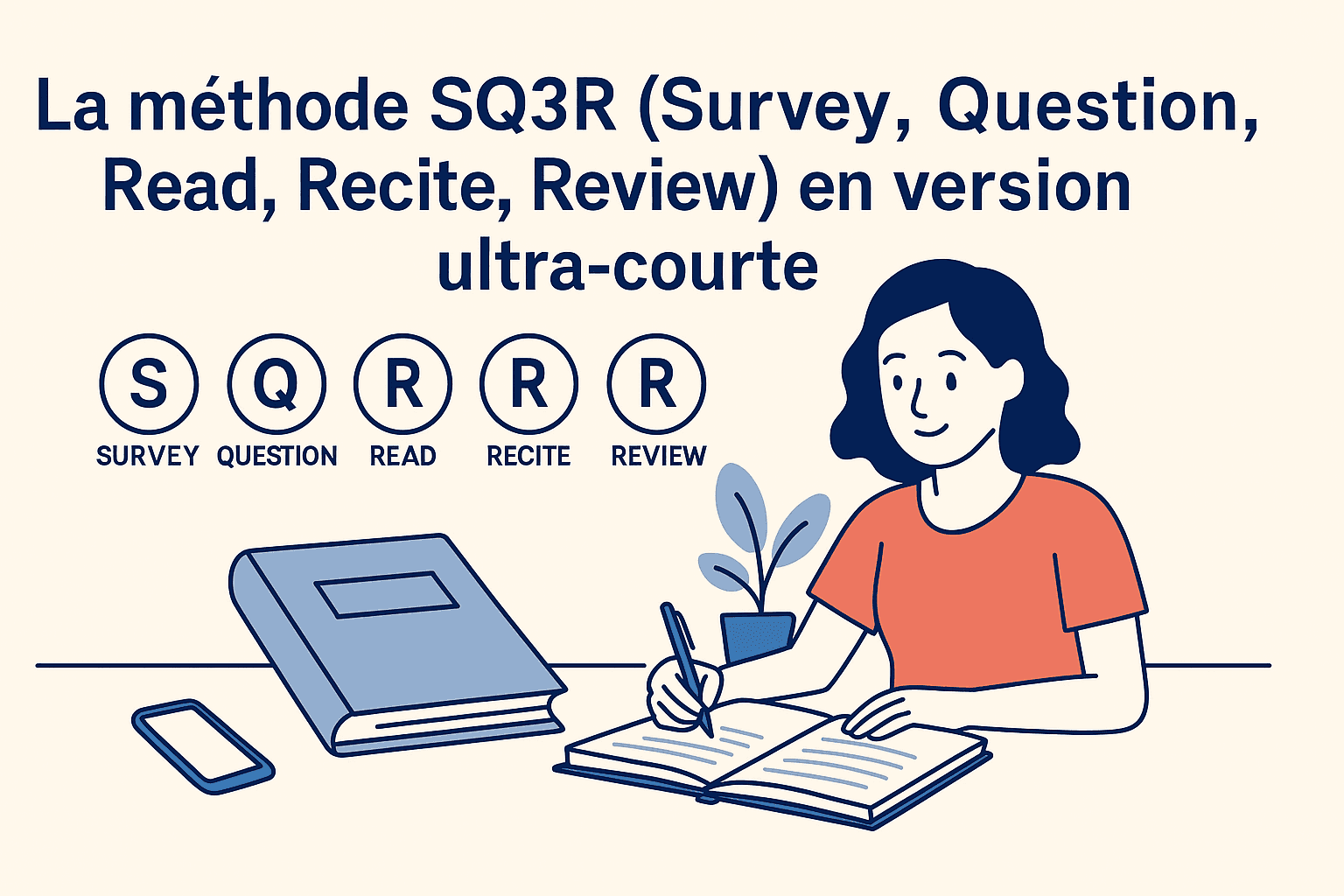
1. Survey: survey smartly
Before reading, you observe.
Titles and subtitles
Bold words
Diagrams, tables
Introduction and conclusion
Objective: understand the structure of the course, not the details.
Recommended time: 2 to 5 minutes maximum.
Classic mistake: reading everything at this stage.
2. Question: turn the course into questions
Each title becomes a question.
Examples:
"Definition of the contract" → What is a contract?
"The causes of inflammation" → What are the causes of inflammation?
This step is essential. It transforms your brain from a passive reader into a seeker of answers.
It’s one of the most powerful levers to learn faster.
3. Read: read to answer, not to highlight
You read now, but with a clear objective: to answer the questions.
You read in short blocks
You stop as soon as you have an answer
You avoid excessive highlighting
If you read without a question in mind, you consume information.
If you read to answer, you learn.
4. Recite: reproduce without looking
Uncomfortable step. Most effective step.
You close your course and you explain:
out loud
or in writing
or as if you were teaching it to someone
If you get stuck, it’s uncontrolled information.
And that’s exactly what your brain needs to identify.
It’s the heart of active recall, essential for lasting memorization.
5. Review: review smartly
You go back over the content:
a few hours later
then a few days after
Not to re-read everything, but to:
do a quick recall
check weak points
consolidate memory
It’s this step that transfers information from working memory to long-term memory.
Concrete example of application on a course
Let’s take a classic chapter from college.
Before SQ3R
Linear reading
1 hour 30 minutes spent
Illusion of understanding
With SQ3R
10 minutes of Survey + Question
Targeted reading
Immediate recall
45 minutes, but with usable real memories
Result: less time, more clarity, and especially less stress before the exam.
Common mistakes with the SQ3R method
Trying to be too perfectionist
Spending too much time on the Survey
Skipping the Recite step because it’s difficult
Confusing revision with passive re-reading
SQ3R is not magic. It’s a framework. It works if you agree to make your brain work.
Adapting SQ3R to your daily student life
When you are in a hurry: Survey + Question + quick Recite
Before a midterm: Targeted Review on key questions
Large volume of courses: SQ3R by chapter, not by subject
In a group: each person reproduces a part
The SQ3R method is flexible. It adapts to your pace, not the other way around.
Modern tools to apply SQ3R more easily
The main barrier to SQ3R is the structure:
creating questions, testing recall, organizing reviews.
That’s why some students today use tools that can:
transform a course into revision notes
generate quizzes for active recall
facilitate review without re-reading all the content
For example, Koro AI fits into this logic. You add your course, and the tool helps you apply the principles of SQ3R through notes and quizzes, with a playful dimension and objectives to keep motivation high.
It’s not the method that changes. It’s the ease of applying it.
Conclusion
If you were to remember one thing:
learning is not re-reading.
The SQ3R method gives you a simple, effective, and scientifically sound framework to:
memorize faster
truly understand
stop wasting unnecessary hours
Test it on your next course. Often one time is enough to never go back.