
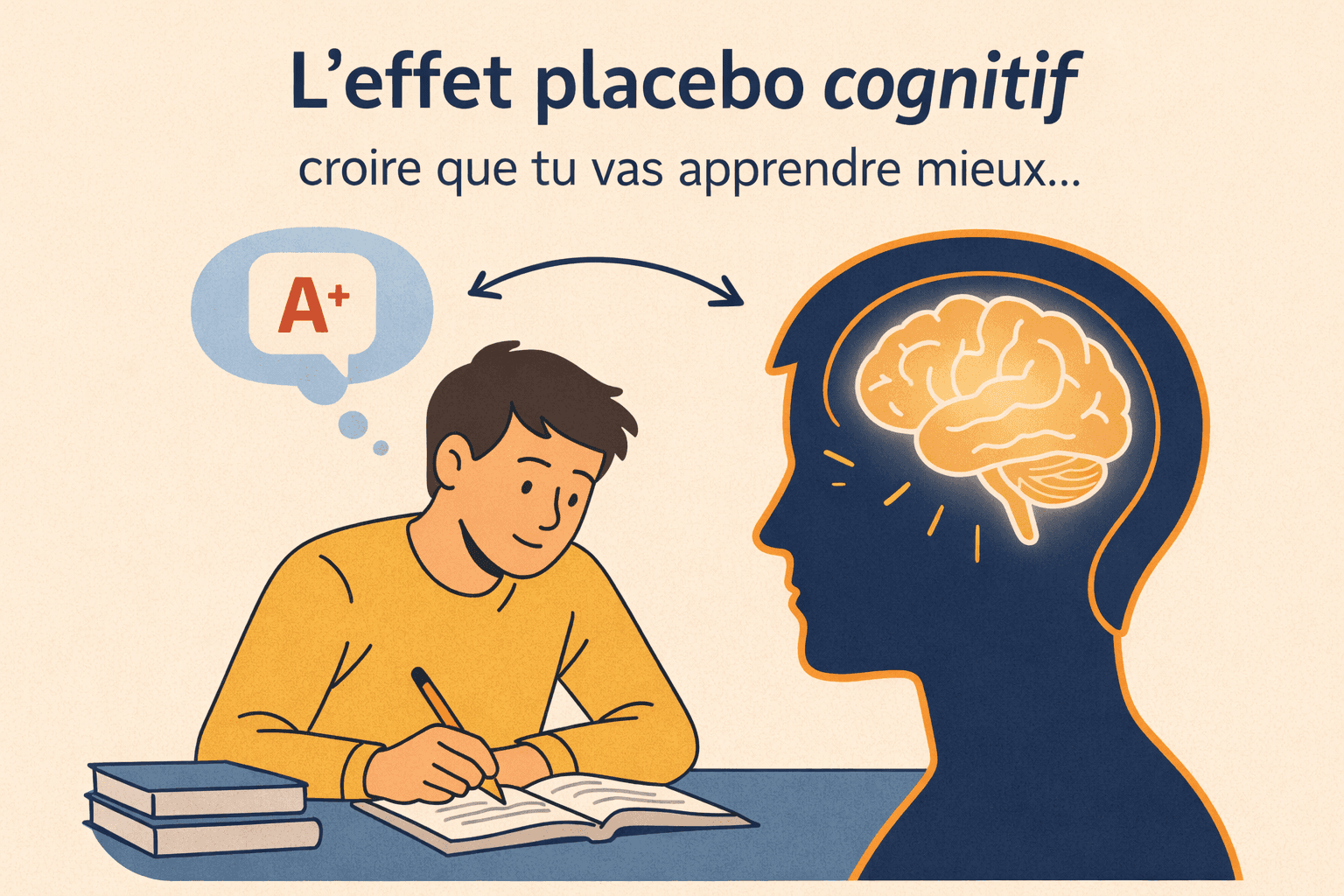
The cognitive placebo effect: believing that you will learn better... actually makes you learn better.
Jan 4, 2026
Introduction
You have surely already noticed this strange phenomenon.
Two students work the same number of hours, using similar methods, and yet their results are very different. One progresses quickly, while the other feels stuck. This is often attributed to intelligence, luck, or talent. In reality, there is a much more discreet, yet remarkably powerful factor: belief.
This is where the cognitive placebo effect comes into play. Simply believing that you learn better can actually enhance your learning, memory, and academic performance.
And no, this is not vague personal development. This is cognitive psychology.
The placebo effect, brain version
At its core, the placebo effect is well-known in medicine. A patient takes a fake medication, but their brain expects a positive effect. The result: real, measurable improvements.
In learning, the mechanism is very similar.
We then talk about cognitive placebo or learning placebo.
When you believe that:
your method is effective
your tool works
you are capable of understanding
your brain adjusts its behavior accordingly. More stable attention, reduced stress, better involvement. You are not pretending to learn better. You are truly learning better.
Why believing that you learn better actually makes you learn better
Your brain does not function like a neutral machine. It is constantly influenced by your expectations.
1. More concentration
If you think that your work session is going to be productive, your brain filters out distractions better. You more easily enter a focused state.
2. Less stress, therefore better memory
Stress blocks access to memory. Conversely, a positive belief reduces mental pressure. The result: information is encoded more easily and recalled better during exams.
3. More perseverance
When you believe that you are making progress, you give up less quickly. You handle difficulty better. Learning always involves a phase of discomfort.
This is exactly why self-confidence and academic success are also linked.
What studies in cognitive psychology say
Learning psychology heavily relies on the concept of self-efficacy. This is the belief in your ability to successfully accomplish a given task.
Research shows that:
students with high self-efficacy learn more effectively
they memorize better with equal effort
they achieve better academic performance
However, there is an important nuance to consider.
Believing that you learn better does not replace work. This is not a magical illusion. It is an amplifier. A good belief without method is not enough. But a correct method reinforced by a positive belief becomes much more effective.
Common mistakes among students
Confusing cognitive placebo with a miracle method
No belief will allow you to learn a course without working on it. The cognitive placebo effect acts on motivation, attention, and perseverance, not on the content itself.
Mentally sabotaging
Statements like:
“I’m terrible at this subject”
“I have no memory”
“I’ve never passed the exams”
are not facts. They are mental constructs that sabotage your learning.
Thinking that difficulty is a failure
If you believe that understanding things slowly means you are bad, you reinforce a negative cycle. In reality, difficulty is often a sign that your brain is learning.
How to intelligently use the cognitive placebo effect
Good news: you can intentionally provoke this effect.
Creating credible rituals
A stable environment, a clear routine, a specific time to study. Your brain associates these signals with an effective work state.
Providing visible evidence to your brain
Seeing your progress is fundamental. Checking off goals, succeeding in quizzes, noticing improvement strengthens the belief that you are learning better.
Setting achievable goals
Small clear goals are better than a large vague goal. Each success fuels motivation and memorization.
Transforming revision into a positive experience
The more engaging the experience, the more your brain accepts the effort. Enjoyment is not a luxury; it is a cognitive lever.
Concrete example in revisions
Let’s take a very simple case.
A student studies by passively reading their courses for two hours. They have no immediate feedback. They doubt. They wonder if it is worth anything.
In contrast, another student uses a method where:
they turn their notes into clear flashcards
they test themselves with quizzes
they receive immediate feedback
they set specific goals
The second student not only learns better technically, but they believe they are learning better. And this belief actually reinforces their results.
This is exactly the type of mechanism found in tools like Koro AI, which allow you to upload your courses, turn them into flashcards and quizzes, with immediate feedback, goals to achieve, and even a bit of humor at the end of quizzes. The idea is not magic, but the combination of method, feedback, and positive belief.
Conclusion
The cognitive placebo effect is not an illusion.
It is a real lever of cognitive psychology and academic performance.
If you combine:
a clear method
a reassuring environment
visible feedback
and the belief that you can progress
you optimize your learning without necessarily working longer.
Learning better is not just a matter of quantity.
It is also a matter of perception, confidence, and how you train your brain.
And that, good news, can be worked on.