
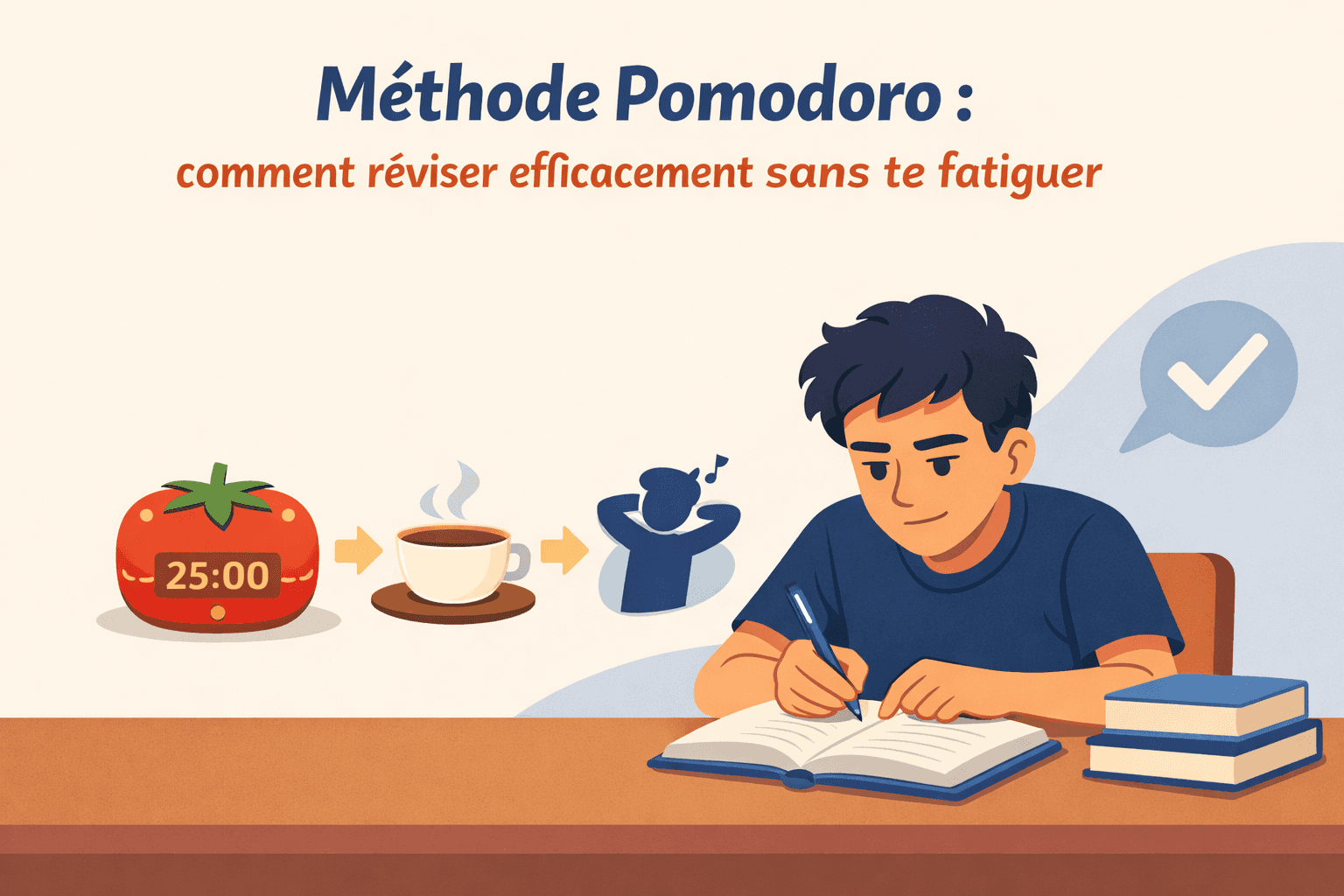
Pomodoro Method: how to study effectively without exhausting yourself
Dec 25, 2025
Introduction
You spend hours studying, but you end up exhausted, distracted, and feeling like you remember nothing. You're not alone. Many students confuse time spent working with quality of concentration.
The Pomodoro method exists precisely to break this illusion of productivity and help you work better, not longer.
In this article, you will understand how to use the Pomodoro method, why it really works on the brain, how to adapt it for revision and exams, and most importantly, how to avoid classic mistakes.
What is the Pomodoro method
The Pomodoro method, also called Pomodoro technique, is based on a simple idea:
You work for 25 minutes
You take a short break
You start again
After several cycles, you take a longer break
A 25-minute cycle is called a Pomodoro.
The goal is not to make you work more, but to maximize your concentration for short, intense periods.
This method is particularly suited for university studies, for revision, and any intellectual work that requires focus.
Why the Pomodoro method works on the brain
Your brain is not built to stay focused for hours. Attention is a limited resource.
When you work too long without a break:
your concentration drops
cognitive fatigue sets in
you read without understanding
you reread without memorizing
The Pomodoro method takes advantage of a key mechanism:
short cycles allow you to remain attentive without exhausting your brain.
Breaks are not wasted time. They help to:
reduce mental load
maintain motivation
improve long-term learning
That's why Pomodoro is effective for concentration, student productivity and combating procrastination.
How to use the Pomodoro method step by step
Here’s how to implement the Pomodoro method step by step, simply.
Choose a clear task
Not “revise law,” but “learn the chapter on civil liability.”Start a 25-minute Pomodoro
Set a timer. One task only. Zero distractions.Work without interruption
No phone, no unnecessary tabs, no multitasking.Stop when the timer goes off
Even if you are “almost done.” This is important.Take a real break
5 minutes to move, breathe, stretch. No infinite scrolling.After 4 Pomodoros, take a longer break
15 to 30 minutes to truly recover.
Adapting the Pomodoro method for revision
The Pomodoro method for effective revision works even better if you adapt it to what you are doing.
Pomodoro for learning a subject
1 Pomodoro to understand the subject
1 Pomodoro to rephrase in your own words
1 Pomodoro to test your memory
Pomodoro for making notes
Beware of the trap. Making notes is not learning.
Use Pomodoro to:
structure the essentials
actively rephrase
avoid passive copying
Pomodoro for practicing
Ideal for:
quizzes
exercises
past exam papers
This is often where the Pomodoro method for exams becomes most effective.
Common mistakes with the Pomodoro method
Many students say that Pomodoro doesn’t work, when they are using it incorrectly.
Classic mistakes:
looking at your phone during the 25 minutes
taking breaks that are too long
multiplying tasks within a single Pomodoro
using Pomodoro for mechanical tasks without reflection
believing that Pomodoro alone is enough to learn
The Pomodoro technique is a framework. Not a magic solution.
Pomodoro alone is not enough (and that's okay)
Working is not learning.
You can do 10 Pomodoros rereading your course without retaining anything.
The Pomodoro method improves your work time, but not automatically your memory.
That’s why it must be combined with active methods:
active recall
quizzes
self-assessment
spaced repetition
How to combine Pomodoro with effective revision methods
Here’s a simple and powerful combination:
1 Pomodoro of active reading
1 Pomodoro of rephrasing
1 Pomodoro of quiz or questions without support
This approach transforms Pomodoro into an learning tool, not just a time management tool.
This is where Pomodoro becomes truly useful for intensive revision and sustainable learning.
Useful tools for applying the Pomodoro method
You can use:
a simple timer
a focus app
or tools that directly structure your revision sessions
For example, platforms like Koro AI allow you to transform your courses into notes and quizzes, which fit very naturally into Pomodoro sessions oriented towards active recall. The idea is not the tool itself but the fact of working actively during each Pomodoro.
A concrete example of a revision session with Pomodoro
A classic scenario before an exam:
Pomodoro 1: understanding the chapter
Pomodoro 2: ultra summary notes
Pomodoro 3: quiz without looking at the course
Long break
Pomodoro 4: corrections and weak points
Result:
less fatigue
more concentration
better memorization
feeling of control
Conclusion
The Pomodoro method is an excellent tool for:
improving your concentration
fighting against procrastination
structuring your revisions
But it’s not a magic wand.
It works when you use it as a framework, combined with active learning techniques.
Try it for a few days. Adjust the times. Observe what works for you.
Revising effectively does not mean working longer. It means working smarter.