
The Dual Coding Method: why drawing + writing doubles memorization.
Dec 24, 2025
Introduction
If you have ever spent hours rereading your class notes, highlighting entire pages, and feeling like everything is forgotten on the day of the exam, the problem does not come from your motivation. It comes from the way you study.
Your brain does not retain information better when you do more. It retains better when the information is encoded better. This is exactly where the Dual Coding Method, also known as the double coding method, completely changes the game.
What exactly is the Dual Coding Method
The Dual Coding Method is a learning method derived from the neuroscience of learning. Its principle is simple.
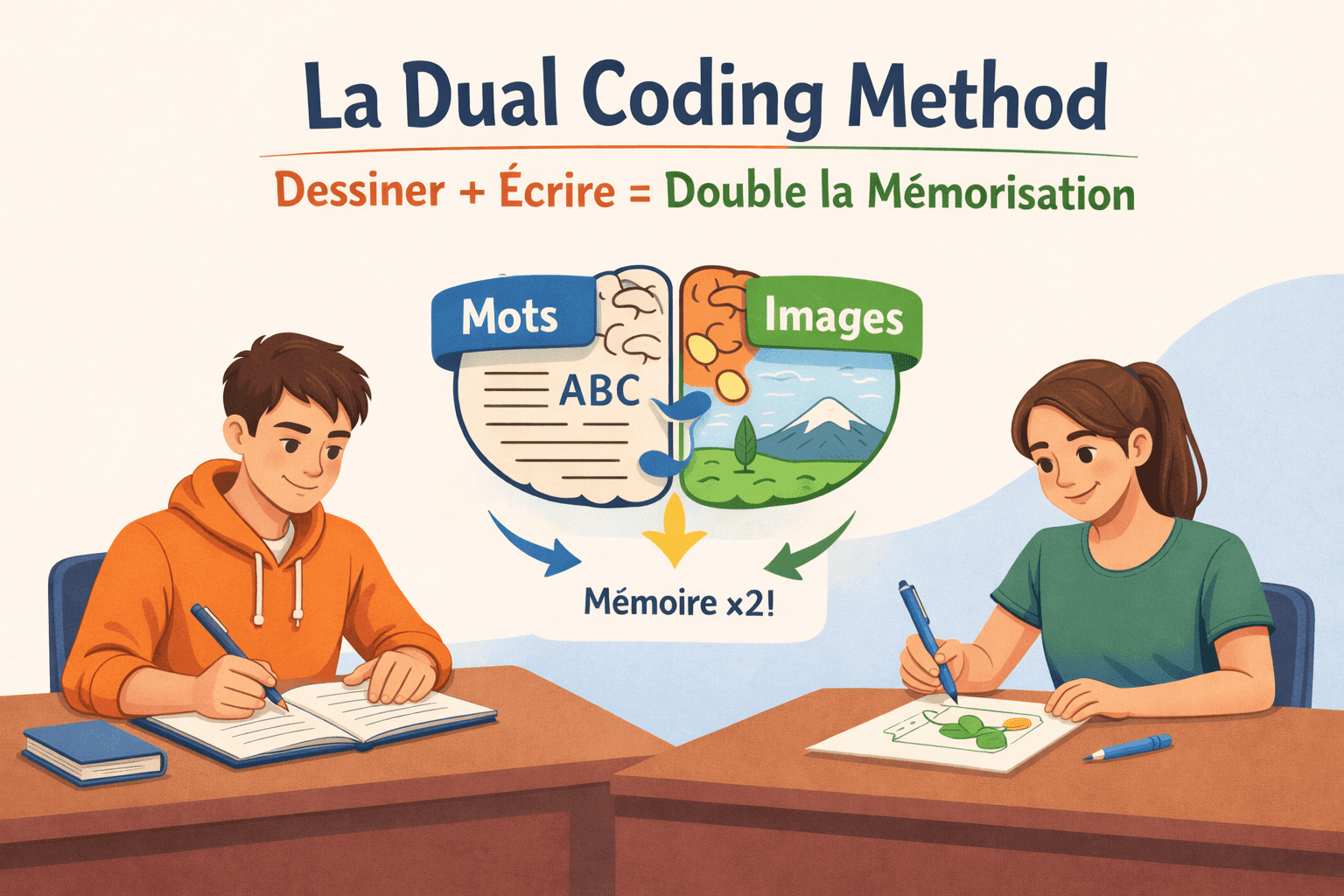
To memorize information durably, your brain needs to encode it in two different ways :
a verbal channel, with words, phrases, explanations
a visual channel, with images, diagrams, symbols
When you only read text, you use a single channel. When you write and draw at the same time, you activate two memory systems in parallel.
That’s why learning with images and text is much more effective than passively rereading a class.
Be careful about one important point. Looking at an image is not enough. What really works is to produce the diagram yourself, even if it’s ugly.
Why drawing + writing really doubles memory retention
Your brain loves shortcuts. When information is encoded in several ways, it becomes easier to retrieve.
With image-text memorization, you create multiple access paths to the same information. On exam day, if one path is blocked, another takes over.
Drawing to memorize better works for three main reasons.
First, you strengthen the encoding of information. Transforming a concept into a drawing forces you to understand it, not just copy it.
Second, you reduce forgetting. A well-associated mental image acts as an anchor in long-term memory.
Finally, you decrease cognitive load. A well-made diagram allows you to see the overall structure of a chapter at a glance.
That’s why learning by drawing is one of the most underestimated memorization methods among students.
What the Dual Coding Method changes compared to traditional revisions
Rereading, highlighting, copying word for word gives an illusion of work. But these techniques engage very little active memory.
With the Dual Coding Method, you move from a passive mode to active learning.
Instead of storing raw information, you transform it. You choose key words. You simplify. You connect ideas together. You build diagrams and learning becomes a process of understanding, not repetition.
That’s also why this method improves concentration. Drawing mobilizes your attention much more than skimming.
How to concretely apply the Dual Coding Method when you revise
Good news, you don’t need to know how to draw.
Here’s how to use dual coding for effective revision.
Start by reading a part of your course. Then, close the text and ask yourself a simple question: how could I explain this visually?
Use:
short key words
arrows to show connections
simple icons
boxes to structure ideas
For a theoretical subject, transform definitions into conceptual diagrams.
For a reasoning subject, represent the steps in the form of a process.
For a complex subject, break the class into visual blocks.
The classic mistake is wanting to make a nice drawing. That is not the goal. An imperfect but understood diagram is worth a thousand copied notes.
Dual Coding and exams: why it works under stress
Under stress, your brain has a harder time retrieving exact phrases. However, it remembers mental images very well.
This is where the Dual Coding Method makes a difference in exam revisions.
A diagram becomes an anchor point. You mentally review the structure of the class, and then the words come back naturally.
Result:
fewer memory gaps
better organization of responses
a sense of clarity even when the pressure rises
This is a huge advantage over traditional rote learning.
The limitations of the Dual Coding Method
Like any method, it is not magical.
It is less relevant for pure lists to learn word for word. It also requires a little effort at first, especially if you are not used to working visually.
Another important point. Too many visual details kill the visual. Simplicity is key. A good diagram explains one idea, not ten.
The Dual Coding Method works even better when combined with other revision techniques like active revision or quizzes.
Tools to apply Dual Coding more easily
The real obstacle for many students is not the method. It’s time and organization.
Transforming your notes into clear sheets, into diagrams, then testing your memory with quizzes requires structure. Koro AI precisely allows you to upload your notes, transform them into revision sheets and interactive quizzes, with goals to reach and even a little touch of humor at the end to stay motivated.
The idea is not to replace your thinking but to help you apply methods like dual coding more easily in everyday life.
Conclusion
If you had to remember one thing, it is this: better encoding is worth more than working more.
The Dual Coding Method shows you why learning with images and text is much more powerful than rereading over and over. Drawing to memorize better is not a waste of time; it is a cognitive shortcut.
Test it during your next revision session. Take a sheet, a pen, and transform your lessons into a diagram. You will quickly see the difference in your understanding, memory, and confidence on exam day.