
The seahorse explained in 30 seconds: the gateway to all your memories
Dec 10, 2025
Introduction
You want to understand how your brain transforms your lessons into lasting memories? Good news, it all comes down to a small structure a few centimeters long: the hippocampus. Without it, it's impossible to remember yesterday's lesson, the list of your exes, or even where you placed your charger. Yet, it remains one of the least known parts of the brain among students. Let’s fix that now.
I. 30 seconds to understand your hippocampus
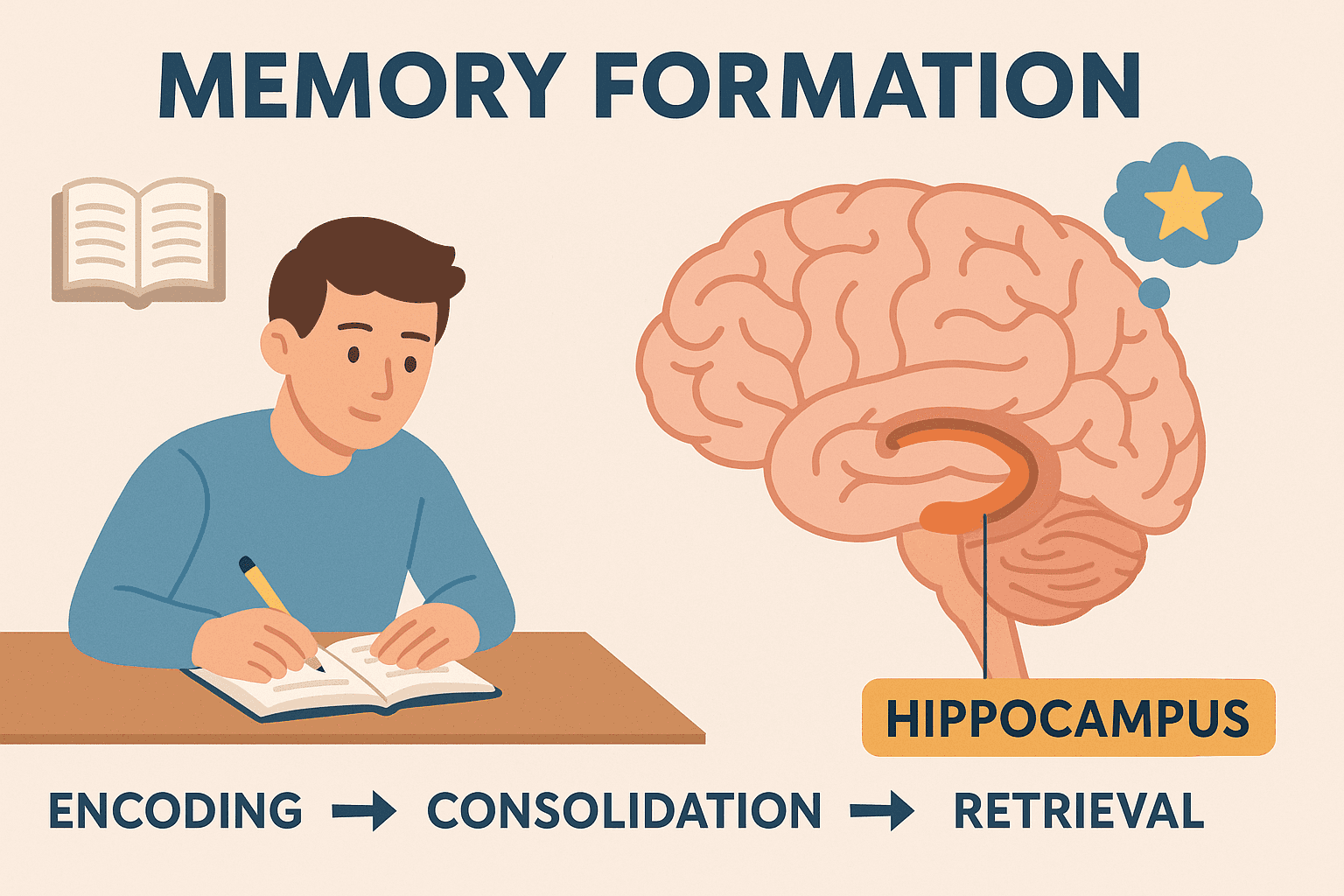
The hippocampus is literally the gateway to your memory. It is the area that encodes, organizes, and retrieves your memories. Every lesson, every concept, every event goes through it before becoming a real memory stored in your long-term memory.
Without the hippocampus, you would remember… nothing.
II. The hippocampus: the heart of the memory system
Where it is located
Imagine a small seahorse hidden in your brain. It is nestled in the limbic system, a key area for emotions, learning, and memory.
What it manages
The hippocampus is responsible for:
episodic memories (events)
declarative memories (facts, concepts, your lessons)
spatial orientation
As soon as you learn something, the hippocampus activates to convert this information into usable memory.
III. How your hippocampus transforms your lessons into lasting memories
1. Encoding
When you listen to a lesson or read a note, your hippocampus transforms raw information into memorable data. This is the encoding phase.
2. Consolidation
This step mainly happens during your sleep. New information is stabilized and transferred to long-term memory. Without consolidation, the information fades quickly.
3. Retrieval
When you take a quiz, do an exercise, or explain a concept, you reactivate your hippocampus. It’s like building muscle for your memory.
Why you forget so quickly (and it's not your fault)
Cognitive overload, fatigue, lack of repetition, or stress disrupt the hippocampus. Cortisol, the stress hormone, limits its ability to encode and consolidate memories. The result: you reread your lesson, you understand, but you forget two days later.
It’s normal. It’s biological. And fortunately, it can be optimized.
IV. Applied neuroscience: how to help your hippocampus work better
A. Repeat with spacing
Spaced repetition is one of the most effective techniques for consolidating your knowledge sustainably. It gives the brain time to reinforce connections.
B. Rephrase to really understand
The Feynman method forces you to rephrase a concept in your own words. You help your hippocampus structure the information and store it.
C. Vary formats
Your brain loves diversity. Alternating between notes, quizzes, diagrams, and rephrasing activates different brain areas, which strengthens memorization.
D. Sleep enough
Memory consolidation directly depends on your sleep. A short night = weakened memory.
E. Move a little before or after studying
A brief physical activity stimulates neuroplasticity, and thus memorization.
V. Subtle mini-section: how Koro AI helps your hippocampus
Koro AI does not replace your methods, but syncs your learning with what neuroscience recommends.
The app automatically converts your lessons into notes, quizzes, and varied educational resources, which facilitates encoding. Then, the repeated quizzes and smart reminders strengthen memory consolidation.
The funny little comments and gamified objectives reduce stress, allowing your hippocampus to work under better conditions.
Conclusion
Understanding the hippocampus is understanding how you retain information. You cannot control everything that happens in your brain, but you can optimize the conditions under which it operates.
If you apply the simple principles of neuroscience — spaced repetition, sleep, rephrasing, quizzes — you will retain faster, longer, with less effort.