
The Zeigarnik effect: why your brain retains incomplete tasks better
Dec 9, 2025
Introduction
You surely know that strange feeling: you started an assignment, a sheet, a chapter… then you stopped in the middle. And despite yourself, your brain keeps coming back to it. As if it refuses to forget until it’s finished.
Good news: it’s not guilt, it’s cognitive psychology. And it has a very specific name: the Zeigarnik effect.
Today, you will understand why your brain remembers incomplete tasks better, how to use this mechanism to study more effectively, and how it can even help you fight against procrastination.
1. Your brain loves what’s unfinished
You close Netflix in the middle of an episode and… you think about it all evening.
You start a chapter for exams but stop at page 3… and it keeps running in your head.
You leave an incomplete task on your to-do list… and it's impossible to really forget it.
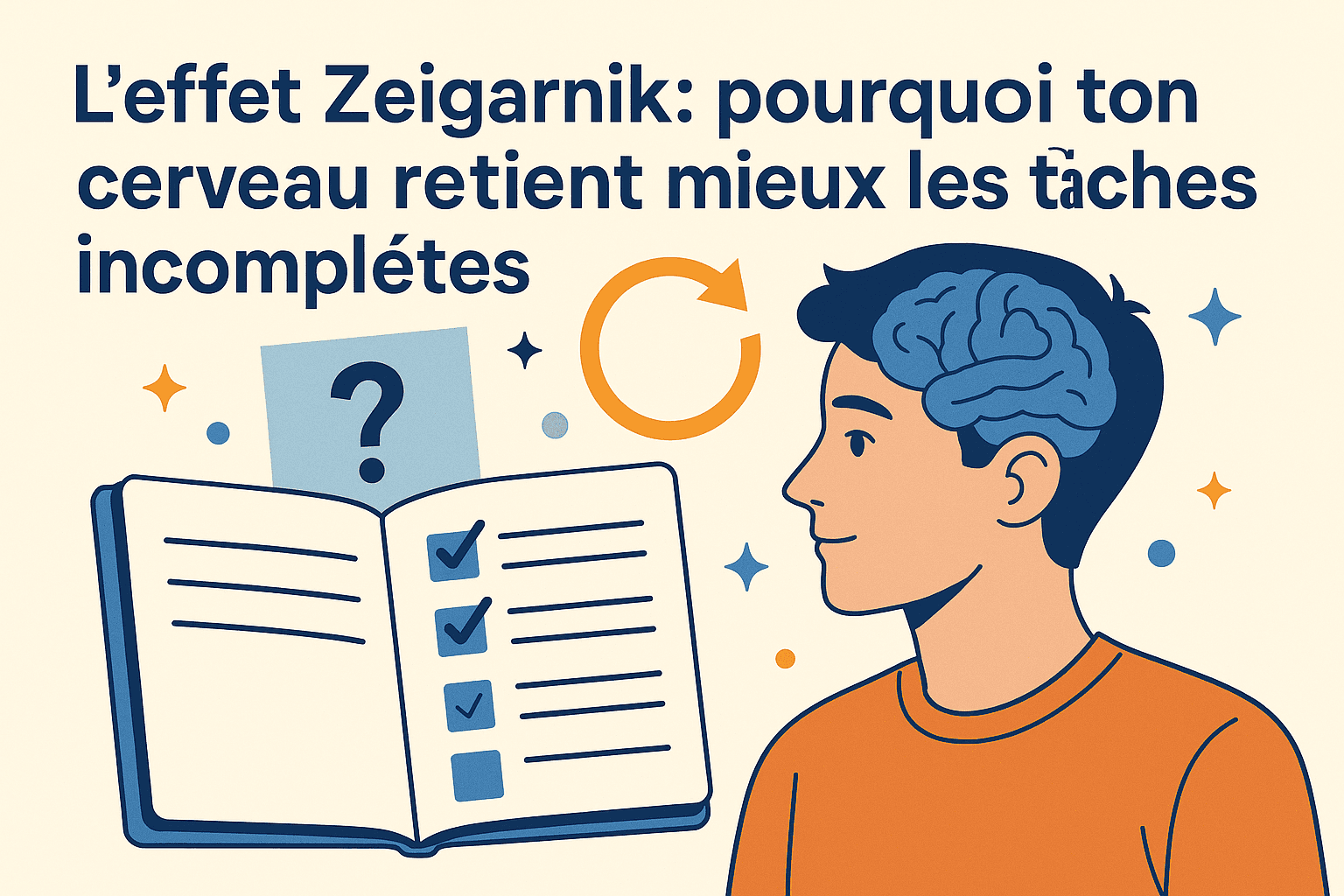
Why does this happen? Because an unfinished task creates cognitive tension. Your brain hates “open loops.” And that’s exactly where the Zeigarnik effect begins.
2. The Zeigarnik effect: what is it exactly?
Discovered by the psychologist Bluma Zeigarnik, this effect shows that we remember interrupted tasks better than completed tasks.
Basically, your brain stores what you haven’t finished much more easily.
In her research, Zeigarnik explained that the brain remains in alert mode as long as an activity is not completely closed. The result: memorization increases naturally, almost effortlessly.
It’s a phenomenon used today in:
productivity,
memory,
motivation,
learning techniques,
strategies to succeed in exams.
3. Why your brain remembers incomplete tasks better
When you start a task—even a very small one—your brain activates an internal system that wants to go all the way.
If you stop, this system remains partially active. This creates:
better memorization,
increased concentration when you resume,
stronger motivation to finish.
More concretely:
Starting a chapter increases your chances of coming back to it.
Starting a sheet improves your overall understanding.
Starting a quiz stimulates your memory even if you don’t finish everything.
The Zeigarnik effect isn’t magical: it simply utilizes how your memory works.
4. How to use the Zeigarnik effect to study more effectively
A. Start tiny: the “just 5 minutes”
The biggest mistake students make is believing they need to be motivated before they start.
False.
The brain creates motivation after starting.
Start a tiny task:
read 1 paragraph,
open your class notes,
start a quiz,
write the title of your sheet.
Once the loop is open, you're already in the process.
B. Deliberately leave a task unfinished
Deliberately leaving a chapter or exercise hanging can increase your motivation to come back later.
Your brain doesn't like to leave a file open for too long.
C. Break your chapters into smaller parts
Instead of aiming to “review the entire course”, break it down into small sections:
what is short = what creates less resistance,
what is broken down = what naturally activates memory.
D. Do short but repeated sessions
Neurosciences have proven: it’s better to learn in several fragments.
The Zeigarnik effect then combines perfectly with spaced repetition.
5. The Zeigarnik effect against procrastination
Procrastination doesn't come from a lack of motivation but from an excess of mental friction.
Starting is the real difficulty.
Now, as soon as you open a task:
your brain wants to finish it,
the resistance decreases,
motivation increases,
you enter a learning dynamic.
Use it to:
review a long course,
get started on an assignment,
write a thesis,
tackle a difficult chapter.
Starting, even very small, breaks procrastination.
6. Concrete demonstrations for students
You have to review a long chapter
Just read the first paragraph.
Your brain will naturally want to continue later.
You need to learn an essay plan
Just write the introduction and the titles of the sections.
The cognitive tension will do the rest.
You need to make a sheet
Note only the main headings: A, B, C.
When you return, you’ll be surprised at how easy it is to continue.
You need to prepare for an exam
Break it down. Start. Stop. Resume.
You perfectly leverage how your memory works.
7. How Koro AI helps you use the Zeigarnik effect naturally
(Short and subtle section, as requested)
Koro AI automatically structures your courses into small units: sheets, quizzes, key questions.
The result: you naturally work in short sequences, perfect for leveraging the Zeigarnik effect.
Each session creates an “open loop” that your brain wants to finish, and the little fun comments + objectives make returning even easier.
It’s not magic; it’s just aligned with how your memory works.
8. Warning: the Zeigarnik effect also has its limits
Too many unfinished tasks = mental overload.
The goal is not to open ten chapters and finish none.
Use the Zeigarnik effect to start, structure, advance, not to leave everything hanging.
The ideal balance:
start small,
break down tasks,
close some loops,
keep a few to stay engaged.
9. Conclusion: use the Zeigarnik effect to make your brain work for you
You don’t need motivation to start.
You just need… to start.
An open task becomes a mental magnet.
Your brain remembers better, focuses better, and resumes more easily.
Try today:
open your course, start a micro-task, close your laptop and let your brain do its job.
You’ll see: it’s simple but extremely powerful.