
Cognitive inertia: why starting is 90% of the problem
Dec 8, 2025
Introduction
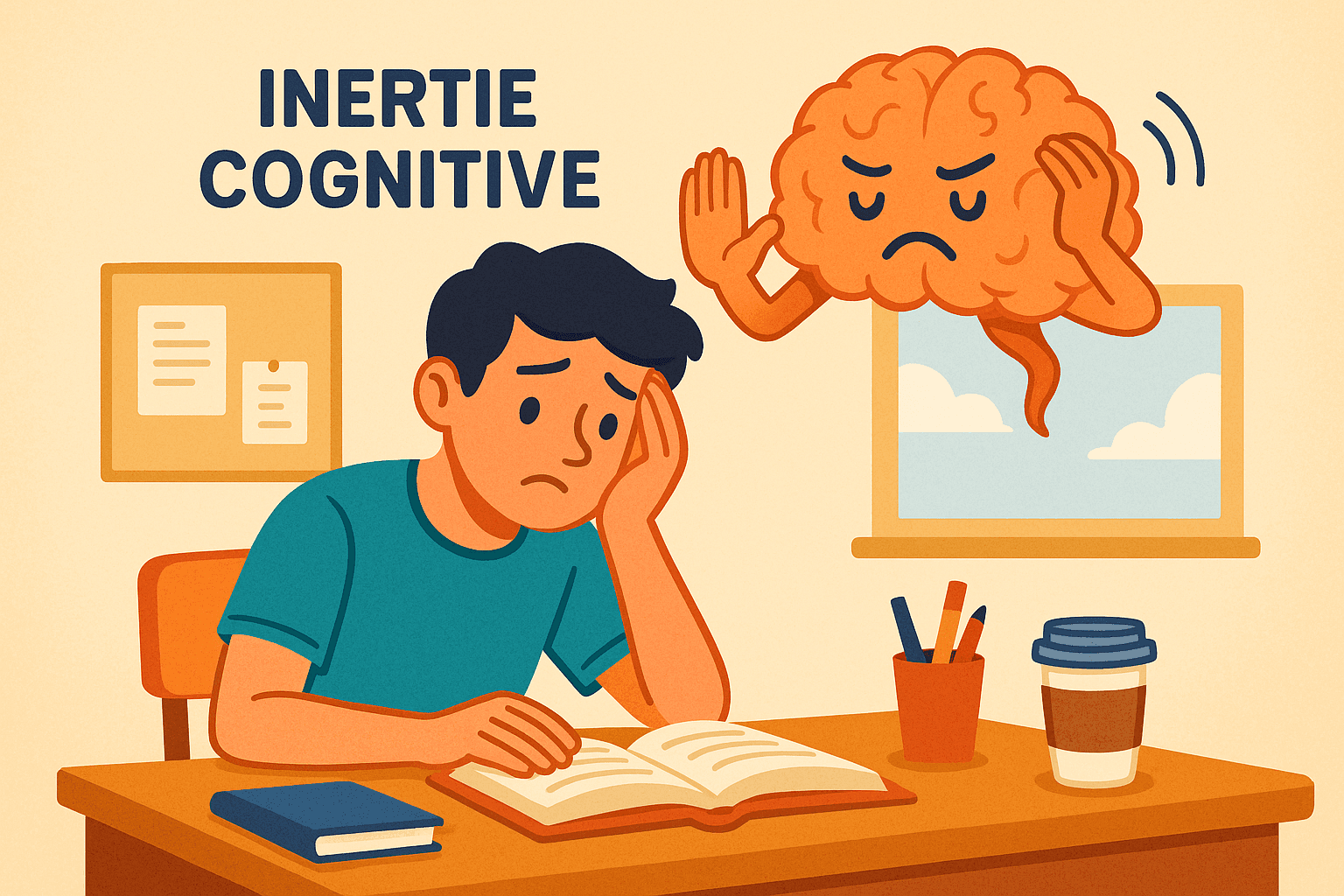
You surely know that moment when you place your computer in front of you, open your notebook... and you do absolutely nothing. You scroll, tidy up your desk, check the weather, do everything, except start studying.
It’s not laziness. It’s not even a real "lack of motivation".
It’s cognitive inertia.
And if you understand this mechanism, you can literally transform your way of working.
I. Cognitive inertia: understanding the mechanism that blocks you
What is cognitive inertia?
Cognitive inertia is the phenomenon that makes starting a mental task much more difficult than the task itself. Your brain naturally resists action, especially when it associates the task with intense effort like studying, memorization, or understanding a dense chapter.
Why does your brain resist starting so much?
It applies a simple principle: conserve its energy.
Starting to work requires a high mental activation cost. Your brain prefers to stay in its comfort zone rather than enter into cognitive effort. The result: you procrastinate, you put it off, you avoid.
It’s not a lack of motivation
You’re not "demotivated"; you’re blocked. Cognitive resistance has nothing to do with being motivated or not: it’s simply a natural mechanism of your brain.
II. Why starting is 90% of the problem
1. The mental activation cost
Getting started consumes a tremendous amount of energy. Once launched, your brain shifts into “cognitive routine” mode. The effort becomes more fluid, more natural.
2. Once you're in, everything becomes easier
You’ve probably experienced it: it takes you 20 minutes to get started, but once you’re off, you can work for an hour without suffering. It’s the effect of cognitive inertia flipping.
3. The positive dynamic
The start is the most painful part. After a few minutes, your brain stabilizes its mental load, and the effort becomes much less burdensome.
4. The snowball effect
Just starting for 2 to 5 minutes creates enough mental launch to build momentum.
It’s scientific: starting is 90% of the problem.
III. The most common student causes of cognitive inertia
1. Course overload
When you don't know where to start, your brain prefers to do nothing.
2. Perfectionism
You want to understand everything perfectly, right from the start. As a result... you procrastinate.
3. Constant distractions
Your phone cancels your focus before it even exists.
4. The fear of the blank page
Starting a note, a summary, an exercise... it’s intimidating.
5. The absence of a clear plan
Without structure, it’s impossible to create a stable revision dynamic.
IV. 7 concrete techniques to overcome cognitive inertia
1. The 2-minute rule
You tell yourself: I’ll just start for 2 minutes.
Your brain accepts the task, and the initial effort disappears.
2. Break it down into micro-tasks
You’re not revising a chapter.
You “open the course,” “read the first section,” “do a quiz.”
Your brain loves small entry points.
3. Create a starting environment
A tidy desk, your water bottle, your headphones, and you’re off.
Your brain associates this environment with action.
4. The 5-minute timer
When you start a timer, your brain accepts the effort.
It’s a powerful anti-procrastination technique.
5. Prepare the ground the day before
You already open your course, you mark the part to review.
The next day, you no longer have the friction of choice.
6. Start with an easy task
Answering a simple question, reviewing a note, doing a quick quiz…
It kickstarts the momentum.
7. Launch a small ritual
A piece of music, a tea, a specific gesture: you condition your brain for work.
It’s a real psychological hack for student productivity.
V. Transforming initial effort into a lasting habit
1. Make starting automatic
If you start every day at the same time, your brain adapts.
2. Create short routines
A work session doesn’t have to be long: it needs to be regular.
3. Associate a reward… at the beginning
The brain loves immediate rewards.
Offer it a mini satisfaction right at the start, not just at the end.
VI. How Koro AI reduces cognitive inertia (short and discreet section)
When you’re stuck in front of your sheet, the blank page is your worst enemy.
This is where Koro AI really helps a lot of students.
You upload your course: the app automatically creates notes, quizzes, and clear learning materials.
You no longer have to choose “what to start with”.
You launch a 2-minute quiz: it creates the cognitive momentum.
The little comments and objectives make starting less intimidating.
That’s exactly what makes its strength: reducing the mental activation cost.
Conclusion
Cognitive inertia is not a flaw: it’s a natural mechanism.
The real challenge is not working; it’s getting started.
Once you have passed those first few minutes, studying becomes much simpler, more fluid, more natural.
Try one of the techniques today. Not tomorrow. Not when you “feel motivated.”
Just now, for 2 minutes.
It’s more than enough to break 90% of the problem.