
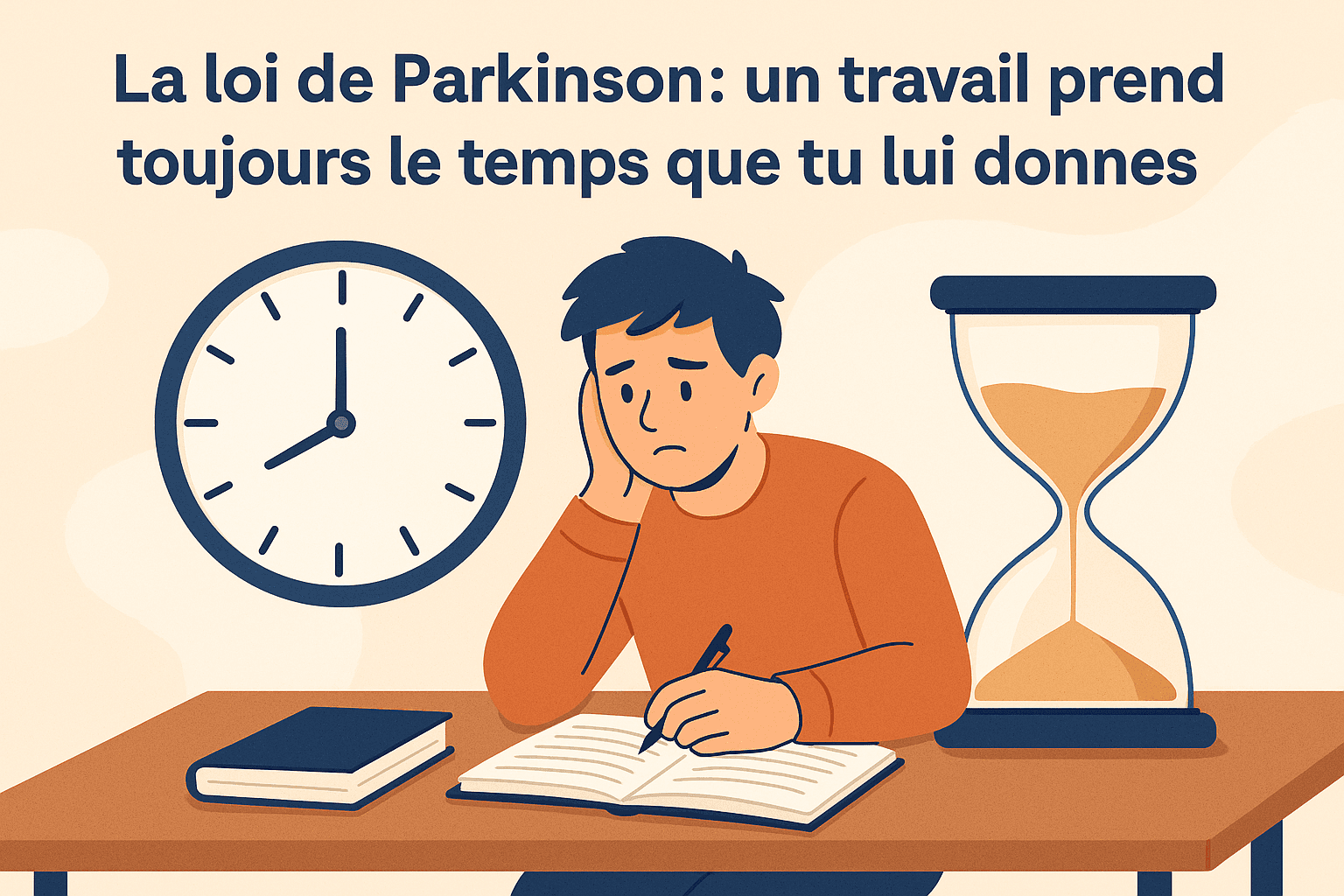
Parkinson's Law: work always takes the time you give it
Dec 17, 2025
Introduction
Have you ever noticed something strange?
A homework assignment that you thought would take an hour ends up taking you the whole evening.
A "quick" revision turns into an endless, exhausting session that may not be effective.
This is not a lack of motivation.
It is not a classic organizational problem either.
It is a well-known phenomenon in work psychology: Parkinson's Law.
Parkinson's Law Explained Simply
Parkinson's Law states something very simple:
Work expands to fill the time available for its completion.
This law was formulated by Cyril Northcote Parkinson, a British historian, originally to observe the functioning of administrations.
But it perfectly applies to studies, and especially to how you work on a daily basis.
If you allocate an entire afternoon to complete an exercise, it will take the whole afternoon.
If you give yourself 45 minutes, it will take 45 minutes.
The work does not change.
The time, however, expands.
Why Parkinson's Law Particularly Affects Students
When you are a student, your main problem is not a lack of time.
It is fuzzy time.
Few strict time constraints
Revisions often poorly defined
Vague goals like “revise the chapter”
A feeling of working as soon as you sit at your desk
As a result: your brain spreads the work out without realizing it.
You spend time on your course, but between distractions, hesitations, and unnecessary perfectionism.
In the end, you are tired but feel like you have made little progress.
This is exactly Parkinson's Law in action.
What Happens in Your Brain When Time is Ample
Parkinson's Law is based on several very concrete psychological mechanisms.
1. Disguised Procrastination
When you have a lot of time, your brain allows itself to postpone important decisions.
You reread, rephrase, adjust, without really making progress.
2. Unnecessary Perfectionism
Without constraint, you seek to do “perfectly,” even when it is not necessary.
You spend too much time on details that do not really enhance your learning.
3. The Illusion of Productivity
Spending a long time on a course gives the impression of working seriously.
But time spent does not equal efficiency.
Your brain prefers to spread the effort rather than concentrate it.
The Concrete Consequences on Your Studies
In the long run, Parkinson's Law has very negative effects on student productivity.
You spend a lot of time working, but results stagnate
You often end up in a rush, with unnecessary stress
You lack time for certain subjects
You tire your mind more than necessary
You lose confidence in your ability to organize well
And above all, you end up believing that “working long hours” is normal to succeed.
When in fact, it is not true.
How to Use Parkinson's Law to Your Advantage
Parkinson's Law is not your enemy.
If you use it correctly, it can become a very powerful tool.
1. Give Yourself Shorter Deadlines Than Necessary
Even if you have the whole day, impose a clear limit on yourself.
For example: “45 minutes to understand and summarize this chapter.”
2. Work in Closed Time Blocks
A session has a beginning and an end.
When time is up, you stop, even if everything is not perfect.
3. Define a Finished Task, Not Just Time Spent
Don’t say “I will revise for 2 hours.”
Say “I should be able to explain this course without my notes.”
4. Deliberately Reduce Work Duration
Less time forces your brain to get to the essentials.
And the essentials are what truly drives progress.
Applying Parkinson's Law to Revisions
Revisions are the perfect ground for Parkinson's Law.
When you say “I will revise this chapter,” your brain doesn’t know when to stop.
The work spreads out.
On the other hand, if you set a clear goal and a limited time, everything changes.
For example:
30 minutes to turn a course into a summary
20 minutes to answer questions without support
15 minutes to check what you have really learned
Constraint enhances concentration, memory, and cognitive effectiveness.
That’s why active revision methods work much better than simple rereading.
Tools That Facilitate This Approach
You can apply Parkinson's Law without any tools.
A timer and a clear goal are already sufficient.
But some tools help structure work and avoid wasting time unnecessarily.
When a task is well defined, your brain can no longer stretch it artificially.
For instance, directly transforming a lesson into notes or quizzes imposes a natural end to the work.
You know when you have finished, and you avoid blurry revisions that drag on.
It is in this logic that tools like Koro AI can be useful for some students.
The principle is simple: you upload your lesson, and you get summaries and quizzes, with clear objectives.
At the end of the quizzes, a light comment helps maintain motivation without making the session heavy.
It’s not magic, but it helps to reduce wasted time and stay focused on the essentials.
What to Remember
Parkinson's Law explains why you often feel like you lack time, even when you have it.
It’s not that you work poorly.
It’s that the work adapts to the time you give it.
By imposing clear constraints, precise objectives, and limited durations, you can:
work less time
regain a real sense of control
The next time you revise, don’t ask yourself how much time you will spend.
Instead, ask yourself when and how you will know that it’s finished.
That is where everything changes.