
The Ivy Lee method: 6 tasks, no more
Dec 16, 2025
Introduction
Have you ever finished a day of studying feeling like you worked all day... without really making progress?
Endless lists, tabs open everywhere, a constant feeling of mental overload.
The problem isn’t that you lack motivation.
The problem is that you are trying to do too many things at once.
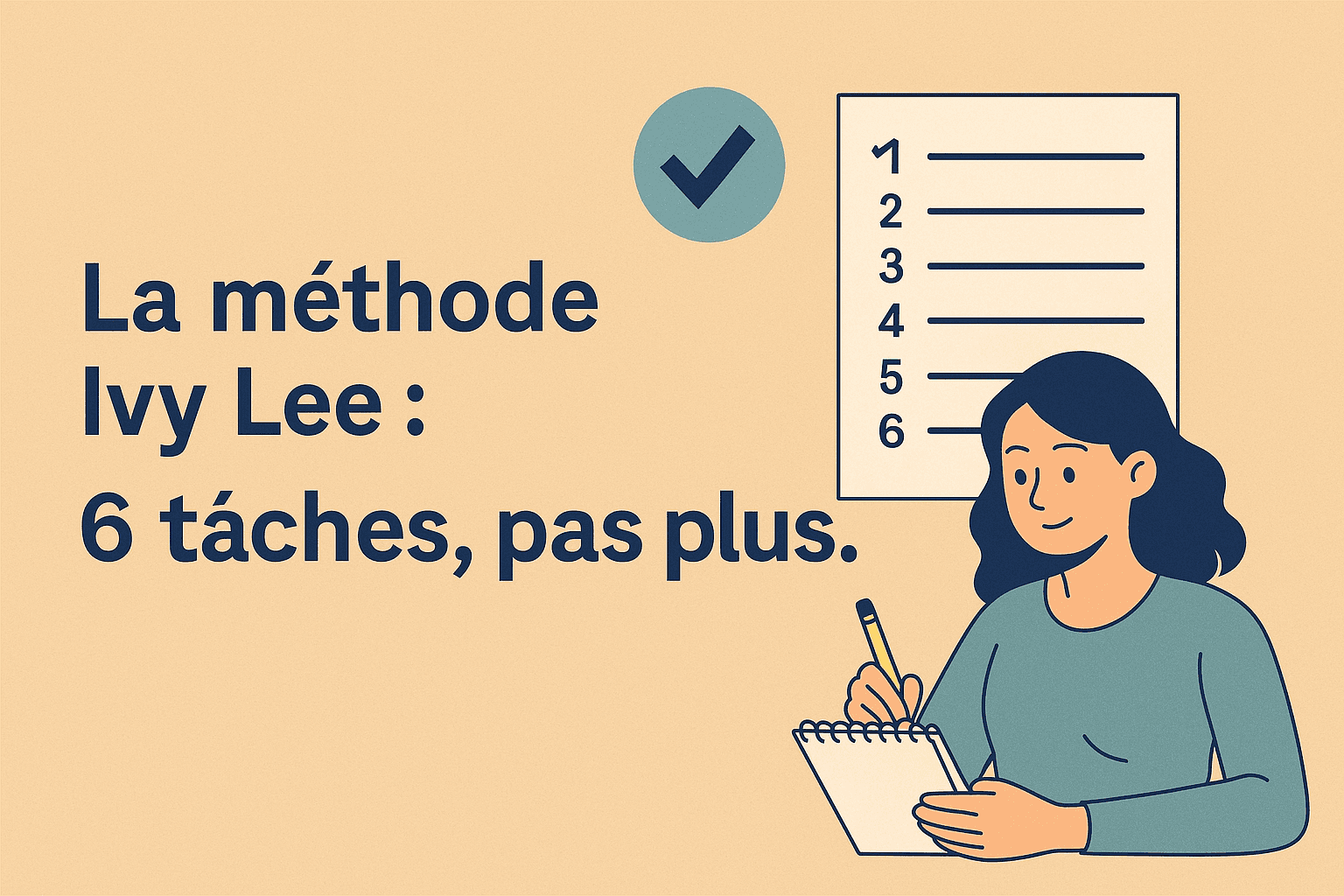
The Ivy Lee method is based on a radical, almost frustrating rule: 6 tasks per day. No more.
And that’s precisely why it works.
What exactly is the Ivy Lee method?
A method over 100 years old
The Ivy Lee method was created in the early 20th century by Ivy Lee, a consultant on professional efficiency.
Its aim was not to make people work longer, but to work better.
Since then, this simple productivity method has been used and cited in numerous work organization systems. And above all, it remains incredibly relevant for students.
The fundamental principle
Every day:
You list all the tasks you could do.
You keep only 6 maximum.
You prioritize them in order of actual importance.
You do them in that order, without skipping any.
No complex optimization. No miracle app. Just task prioritization.
Why this method really works
Your brain hates multiple choices
When you have too many tasks in mind, your brain saturates.
This is referred to as cognitive load and decision fatigue.
The result:
you procrastinate
you switch from one task to another
you confuse activity with effectiveness
The Ivy Lee method intentionally reduces the number of decisions to make. Fewer choices, more attention, more focus.
Doing less increases performance
Completing an important task triggers a genuine feeling of progress.
This is what fuels motivation, not the act of checking off 15 useless micro-tasks.
Working less but better is often more effective than working longer without structure.
How to apply the Ivy Lee method as a student
Step 1: Clear your mind
Start by listing absolutely everything:
review a chapter
redo a tutorial
advance a presentation
re-read a course
prepare a quiz
Without filtering. The goal is to clear your mind.
Step 2: Keep only 6 maximum tasks
This is the most difficult step.
You have to choose.
Ask yourself:
Which 6 tasks will have the most impact on my results?
This is an effective prioritization method, not a comfort list.
Step 3: Rank by actual importance
Not by ease.
Not by preference.
By importance.
What actually advances your understanding must come before everything else.
Step 4: Execute in order, without multitasking
Work on task number 1 until it is complete.
Only then do you move on to the next one.
Multitasking is the number one enemy of concentration and memory.
Common mistakes to avoid
Turning tasks into vague phrases like “review the course”
Adding micro-tasks to feel better
Reorganizing the list all day
Confusing being busy with being effective
The Ivy Lee method requires discipline, but above all honesty with oneself.
Adapting the Ivy Lee method to studying
Concrete example of a day
Before:
re-read several courses
make notes
review exercises
watch an explanatory video
review another chapter
After using the Ivy Lee method:
Understand chapter 3 of constitutional law
Transform this chapter into clear notes
Test my understanding with a quiz
Correct my mistakes
Review chapter 3 from the day before
Prepare for tomorrow's work
Result: less distraction, more mental clarity, less stress.
The limits of the Ivy Lee method
Let’s be honest. This is not a miracle solution.
It does not replace learning methods
It does not do the work for you
It requires making sometimes uncomfortable choices
But when combined with good revision techniques, it becomes incredibly effective.
Applying the method frictionlessly
The real problem is often not the method, but its implementation.
When your courses are poorly structured, when you waste time creating notes or inventing exercises, prioritization becomes complicated.
This is where tools that automatically structure content can help. For example, turning a course into clear notes and quizzes allows you to focus on the essentials, with specific and motivating goals. Some tools like Koro AI go in this direction, not replacing the method, but making it easier to apply in daily life.
Conclusion
The Ivy Lee method teaches you an essential thing: do less, but better.
By intentionally limiting your tasks, you reduce mental overload, improve your concentration, and truly make progress in your studies.
Try it for a week.
6 tasks per day. No more.
And observe what changes in your way of working.
Often, it is the simplest methods that make the biggest difference.