
The 4 types of memory (procedural, semantic, episodic, working)
Dec 15, 2025
Understand How Your Memory Works for Really Effective Studying
If you've ever spent hours rereading your notes without retaining anything, the problem isn't you. It comes from the way you use your memory. Contrary to popular belief, there isn't just one type of memory, but several distinct systems, each with a specific role in learning.
Understanding the types of memory means stopping random studying and starting to learn intelligently. This is exactly what makes the difference between working hard and actually making progress.
Why There Isn't Just One Type of Memory
In cognitive psychology and neuroscience, human memory is seen as a set of complementary systems. Some serve to store knowledge, others to act, and still others to manipulate information in real-time.
The problem is that many students use a single revision method for everything, often passive rereading. However, this method only engages a very limited part of memory, and rarely the most effective for exams.
To better retain your notes, you need to understand how memory works and especially what type of memory you are engaging when you study.
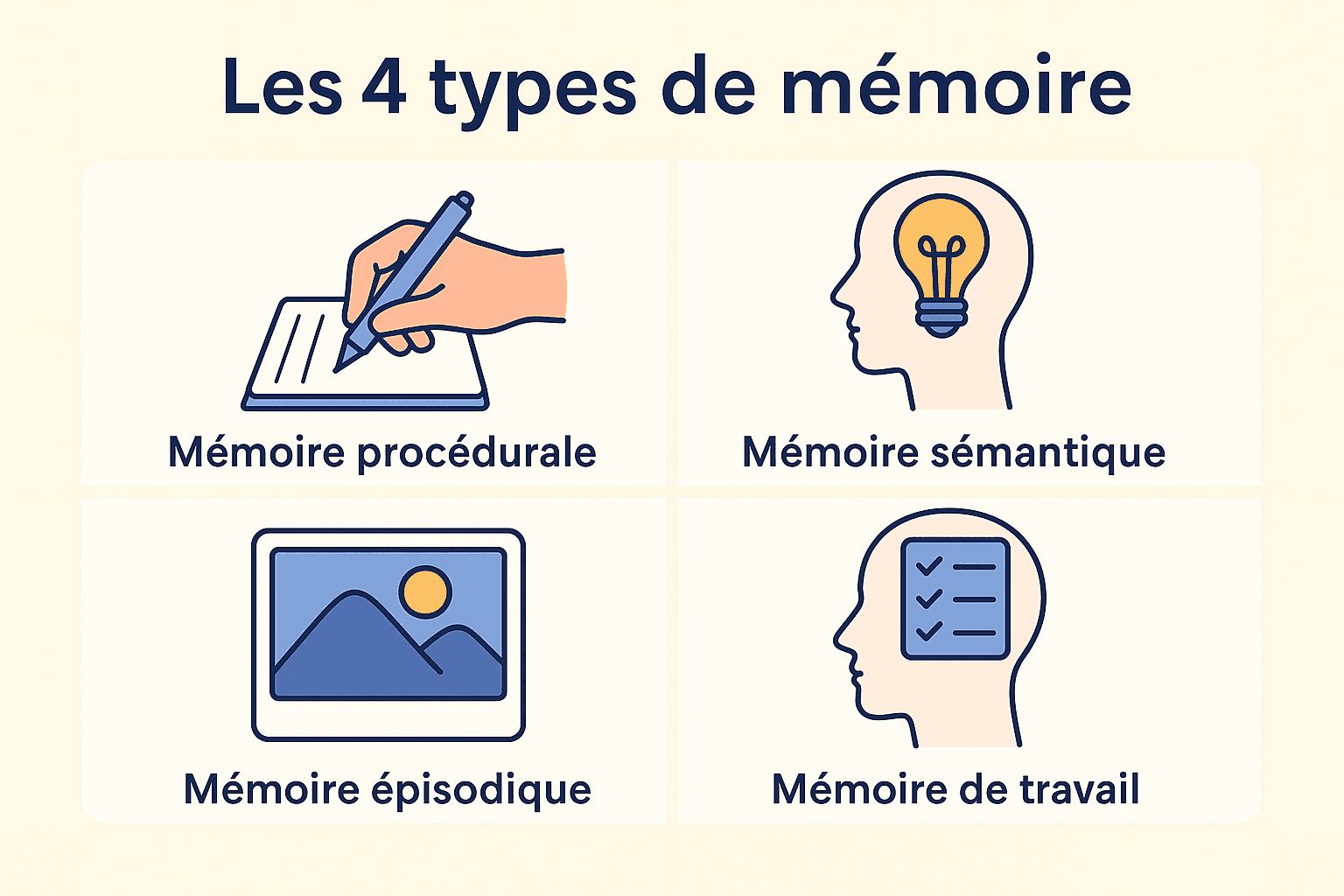
Procedural Memory: Learning by Doing
Procedural memory is the memory of automatism. It allows you to ride a bike, type on a keyboard, or solve a type of exercise without thinking about each step.
Concrete Examples for a Student
Solve math or accounting exercises
Apply an essay-writing method
Use a formula without needing to prove it again
This memory develops only through practice. Reading an answer key or watching someone else do it isn't enough. As long as you don't do the exercise yourself, procedural memory is not activated.
How to Use It for Studying
Do exercises, even imperfect ones
Repeat the same type of problem several times
Making mistakes and correcting them is essential
If you want to automate, you need to act. This is one of the foundations of effective learning.
Semantic Memory: Understanding and Structuring Knowledge
Semantic memory corresponds to everything you know about the world: definitions, concepts, facts, rules. It is the memory of "theoretical" knowledge.
Semantic Memory and Learning
Learning a lesson is not about memorizing word for word; it's about understanding the ideas and the relationships among them. Semantic memory functions very poorly with brute memorization but very well with structuring.
Effective Techniques
Rephrase in your own words
Create summary notes
Link concepts together
Explain the lesson to someone else
This is the memory that allows you to answer open-ended questions, reason, and adapt on exam day.
Episodic Memory: The Power of Context and Memories
Episodic memory is the memory of lived events. It records the context, emotions, and the precise moment something happened.
You might remember a particular class, a notable teacher, or an anecdote related to a concept very well. This is not by chance.
Why It Is Useful for Studying
When information is associated with a strong context, it becomes easier to retrieve. The brain uses these cues to access the memory.
How to Use It Smartly
Create concrete examples
Associate a concept with a story or a mental image
Revise in conditions similar to the exam
Regularly test yourself to recreate the retrieval context
Episodic memory is often underestimated, yet it can make a real difference on exam day.
Working Memory: The Bottleneck of Learning
Working memory is the short-term memory that allows you to manipulate information in real time. It is very limited. On average, you can manage only a few items at a time.
Why It Is Problematic
When you try to learn everything at once, revise with your phone next to you, or move from chapter to chapter without structure, you overload your working memory. The result: fatigue, confusion, and rapid forgetting.
How to Lessen Cognitive Load
Break lessons into small units
Eliminate distractions
Use clear and structured materials
Automate certain knowledge with the help of other memories
Better managing your working memory makes learning much less painful.
How to Smartly Combine the 4 Types of Memory for Studying
An effective review never relies on just one type of memory. It combines several systems.
Example of an effective study session:
Structured reading and rephrasing for semantic memory
Quizzes or active questions for working memory
Exercises for procedural memory
Concrete examples and context reminders for episodic memory
In contrast, rereading a lesson in a loop activates almost none of these memories in an optimal way.
Adapting Study Methods to Each Type of Memory
Procedural Memory: exercises, repetition, application
Semantic Memory: notes, diagrams, explanations
Episodic Memory: examples, scenarios, tests
Working Memory: clarity, breakdown, simplicity
The best learning techniques are those that respect the brain's natural functioning.
A Word on Study Tools
Many students waste a huge amount of time organizing their notes instead of learning. Structuring, transforming, and testing one's knowledge requires true rigor.
Some recent tools are designed precisely to automatically apply these scientific principles. For example, platforms like Koro AI allow you to upload your notes and transform them into study sheets and quizzes. The interest lies not in the technology itself but in prompting the right types of memory, with clear objectives and immediate feedback, sometimes even with a touch of humor at the end of the quiz.
This kind of approach aligns with a logic of effective learning, not just a simple digitalization of paper notes.
Conclusion
Better studying does not mean having a better memory. It means understanding how human memory works and using the right levers at the right time.
By learning to activate procedural, semantic, episodic, and working memory, you completely transform your way of studying. Learning becomes clearer, more effective, and much less frustrating.
The real skill to develop during your studies is not just to learn the lessons. It is to learn how to learn.