
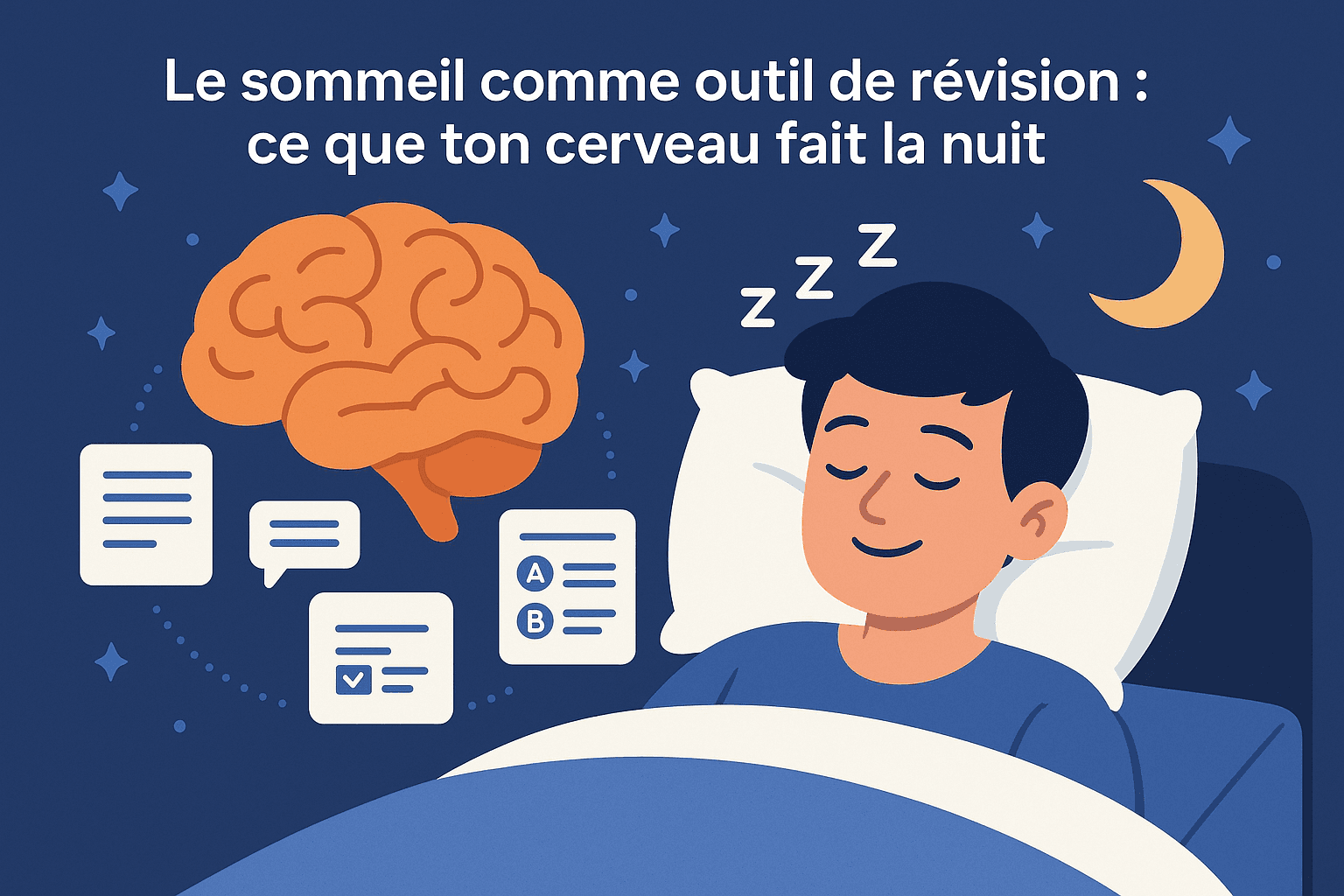
Sleep as a revision tool: what your brain does at night.
Dec 14, 2025
Introduction
You spend hours reviewing, making notes, struggling with complex concepts… but you may be neglecting the ingredient that makes the real difference: sleep. And yet, it is during the night that your brain does the bulk of the work. Yes, literally.
Welcome to the comprehensive guide that will explain to you how to learn while sleeping, why your brain loves it, and how to use sleep as a secret weapon to boost your memorization.
I. What if your best ally for studying… is your bed?
It is often said that “sleeping is wasting time.” In reality, this myth is responsible for a lot of bad nights for students. Science is categorical: sleep and study go hand in hand.
While you sleep, your brain sorts, stabilizes, and strengthens your memories, a process called memory consolidation. That’s why you often remember better after a good night than after a late session where you forced yourself.
II. What your brain really does at night
To understand why studying effectively requires good sleep, you need to look at what happens under the hood.
1. Sleep stages (ultra-simple version)
Your sleep is divided into three main stages:
Light sleep : the brain entering standby mode.
Deep sleep : key phase for recording knowledge.
REM sleep : where you dream and your brain connects ideas.
2. The role of each phase in memorization
Deep sleep reinforces facts, dates, definitions, formulas.
REM sleep creates links between concepts, improves overall understanding, and enhances creativity.
The result: what you learned during the day becomes a lasting memory, something stable and usable in exams.
3. Why poor sleep ruins everything
Lack of sleep means:
reduced concentration
decreased ability to learn
preventing memory consolidation
In short, you can study for 4 hours… but if you sleep for 5 hours, you’ll retain the equivalent of 1 hour.
III. The science behind the idea of learning while sleeping
1. Memories go from fragile to stable
When you learn something, the information is still “fragile,” easily forgotten. During sleep, your brain transforms it into a “durable” memory. This is exactly what makes evening revisions so powerful.
2. REM sleep, your "update mode"
This phase:
improves understanding
creates connections
allows you to solve problems you thought were impossible
Have you ever gone to bed stuck on an exercise, then woken up with a solution? That’s not a miracle, it’s REM sleep.
3. It’s scientifically validated
Countless neuroscience studies show that reviewing before bed significantly improves memorization and academic performance.
IV. How to use your sleep to study better
Here’s the really useful part: how to leverage your sleep to learn faster, memorize more durably, and work your brain all night.
1. The ideal timing
Reviewing at the end of the day (without going to bed stressed) prepares your brain to consolidate the information.
2. Simple techniques
re-read a note, a summary, or a quiz before bed
avoid overly stressful revisions just before sleeping
turn off screens at least 30 minutes beforehand
end with concepts already understood to reassure your brain
3. Naps, a legal cheat code
A 20-minute nap allows:
to recharge attention
to improve consolidation
to boost memory
To be done especially during intense revision periods.
V. What sabotages your learning at night
Here are the sworn enemies of the combo sleep + memorization :
screens right before sleeping
late caffeine
too short nights
sessions until 2 AM
stress and anxiety before exams
You don’t need to sleep “a lot”, you need to sleep enough, regularly, and deeply.
VI. A special evening routine for students
Here’s a simple routine to optimize your memory during the night :
20 minutes of light reviewing
re-reading your notes or taking a short quiz
tidying up your space to reduce cognitive load
preparing your bag for the next day
warm lighting
slow breathing or a short meditation
turning off screens
In a nutshell: calmness and coherence.
VII. Short and subtle section: where Koro AI comes into the equation
To optimize the duo review + sleep, you need clear, concise, and easy-to-revise content in the evening. This is where Koro AI can help you.
You can:
upload your courses
automatically obtain review sheets
take quick quizzes just before sleeping
consolidate all of this with your brain at night
With its playful aspect and the little comments at the end of the quizzes, it makes the final evening activation lighter and more effective. No friction, just a smooth routine.
VIII. Conclusion: sleeping is not a luxury, it’s strategic
If you really want to study effectively, retain faster, and reduce your stress, there’s no need to overload yourself. Sleep is not lost time; it’s active memorization time.
Your brain works while you sleep. It’s now up to you to provide the right conditions.
And if you establish a small “calm revision + sleep” routine, you will definitely notice the difference.