
The best memorization techniques for college and high school
Nov 16, 2025
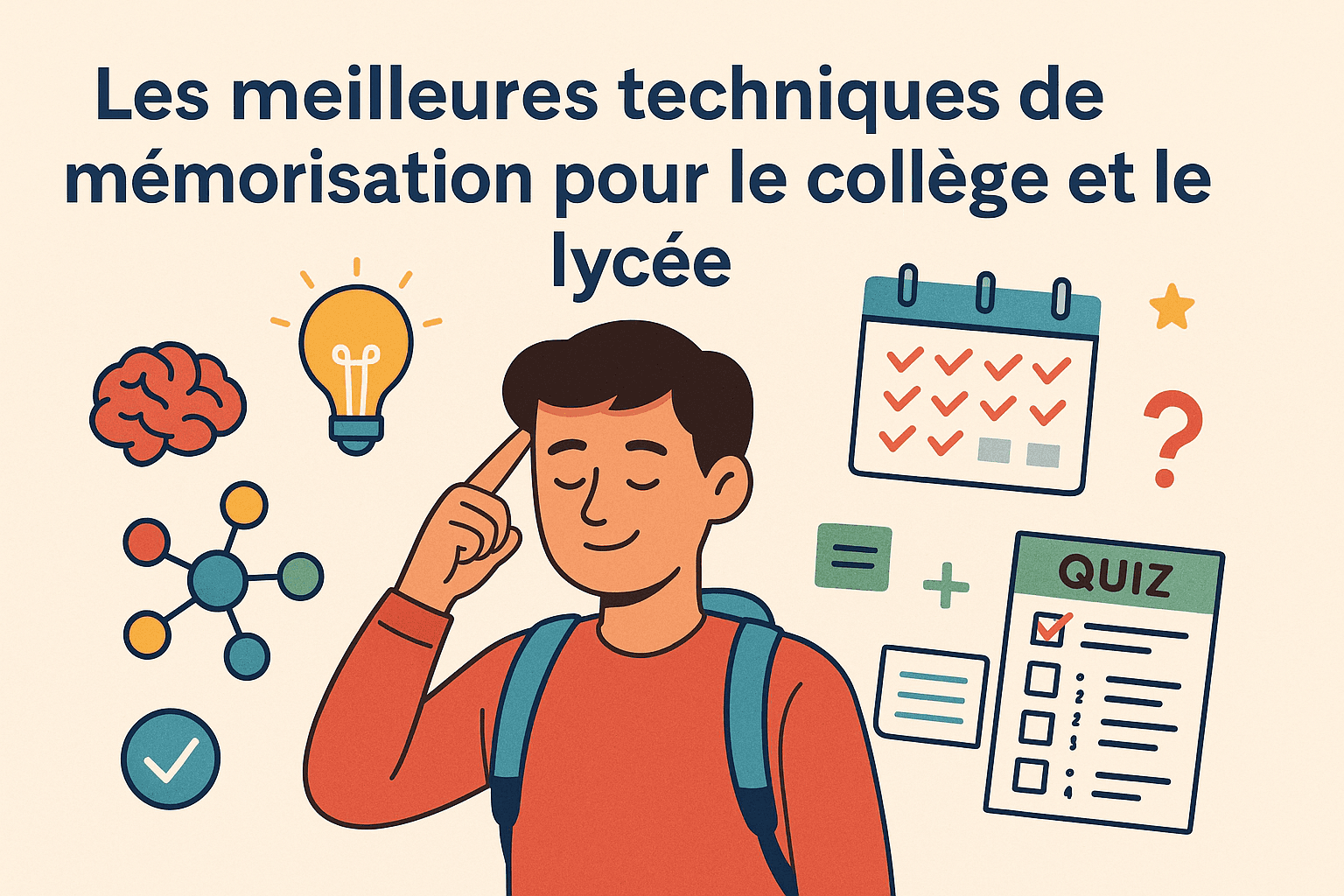
Introduction
Do you spend your time re-reading your lessons without retaining anything? You are not alone. Memory is your superpower for success, but you must know how to use it. With the right memorization techniques, you can learn faster, retain longer, and revise without pulling your hair out. In this article, you will discover how to better memorize your lessons in middle and high school, with simple, effective, and even fun methods.
1. Understand how your memory works
Before looking for tips, you need to know how your brain retains information.
There are three key steps:
Encoding, when you understand and transform the information to store it.
Storage, when you store this information in your long-term memory.
Recall, when you can bring it back at the right moment (like during your exam).
The problem is that many students merely re-read their lessons or highlight without really thinking. As a result, you feel like you know your lesson, but your brain has stored nothing.
The solution is to actively stimulate your memory. This is the secret behind all good learning techniques.
2. The best memorization techniques (tested and approved)
a. Spaced repetition
This is THE technique for successful students. The idea is to review your lessons multiple times, but spaced out in time (for example: the next day, then 3 days later, then a week later).
This spaced repetition method helps anchor information in your long-term memory.
You can use flashcards on paper or an app to help you review regularly.
b. Active recall
Instead of re-reading, quiz yourself! Ask yourself questions about your lesson, take a quiz, or try to recite without looking.
This is what we call active memorization. By forcing your brain to search for the information, you strengthen the neural connections.
This is also a great method for effective revision without getting bored.
c. Mind mapping
If you are more visual, try the mind map.
You take a sheet of paper, write your subject in the center, and connect the main ideas with branches and colors.
This technique helps your brain visualize the links between concepts and facilitates understanding.
Plus, your visual learning becomes much more enjoyable and creative.
d. Mental associations and stories
To learn by heart, nothing is better than associating information with images or stories.
Example: to remember the kings of France, imagine a funny or absurd scene with each of them.
The crazier it is, the more your brain will remember it!
This method also works for remembering historical dates or math formulas.
e. The memory palace (method of loci)
Do you want a technique used by memory champions? Try the mental palace.
You visualize a place you know well (your room, your school, your favorite route) and “deposit” each element of your lesson in a specific location.
When you want to remember, you retrace the path in your mind.
This is powerful for learning your lessons or complex lists.
3. Create your ideal environment for learning
Your concentration depends a lot on your environment.
Here are some tips:
Choose a quiet place, well-lit, without a phone nearby.
Maintain good posture and take breaks every 30 to 45 minutes.
Avoid music with lyrics, as it disturbs your auditory memory.
Your brain likes consistency and tranquility. An organized revision plan will help you maintain a steady pace without stressing.
4. The importance of sleep, nutrition, and breaks
Do you want to retain your lessons longer? Sleep well.
It is during sleep that your brain consolidates memory.
And to nourish it, think of foods that boost memory: fatty fish, nuts, water, magnesium.
Finally, don't forget micro-breaks. The Pomodoro technique (25 minutes of work, 5 minutes of break) helps you stay focused without overloading.
5. Turn your revisions into a game with AI 🎮
Are you tired of flashcards and re-reading? Good news: you can learn with AI!
Apps like Koro AI make revisions fun and interactive.
You can upload your lessons, and the app automatically creates revision sheets, custom quizzes, and goals to achieve.
Each quiz ends with a funny comment to keep motivation high.
This is a modern and fun way to revise without stress, all while boosting your active memorization.
6. Create your own memorization routine
There is no unique magic method. The secret is to combine techniques that work for you:
If you are visual → make mind maps.
If you are auditory → recite your lessons out loud.
If you are kinesthetic → rewrite your lessons by hand.
Plan your revisions several days before an exam, alternating subjects. The important thing is the consistency and the variety of methods.
🧩 Conclusion: your memory is a muscle, train it
Your memory is not a gift; it is a muscle. And like any muscle, it strengthens with training.
By combining spaced repetition, active recall, mind mapping, and modern tools like Koro AI, you can truly learn faster and remember better.
Remember this: learning is like exercising, but for your brain. And the more you practice, the more you progress.