
How to gain 2 average points in law without working more
Jan 27, 2026
Introduction
If you are in a law degree, you've probably experienced this already. You spend hours revising, rereading your courses, making notes, attending tutorials... and yet your average in law stagnates. Worse, sometimes it drops. The truth is that in law, working more is not enough. What makes the difference is the method.
Good news: gaining 2 points in your law average is totally achievable, without extending your working hours. Provided you revise more intelligently.
Understanding why you're plateauing (even while working hard)
Before discussing solutions, we must be honest about the causes.
Most law students:
learn their courses by heart without understanding legal logic
revise passively (rereading, highlighting, copying)
neglect legal methodology
confuse quantity of work with effectiveness
Result: a lot of effort, few points. In law, the grade rewards structure, reasoning, and clarity much more than the accumulation of raw knowledge.
Mastering legal methodology: the number one lever to gain points
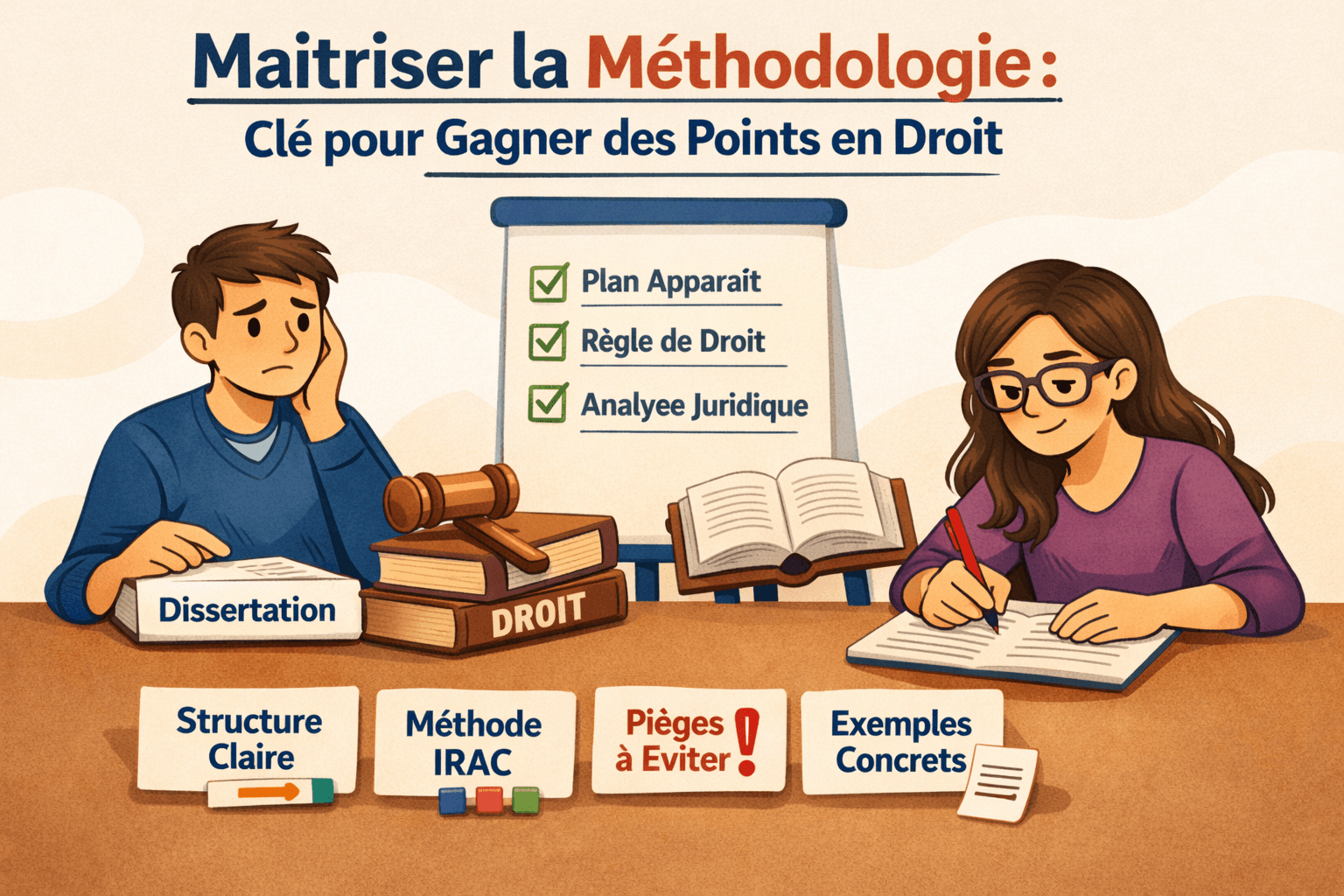
If you want to increase your average in law, start here. Methodology is where examiners easily distribute points.
Legal dissertation
Structured introduction (hook, definition, problem statement, plan announcement)
Clear and logical plan, not recited
Progressive legal reasoning, not a list of knowledge
Practical case
IRAC method followed (qualification, rule of law, application, conclusion)
Clear reasoning, even if the substance is imperfect
Case comment
Legal analysis, not a summary
Highlighting the legal issue and the implications of the decision
👉 A solid methodology can earn you 1 to 2 points on its own, even with an average level of knowledge.
Transforming your courses into tools for active memorization
Making revision notes in law is essential, but it must be done correctly.
Rereading your courses or notes is not an effective method. Your brain learns better when it is active.
Instead:
transform each concept into questions
force yourself to answer without looking
rephrase in your own words
test yourself regularly
This approach improves law memorization and reduces the time spent revising. You work less, but with much more impact.
Revising effectively in law without working more
Long revision days are often counterproductive. What really works:
short and focused sessions
specific objectives for each session
regular revisions rather than marathons before exams
In law, some concepts are much more profitable than others. Identifying what frequently appears on exams allows you to optimize your working time and improve your grades without exhausting yourself.
Practicing like in the exam (and stop revising like in high school)
A common mistake made by law students: spending too much time on the course, not enough on practice.
To succeed in law exams, you must:
practice on standard topics
reason under time constraints
self-correct methodically
repeat legal reasoning patterns
It is this active repetition that allows you to be effective on the day of the exam, even under stress.
The costly mistake: neglecting clarity
Examiners read quickly. Very quickly.
If your reasoning is good but poorly presented, you lose points. In law, clarity is essential:
apparent plan
spaced paragraphs
simple and precise sentences
mastered legal vocabulary
Making it clear, structured, and readable often allows you to gain points without extra work.
A tool to revise more intelligently (without spending more time)
When time is short, having an appropriate tool can make a difference.
Some students use Koro AI, a revision app designed for students. It allows you to:
centralize your law courses
transform your content into revision notes and quizzes
practice regularly through active memorization
stay motivated with goals and fun feedback
It is not a miracle solution, but an effective complement to learn law better without multiplying working hours.
Conclusion: in law, it’s not the one who works the most who succeeds
Gaining 2 points in law does not require sacrificing your social life or sleep. It requires:
mastering legal methodology
revising effectively
prioritizing active memorization
practicing like in the exam
working more strategically
If you change your way of working, your average will follow. And often, much faster than you think.