
Right = learning by heart? The truth that no one explains.
Jan 28, 2026
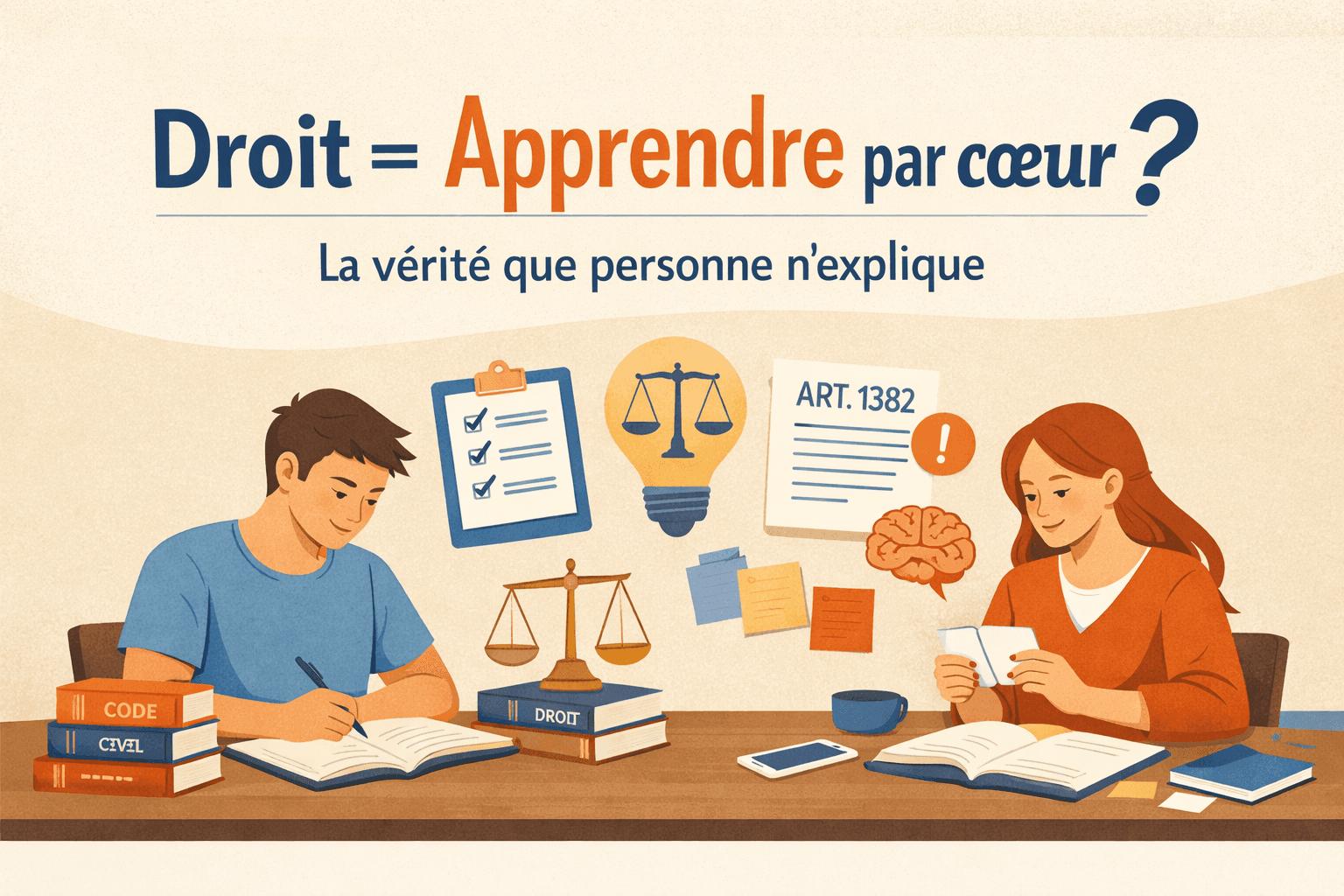
The truth that no one explains
If you are studying law, you must have asked yourself the question.
Must you learn the law by heart to succeed?
To memorize everything word for word? The articles, the rulings, the definitions, the outlines?
Useful spoiler: no, law is not a subject of recitation.
But yes, there is a part of memorization in law.
The real difficulty is knowing what to learn, how, and why.
This article gives you a clear method to review law effectively, without cramming or exhausting yourself.
Why we believe that law requires rote memorization
This idea did not come from nowhere.
In L1, you face:
a course overload in law
handouts of 80 pages
laws everywhere
rulings galore
Add to that:
little explanation on the revision methodology in law
vague advice among students
the fear of failure in law school
Result: many think that reviewing law = learning everything by heart.
This is false. And often counterproductive.
The truth: what MUST be learned by heart in law
Yes, certain things must be memorized. But in a targeted way.
What you must learn by heart
The key legal definitions
The fundamental concepts of a subject
The standard outlines and legal reasoning
Certain structural articles, not the entire code
A few landmark rulings, not entire commentaries
Learning law by heart is not about reciting.
It’s about anchoring reference points to reason quickly on exam day.
What you should not learn by heart
This is where many go wrong.
Avoid absolutely:
learning your law courses word for word
memorizing comments on rulings without understanding
retaining endless lists of laws
learning examples without legal logic
Why?
Because in exams, you are never asked to recite, but to apply.
Understanding before memorizing: the real method in law
The good students are not those who know the most, but those who understand legal reasoning.
Before memorizing:
understand the logic of the course
identify the mechanisms
rephrase with your own words
transform the course into tools, not sacred text
This is the difference between:
passively rereading
and activating your memory
How to learn law effectively without cramming
Here is an effective method to review law without exhausting yourself.
1. Create revision sheets in law
Not decorative summaries.
Goal-oriented sheets:
definitions
mechanisms
outlines
links between concepts
2. Use quizzes and tests
Testing yourself is much more effective than rereading.
The law quizzes, the flashcards, and active repetition allow for real memorization in law.
3. Repeat intelligently
not all at once
but regularly
with spaced reminders
That’s how you learn without cramming.
Practical case, essay, commentary: what professors really evaluate
The assessors look at:
your reasoning
your ability to mobilize notions
the structure of your answer
the relevance of the articles and rulings used
They do not grade on:
your ability to recite a lesson
the quantity of rote memorization
That’s why understanding law vs. learning by heart is not a debate.
Understanding always comes first.
The most common mistake of law students
Thinking that:
the more you learn, the better you will succeed
In reality:
too much learning = mental overload
overload = stress during law revisions
stress = memory gaps on the day
Reviewing law effectively is about selecting, not accumulating.
How to organize yourself concretely to review law
A simple and realistic routine:
understand the course during the week
create synthetic sheets
practice with quizzes
regularly review the key concepts
test yourself under exam conditions
Goal: learn law intelligently, not retain everything.
A tool to learn law without memorizing everything
A true problem for students is transforming their courses into revision tools.
Some applications allow you to:
create revision sheets in law
generate quizzes
regularly test yourself
For example, Koro AI allows you to load your courses, transform them into sheets, quizzes, and flashcards.
It’s not magic, but when used well, it helps transition from passive re-reading to active revision.
Conclusion
So, should you learn by heart in law ?
No, not everything.
Yes, certain basics.
Above all, you must understand, structure, and practice.
Law is not a subject of recitation.
It is a subject of reasoning, and that changes everything in your way of reviewing.
If you want to succeed in law school without wearing yourself out, remember this:
learn less, but better.